

Body contouring after weight loss is a collection of surgical procedures designed to remove excess, sagging skin and reshape the body after you’ve achieved a significant weight loss goal. Many patients see it as the final, restorative step that brings their physical appearance in line with their incredible health accomplishment.
The Final Step in Your Weight Loss Journey
First, congratulations on your major weight loss. This is a monumental success that brings countless health benefits. However, many people discover an unexpected challenge after the numbers on the scale stabilize: excess, sagging skin that hides their hard-earned results.

This loose skin isn't a failure of your diet or exercise plan. It's the natural result of your body's transformation. When skin is stretched for a long time, its underlying collagen and elastin fibers can become damaged, losing their ability to snap back into place.
I often tell my patients to think of it like a suit of clothes that’s now several sizes too big. While the person inside is fit and healthy, the exterior fit is off. Body contouring after weight loss is the tailoring process that customizes that suit to your new form, creating a perfect fit that lets you feel as good as you look.
To give you a clearer picture, here is a quick overview of what this process entails.
Body Contouring At a Glance
| Concept | Primary Goal | Common Procedures |
|---|---|---|
| Candidacy | Ensure you are a healthy, stable candidate for surgery. | Weight must be stable for at least 6-12 months. |
| Upper Body | Address loose skin on the arms, chest, and back. | Arm lift (brachioplasty), breast lift, upper body lift. |
| Midsection | Remove sagging skin and tighten muscles in the abdomen. | Tummy tuck (abdominoplasty), panniculectomy, lower body lift. |
| Lower Body | Sculpt the thighs and buttocks for a smoother contour. | Thigh lift, buttock lift, lower body lift. |
This table provides a high-level summary, but each patient’s journey is unique and requires a personalized surgical plan.
From Weight Loss to Body Sculpting
It's important to frame this step correctly. This is not another weight reduction procedure; it's about revealing the sculpted shape you've already worked so hard to achieve. The journey to a healthier you involves more than just numbers on a scale—it’s also about feeling comfortable and proud in your own skin.
Before considering surgery, the next critical step is ensuring you know how to lose weight safely and keep it off. This stability is crucial for making sure the results of your surgery are long-lasting.
Body contouring is the final chapter in a life-changing story. It addresses both functional and aesthetic concerns, from the physical discomfort caused by skin chafing to the emotional relief of finally seeing your true shape.
This guide will walk you through what this final chapter entails. We’ll explore who makes a good candidate, what procedures are available, and what you can realistically expect from the recovery process. My goal is to provide the clarity you need to decide if body contouring after weight loss is the right next step for you.
Determining if You Are Ready for Surgery
Deciding on body contouring after major weight loss is a serious commitment. It’s the final step in your process, and one you should only take when you’re physically, nutritionally, and emotionally prepared. Your readiness is what a successful, lasting result is built on.
Think of it like training for a marathon. You wouldn’t just show up on race day without putting in months of hard work. Preparing for surgery is your "training" period—it gets your body in the best possible shape for a safe procedure and a smooth recovery.
The Importance of a Stable Goal Weight
The single most critical requirement for body contouring after weight loss is maintaining a stable weight. Dr. Bain, like any experienced surgeon, will require you to keep your weight steady for at least six to twelve months before scheduling surgery. There's a very practical reason for this.
If you lose more weight after your surgery, new areas of loose skin can appear, undermining the very results you invested in. On the other hand, gaining a significant amount of weight can stretch the newly tightened skin, undoing the surgeon's careful work.
A stable weight is your insurance policy for a surgical outcome that lasts. It tells the surgeon your body has found its new normal, making it a reliable canvas to work on.
This period of stability also shows that your new healthy habits are truly a part of your life. Surgeons look for patients who are within 10-15 pounds of their ideal weight and are no longer seeing big swings on the scale.
Your Overall Physical and Nutritional Health
Being in good general health is non-negotiable. Major surgery puts a lot of stress on your body's ability to heal, so starting from a strong place is essential. This means any chronic conditions, like diabetes or heart disease, must be well-managed.
A huge piece of this is your nutrition. Healing is fueled by nutrients, especially protein, which your body needs to repair tissue and build new collagen after surgery. A surgeon may have to postpone a procedure if a patient is nutritionally deficient.
Another critical factor is smoking. Nicotine severely restricts blood flow, which dramatically increases the risk of serious problems, such as:
- Poor wound healing
- Tissue death (necrosis)
- Higher risk of infection
- Thicker, more noticeable scarring
Because of these risks, you must be a non-smoker or be willing to quit completely for at least four to six weeks before and after your surgery.
Are You Mentally Prepared for the Journey
The psychological side of this is just as important as the physical. While the final outcome is incredibly rewarding, the surgery and recovery can be demanding. An ideal candidate has a positive outlook and knows what to expect.
You should understand a few key things:
- The goal is improvement, not perfection. We are aiming for a significant, positive change.
- Scars are part of the trade-off. A skilled surgeon like Dr. Bain places incisions strategically to hide them, but they are a permanent result of removing excess skin.
- Patience is required for recovery. You'll have good days and bad days, with swelling and some discomfort, before your final shape becomes clear.
Being emotionally ready means you see surgery not as a quick fix, but as the final, empowering step that honors all the hard work you’ve already done. This mindset is what will carry you through the healing process with confidence.
Understanding Your Surgical Options
Body contouring after significant weight loss isn't just one operation. It’s a combination of surgical procedures that a plastic surgeon selects and customizes to fit your specific anatomy and goals. We choose the right procedures to address the areas where you have the most loose skin, creating a more harmonious and natural shape.
Below, we'll go over the most common surgical options for patients who have achieved major weight loss. This will help you understand what each procedure is designed to accomplish.
Tummy Tuck (Abdominoplasty)
After losing a lot of weight, the abdomen is often one of the areas most affected. The skin that was stretched now hangs loose, and the underlying abdominal muscles can become separated and weak. A tummy tuck, or abdominoplasty, is designed to correct both of these problems.
During a tummy tuck, an incision is made low on the abdomen, usually from hip to hip, so it can be easily hidden by underwear or a bikini. Through this incision, a surgeon can:
- Remove the "apron" of excess, hanging skin.
- Repair and tighten separated abdominal muscles, a condition known as diastasis recti.
- Pull the remaining upper abdominal skin down for a much smoother, flatter contour.
The result is a firm and more defined midsection. A tummy tuck not only improves your physical contour but can also help restore core stability and relieve issues like skin irritation.
Lower Body Lift (Circumferential Body Lift)
For patients who have loose skin that goes beyond the abdomen to the hips, outer thighs, and buttocks, a lower body lift is a more comprehensive procedure. Think of it as a tummy tuck that continues all the way around the torso, addressing the entire lower "belt" of the body in a single operation.
A lower body lift is one of the cornerstone procedures in body contouring after weight loss. It provides a 360-degree improvement, lifting and tightening the abdomen, waist, hips, and buttocks simultaneously for a balanced, natural-looking result.
The incision for a lower body lift is circumferential, meaning it circles the lower torso, similar to the waistband on a pair of low-rise pants. This allows the surgeon to remove a whole band of loose skin and fat. This effectively lifts the sagging tissues of the thighs and buttocks while also creating a flat abdomen. It is a major surgery, but it delivers a significant change in your body's contour.
Arm Lift (Brachioplasty)
One of the most common issues after major weight loss is the loose, hanging skin on the upper arms, sometimes called "bat wings." This can make people self-conscious in sleeveless or short-sleeved tops and can also lead to chafing. An arm lift, or brachioplasty, directly targets this concern.
This procedure requires an incision on the inner side of the upper arm, often running from the armpit toward the elbow. This placement helps hide the scar when your arms are down by your side. A section of excess skin and fat is removed, and the remaining skin is redraped to create a tighter, more slender arm contour.
While the main goal is removing skin, liposuction is often used at the same time to further refine the arm's shape for the best possible result. It's helpful to understand what different liposuction techniques can offer; you can learn more about advanced liposuction options in our detailed guide. The final outcome is a toned and proportionate upper arm that fits your new physique.
Breast Lift (Mastopexy)
Just like the skin on the stomach and arms, breast tissue is also significantly affected by major weight changes. Breasts often lose volume and begin to sag, a condition we call breast ptosis. A breast lift, or mastopexy, is the surgical procedure designed to restore a higher, more youthful breast position and shape.
During a breast lift, excess skin is removed and the surrounding tissue is tightened to reshape and support the new breast contour. The nipple and areola are also moved to a higher position on the breast.
It's very common for post-weight loss patients to have lost a great deal of breast volume. In these cases, a breast lift is often performed with breast augmentation using implants. This combination—a breast lift with augmentation—solves both problems at once. The lift restores the "perkiness" of the breast, while the implant replaces the lost volume for a fuller, rejuvenated appearance.
How Surgeons Plan a Staged Approach
It's simply not safe or practical to address loose skin on the arms, abdomen, and thighs all in one go. That's why experienced surgeons create a staged approach for comprehensive body contouring after major weight loss. This strategy involves carefully breaking down your full transformation into a series of separate operations, scheduled months apart to allow for proper healing.
Think of it as building a house. You lay the foundation first, let it set, and then build the framework. You don't try to put up the walls, roof, and windows all on the same day. Each step has to be completed correctly before moving on to the next.
Staging your surgeries follows this exact same, time-tested principle. It's a deliberate, safety-first method that gives us the ability to achieve more precise results while making your recovery far more manageable.
The Benefits of Staging Surgeries
Attempting too many procedures in a single operating session dramatically increases surgical risks. Your body can only handle a certain amount of trauma and time under anesthesia at once. For post-weight loss patients, spacing out operations is the gold standard of care.
The key safety and recovery benefits are clear:
- Reduced Anesthesia Time: Combining multiple large procedures can lead to excessively long operating times. This is directly associated with a higher risk of serious complications, including blood clots.
- Lower Risk of Complications: Staging minimizes the total stress on your body in any single session. This reduces the chances of issues like significant blood loss, infection, and problems with wound healing.
- More Manageable Recovery: Healing from a lower body lift alone is a demanding process. If you were to add an arm lift and thigh lift to that same surgery, recovery would become incredibly difficult. A staged approach lets you focus your energy on healing one area at a time.
This methodical planning also produces better aesthetic outcomes. When a surgeon can dedicate their full attention to one or two related areas, the precision and quality of the contouring work improve significantly.
The infographic below shows a typical timeline for how we might stage these procedures, moving logically from the core of the body outward.
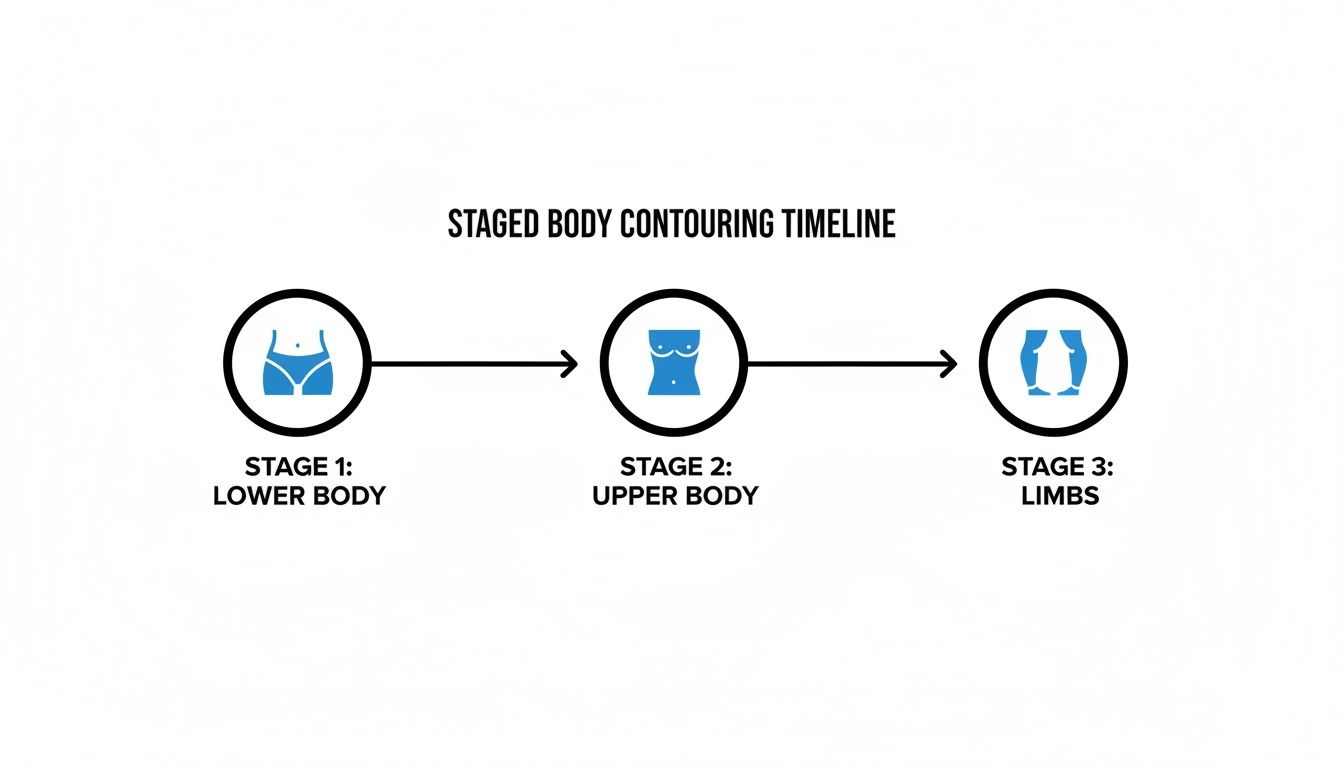
As you can see, a surgeon often addresses the lower body first, then moves to the upper body, and finally the arms and legs, with complete healing between each stage.
Common Staging Combinations and Timeline
While every patient's surgical plan is customized, there are common patterns we follow when staging body contouring after weight loss. We typically group procedures by their location on the body to create a logical workflow and address anatomically related areas together.
A common staged plan might look like this:
Stage 1 Foundational Procedures
This first stage almost always focuses on the torso, as this creates the central foundation for your new body shape.
- Common Combination: A lower body lift (circumferential body lift), often performed in conjunction with a breast lift.
- Rationale: These procedures address the entire midsection and upper torso, providing the most dramatic and foundational change right away.
Following Stage 1, you will need a substantial healing period—typically at least three to six months. This time is crucial for your body to recover, swelling to resolve, and for you to regain your strength before the next step.
Stage 2 Refining the Limbs
Once your core has healed well, we can shift focus to the arms and legs.
- Common Combination: An arm lift (brachioplasty) paired with a medial thigh lift.
- Rationale: These surgeries tackle the remaining loose skin on your extremities, completing the overall contour. Advanced techniques may be used, and you can learn more about high-volume liposuction and advanced body contouring in our detailed article.
The goal of staging is to ensure that by the end of your journey, your results are balanced, proportionate, and achieved with the highest level of safety. This is a marathon, not a sprint.
This deliberate, multi-step process requires patience, but it is the most reliable path to achieving the beautiful, lasting results you've worked so hard for. I work closely with every patient to create a personalized timeline that aligns with their specific goals and overall health.
Navigating the Recovery and Healing Process
The surgery itself is only half the story when it comes to body contouring after weight loss. Your recovery journey is just as critical to the final outcome, and understanding what to expect will help you stay patient as your new shape emerges from the initial swelling and bruising.

Think of the post-operative period as the "setting" phase. Much like a sculptor's work needs time to cure, your body requires a dedicated period of rest and specific care to heal properly and reveal the meticulous results of your procedure.
The Immediate Post-Operative Period
The first one to two weeks are primarily focused on rest, managing discomfort, and letting your body begin the healing process. You should expect to feel tired, and your mobility will be limited. It’s absolutely essential to have a support system in place to help with daily tasks during this time.
You will be given specific instructions for managing any discomfort with prescribed medication. You will also have surgical drains to prevent fluid from building up and will be fitted with compression garments. These aren't just for support; they play a vital role in controlling swelling and helping your skin adapt to its new contours.
The Role of Compression and Early Movement
Your compression garments are your most important tool during the initial recovery. These are custom-fitted, medical-grade garments that apply steady, even pressure to the surgical sites.
Wearing them as directed is non-negotiable for a few key reasons:
- Minimizing Swelling: They help reduce the natural fluid accumulation that occurs after surgery, which allows you to see your results sooner.
- Supporting Tissues: The garments provide crucial support to healing tissues, which takes the strain off your incision lines as you start moving again.
- Improving Contours: Consistent pressure helps your skin and the underlying tissues settle smoothly into their new, reshaped positions.
While rest is the priority, we also encourage light movement. Gentle, short walks are important for promoting circulation and reducing the risk of blood clots. Physical therapy is often a key part of this phase, providing comprehensive post-surgical rehabilitation to help you safely regain strength and mobility.
Your recovery is an active process, not a passive one. Faithfully following post-operative instructions—wearing compression garments, managing drains, and engaging in light activity—is your part in achieving the best possible outcome.
This early stage demands patience, but it’s important to remember that the initial discomfort and swelling are temporary steps on the way to your final result.
A Realistic Look at Scarring and Scar Care
An honest conversation about scarring is crucial. Any procedure that removes a significant amount of excess skin will result in scars. However, an experienced plastic surgeon like Dr. Bain plans incision placement with great care to keep them as concealed as possible within the body's natural contours.
For instance, a tummy tuck scar is placed very low on the abdomen, easily hidden by underwear or a swimsuit. An arm lift scar is placed on the inner arm where it is least conspicuous.
Your scars will change over time, a process that can take up to a year or more. At first, they will appear red and slightly raised. With proper care, they will gradually soften, flatten, and fade to a much less noticeable, lighter color. For those who want to improve skin texture with less invasive techniques, you can also learn more about non-surgical skin tightening options as a potential complementary treatment.
Effective long-term scar care includes:
- Sun Protection: Protecting your scars from sun exposure for at least the first year is absolutely essential. UV rays can cause scars to darken permanently, making them more visible.
- Silicone Products: Once your incisions are fully closed and healed, using silicone sheets or gels can hydrate the scar tissue and significantly improve its final appearance.
- Gentle Massage: After Dr. Bain gives you the go-ahead, gently massaging your scars can help break down firm tissue and encourage them to soften and flatten.
By committing to the recovery process, you empower yourself to navigate the healing journey with confidence and achieve the beautiful, lasting contours you’ve worked so hard for.
How to Choose the Right Plastic Surgeon
Choosing your surgeon is the single most important decision you will make on your body contouring after weight loss journey. This isn’t just about finding a doctor. It’s about finding a partner with the specialized skill, artistic eye, and commitment to safety that these complex procedures demand.
The right surgeon will guide you through this final, critical step of your transformation with proven expertise.
Verify Credentials and Experience
Your search must start and end with one absolute requirement: board certification. A surgeon certified by the American Board of Plastic Surgery (ABPS) has completed years of specialized training specifically in plastic and reconstructive surgery. This is the gold standard. You should verify any potential surgeon’s status directly on the ABPS website.
Beyond certification, you need a surgeon who regularly performs post-weight loss procedures. This is a highly specialized field, very different from a standard tummy tuck. Ask directly about their experience with massive weight loss patients.
Another key indicator of a surgeon's quality is their hospital privileges. Surgeons like Dr. Bain, who hold privileges at respected facilities like Hoag Memorial Hospital, have been thoroughly reviewed by their peers. This confirms they meet the highest standards for safety and patient care.
The Power of Before-and-After Photos
A surgeon’s before-and-after gallery is their portfolio. Don’t just glance at a few photos—you need to look for something specific. Find patients who had a body type similar to yours before their surgery.
When you review photos, ask yourself: Does the surgeon consistently create natural, well-proportioned results? Are the scars placed thoughtfully and healing cleanly? Seeing an "after" photo that started from a "before" like yours is the clearest way to see what's realistically possible.
Look for a large collection of photos for the exact procedures you are considering, whether it's a lower body lift or an arm lift. A deep gallery shows a wealth of experience and a consistent track record.
The Consultation Is a Two-Way Interview
The consultation is your chance to make sure you feel a genuine sense of trust and partnership. This is where you see if the surgeon’s communication style works for you. A great surgeon will listen to your goals, answer every question without making you feel rushed, and give you honest, clear feedback.
Come prepared with a written list of questions. During your talk, notice if you feel heard and respected. The right surgeon for your body contouring after weight loss is an expert you feel completely comfortable with—someone you can trust to safely complete your incredible transformation.
Frequently Asked Questions About Post-Weight Loss Surgery
Embarking on the final stage of your weight loss journey with body contouring is a significant decision. Patients often have many questions during their initial consultation. Below are answers to some of the most common inquiries Dr. Bain addresses.
How Long Should I Wait After Weight Loss for Surgery?
The most critical factor for a successful outcome is weight stability. Dr. Bain, like most board-certified plastic surgeons, advises patients to maintain a stable weight for at least six to twelve months before proceeding with surgery.
This waiting period is essential. It confirms that your new, healthy habits are firmly established, which helps ensure your surgical results will be lasting. Think of your body as the foundation for the procedure; if that foundation is still changing, the final result can be compromised. Waiting prevents new areas of loose skin from forming if you happen to lose more weight down the line.
Are the Results of Body Contouring Permanent?
Yes, the results of body contouring surgery are designed to be permanent. The excess skin and targeted fat cells that are surgically removed are gone for good and will not grow back.
However, the longevity of your new contours is entirely dependent on your lifestyle post-surgery. To maintain your results, you must:
- Keep your weight stable. Significant weight fluctuations can stretch the remaining skin and negatively affect your final shape.
- Follow a healthy lifestyle. A balanced diet and consistent exercise are crucial for preserving your new physique.
- Avoid smoking. Smoking impairs healing and damages the skin's elasticity, which can impact your long-term appearance.
While the natural aging process will continue, the fundamental improvements achieved through surgery will remain.
How Much Pain and Downtime Should I Expect?
Recovery is different for everyone and depends entirely on the combination of procedures performed. In general, patients should plan to take two to six weeks off from work and their typical daily activities. Discomfort is most pronounced during the first week and is carefully managed with prescribed pain medication.
It's crucial to understand that body contouring is a major surgery, not a quick fix. Patience during recovery is essential, as final results can take up to a year to fully settle and for scars to mature.
Most patients feel significantly better after the first couple of weeks, though swelling can persist for several months. Following your post-operative instructions, especially regarding the use of compression garments, is vital for a smooth and successful healing process.
If you're in the Orange County area and ready to take the next step, schedule a personal consultation with Michael A. Bain, MD. As a board-certified plastic surgeon specializing in post-weight loss transformations, Dr. Bain can provide the expert guidance you need to complete your journey with confidence and achieve the results you deserve. Learn more at https://www.drbain.com.