

While your full breast augmentation recovery takes about six weeks, you’ll be surprised at how quickly you start to feel like yourself again. Most of our patients are back to light activities like desk work and driving within just 5 to 7 days. The first couple of days are the toughest, with discomfort and swelling usually peaking around day two or three before getting noticeably better each day.
Your Breast Augmentation Recovery Journey Begins
Now that your surgery is complete, the next phase begins—healing. This guide is your step-by-step manual for the days and weeks ahead, taking the guesswork out of your recovery. We've found that a well-informed patient is a more confident and comfortable patient.
Following this plan is just as important as the surgery itself for getting the beautiful, natural-looking outcome you want. The goal isn't weeks of bed rest, but a structured and supported healing process that gets you back to your routine safely.
Understanding the Modern Healing Process
Today's approach to recovery is all about managing comfort and getting you back on your feet predictably. It’s a well-defined process that includes:
- Effective Discomfort Management: We use a combination of medications designed to keep you comfortable, which often reduces the need for strong narcotics.
- Controlled Activity: We actually encourage light movement early on to help with circulation. Strenuous activities, however, are put on hold to protect the healing tissues.
- Swelling and Bruising Control: Following instructions for your compression garment is key. This will dramatically minimize the swelling and bruising that are a normal part of healing.
Think of your recovery as a partnership. By following my specific postoperative instructions, you play an active role in ensuring everything goes smoothly and your final result is exactly what you hoped for.
Knowing what to expect makes all the difference. Understanding everything from the initial feeling of tightness to the "drop and fluff" process—where your implants gradually settle into their final, natural position—helps you navigate your recovery with confidence. Some patients consider a fat transfer breast augmentation, which has its own recovery path. For those who choose implants, the road ahead is very well-established.
Let’s walk through the process together, so you have a clear picture of your recovery from day one.
Breast Augmentation Recovery: The First 7 Days
The first week after your breast augmentation surgery is without a doubt the most critical part of your healing journey. I tell my patients to think of this time not as being "out of commission," but as actively participating in their recovery. Your only job for these first seven days is to rest, and doing that job well sets the stage for a smooth, comfortable recovery and beautiful final results.
Knowing what to expect day by day can turn what feels like a period of uncertainty into a manageable and predictable process. Here’s a look at what you can anticipate.
Day 1: Your First Day Home
Once you’re home from surgery, you’ll likely feel tired and groggy as the anesthesia wears off. Your priorities are simple: rest, drink plenty of water, and stay right on schedule with the pain medication Dr. Bain has prescribed. You’ll be wearing your surgical bra, which is essential for providing support and minimizing movement.
It’s very common to feel a significant tightness across your chest, almost like the feeling after a very intense chest workout. This is completely normal; it’s just your skin and pectoral muscles beginning to adjust to the presence of the new implants. Today is all about settling in and letting your designated caregiver help you get comfortable.
Days 2-3: The Peak of Swelling and Discomfort
These next two days are typically when you'll experience the most noticeable swelling and soreness. This is your body's natural healing response at work, sending fluids and restorative cells to the area. Your breasts will probably look quite large—maybe even larger than you expected—and sit high on your chest. Don't worry, this is temporary and a normal part of the process.
The key to getting through these days comfortably is consistency. It's crucial to stick to the pain medication schedule Dr. Bain provided, even if you feel a brief moment of relief. It's much easier to stay ahead of the discomfort than to play catch-up later. This is the perfect time to let your support person take care of you, handling meals and keeping your water bottle filled so you can focus entirely on resting with your head and shoulders elevated.
Days 4-5: Reaching the Turning Point
Around the fourth or fifth day, most of my patients tell me they feel a real corner has been turned. That initial, intense feeling of tightness starts to subside, and the soreness becomes much more manageable. You’ll start to feel more like yourself and will likely be moving around your house for short walks.
This is a major step forward. You might feel comfortable enough to start weaning off the prescription pain medication and switching to an over-the-counter option, just as Dr. Bain directs. This progress is a direct payoff from the dedicated rest you put in during those first few crucial days.
This infographic helps visualize the entire recovery journey, breaking it down from this initial healing phase all the way to your final, settled results.
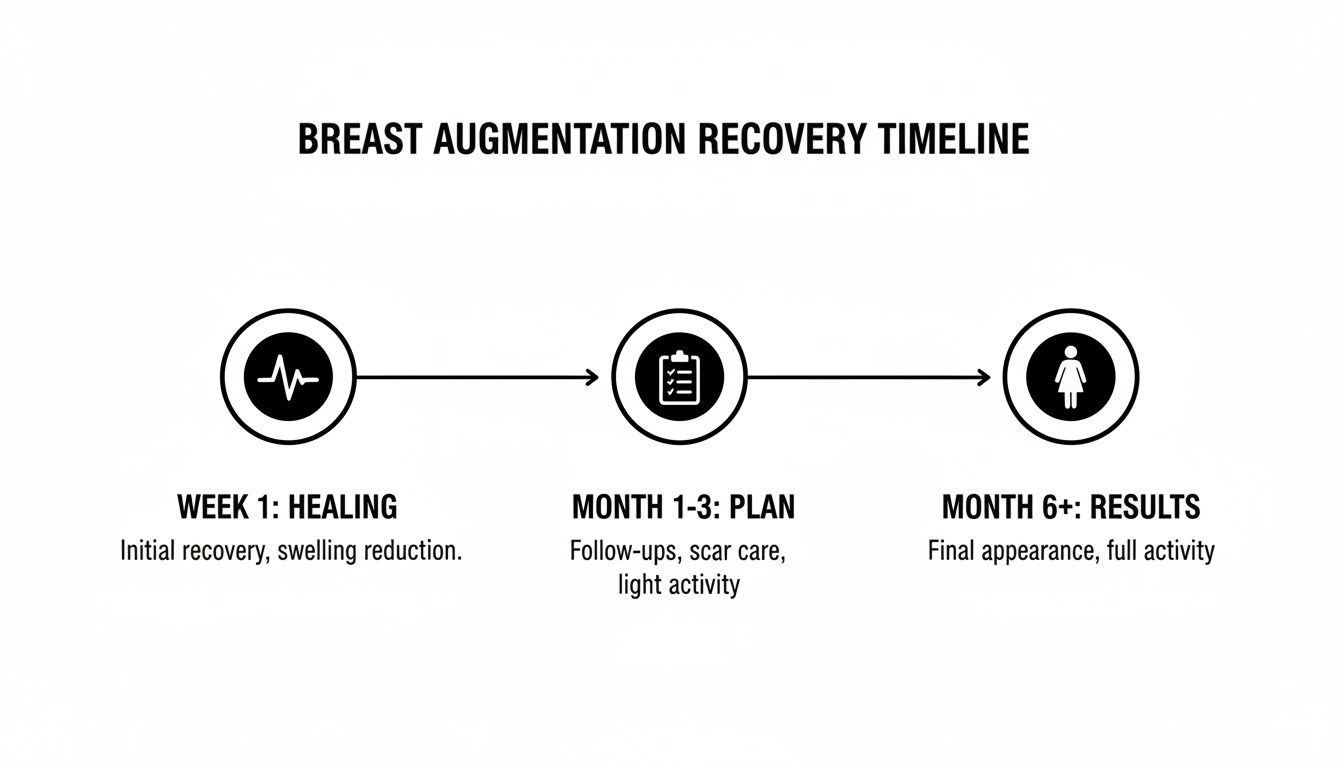
This turning point is also happening sooner for patients thanks to modern surgical protocols. In fact, refined techniques have led to a 65% reduction in the need for postoperative narcotics. Many patients find they can manage their discomfort with over-the-counter options after just two days. When combined with minimally invasive approaches that can reduce incision sizes by up to 40%, this often means patients can get back to light daily activities within 5 to 7 days. You can see more data on how breast enhancement has evolved by reading these insightful statistics on MadisonPS.com.
Days 6-7: Getting Ready for Your Follow-Up
By the end of this first week, you should feel a world away from how you felt on day one. While swelling is definitely still present, you'll notice it has started to go down, and you’ll feel much more mobile and independent.
Your main goal now is to prepare for your first post-op appointment with Dr. Bain. This visit is incredibly important for a few reasons:
- Incision Check: Dr. Bain will carefully inspect your incisions to make sure they are healing cleanly and properly.
- Progress Assessment: He will take a look at your swelling and overall progress to ensure everything is on track.
- Updated Guidance: You’ll get new instructions for the next phase of your recovery, including when it’s safe to shower and how to gradually increase your activity.
Remember to continue avoiding any lifting, pushing, or pulling. Even though you’re feeling better, your internal tissues are still very delicate and need time to heal without strain. Think of this first week as building the strong foundation for a fantastic long-term result.
Breast Augmentation Recovery Milestones at a Glance
To help you visualize the next several weeks, this table provides a quick summary of the key milestones, restrictions, and sensations you can expect.
| Timeframe | Typical Sensations | Activity Level | Key Milestone |
|---|---|---|---|
| Week 1 | Tightness, soreness, swelling, high breast position | Primarily rest, short walks around the house | Weaning off prescription pain medication |
| Weeks 2-3 | Swelling decreases, mild soreness, some itching | Return to desk work, light daily activities, no lifting over 10 lbs | First post-op visit, clearance to shower |
| Weeks 4-6 | Breasts begin to soften and "drop," numbness fades | Can resume lower body exercise, increased cardio, still no heavy lifting | Transition to a supportive sports bra (with surgeon approval) |
| After 6 Weeks | Numbness continues to resolve, breasts feel softer | Cleared for most exercise, including upper body workouts and chest movements | Breasts begin settling into their final position, though softening continues |
Keep in mind that this is a general guide. Your personal recovery timeline will depend on your body’s unique healing process, the specifics of your surgery, and how closely you follow Dr. Bain’s post-operative instructions.
Healing Through Weeks Two to Six
Once you get past that first week, you’ll start to feel a real shift in your breast augmentation recovery. The need for intensive rest begins to fade, and you can start slowly, carefully, re-engaging with your daily life. This period, from the second to the sixth week, is when the results of your surgery really start to settle in and take shape.
Think of it as a gradual reawakening. The initial tightness and significant soreness will start to become background noise. You might notice some itching around your incisions, which is a perfectly normal and reassuring sign of healing. Your energy will return, and you'll naturally feel the pull to get back to your regular routine.
The “Drop and Fluff” Phenomenon
During these weeks, one of the most anticipated phases begins: the "drop and fluff." Right after your surgery, it's completely normal for your new implants to sit high and tight on your chest, looking a bit firmer than you might have expected.
Now, as the initial swelling goes down and your pectoral muscles begin to relax their hold, the implants will gradually settle downward and outward. This is the "drop." At the same time, your own breast tissue will start to expand and soften around the implant, creating a fuller, more rounded, and natural contour. This is the "fluff." While the process continues for months, the most significant changes often happen right in this two-to-six-week window.
Reintroducing Your Daily Activities
Even though you'll be feeling much better, patience is still your best friend. Your body is working hard healing internally, and jumping back into things too quickly can cause setbacks.
Following a structured, evidence-based plan is the key to getting the best possible outcome. For Dr. Bain's patients, from Costa Mesa to Laguna Beach, this typically means a return to desk work within 3-5 days and getting back behind the wheel by day 7. However, anything more strenuous needs more time; a full return to your gym routine usually isn't cleared until six weeks. This methodical approach is a major reason for our exceptionally high 98% patient satisfaction rate and a 64% improvement in quality-of-life scores. You can discover more about modern recovery benchmarks and outcomes and how they help minimize complication rates.
Here's a general guide for getting back to your life:
- Desk Work and Driving: Most patients are ready for a desk job and driving around the one-week mark. The key is that you must be off all prescription pain medication and feel confident you can react quickly and safely.
- Light Errands: Short trips to the store are usually fine. However, you must continue to avoid lifting anything over 10 pounds. That means no heavy grocery bags, laundry baskets, or picking up small children.
- Household Chores: Stick to light-duty tasks only, like preparing simple meals or dusting. Avoid anything that puts a strain on your chest muscles, like vacuuming, mopping, or even reaching for items on high shelves.
Your body gives you constant feedback during recovery. If an activity causes pain or a pulling sensation, it's a clear signal to stop and rest. Listening to these cues is essential for a smooth healing process.
Safely Restarting Your Exercise Routine
We know that getting back to the gym is a huge milestone. But starting too soon is one of the biggest mistakes you can make during your breast augmentation recovery. It can easily increase swelling, put too much tension on your incisions, and even carry the risk of moving your implant out of position.
Dr. Bain will give you a specific timeline based on your personal healing progress, but a safe and steady progression usually looks like this:
- Weeks 2-3: After your follow-up appointment, you may be cleared for very light cardio. This is limited to leisurely walking on a treadmill—no incline and no vigorous arm swinging.
- Weeks 4-5: You can typically ramp up your lower-body workouts. Think stationary biking, using the elliptical (without the arm handles), and working with lower-body weight machines. It's crucial to continue avoiding all upper-body and core exercises.
- Week 6 and Beyond: This is the milestone many patients are waiting for. Once you have Dr. Bain's specific approval, you can slowly begin to reintroduce upper-body exercises and more intense cardio. Always start with very light weights and pay close attention to your body, stopping immediately if you feel any strain or pain in your chest.
Managing Swelling, Pain, and Discomfort
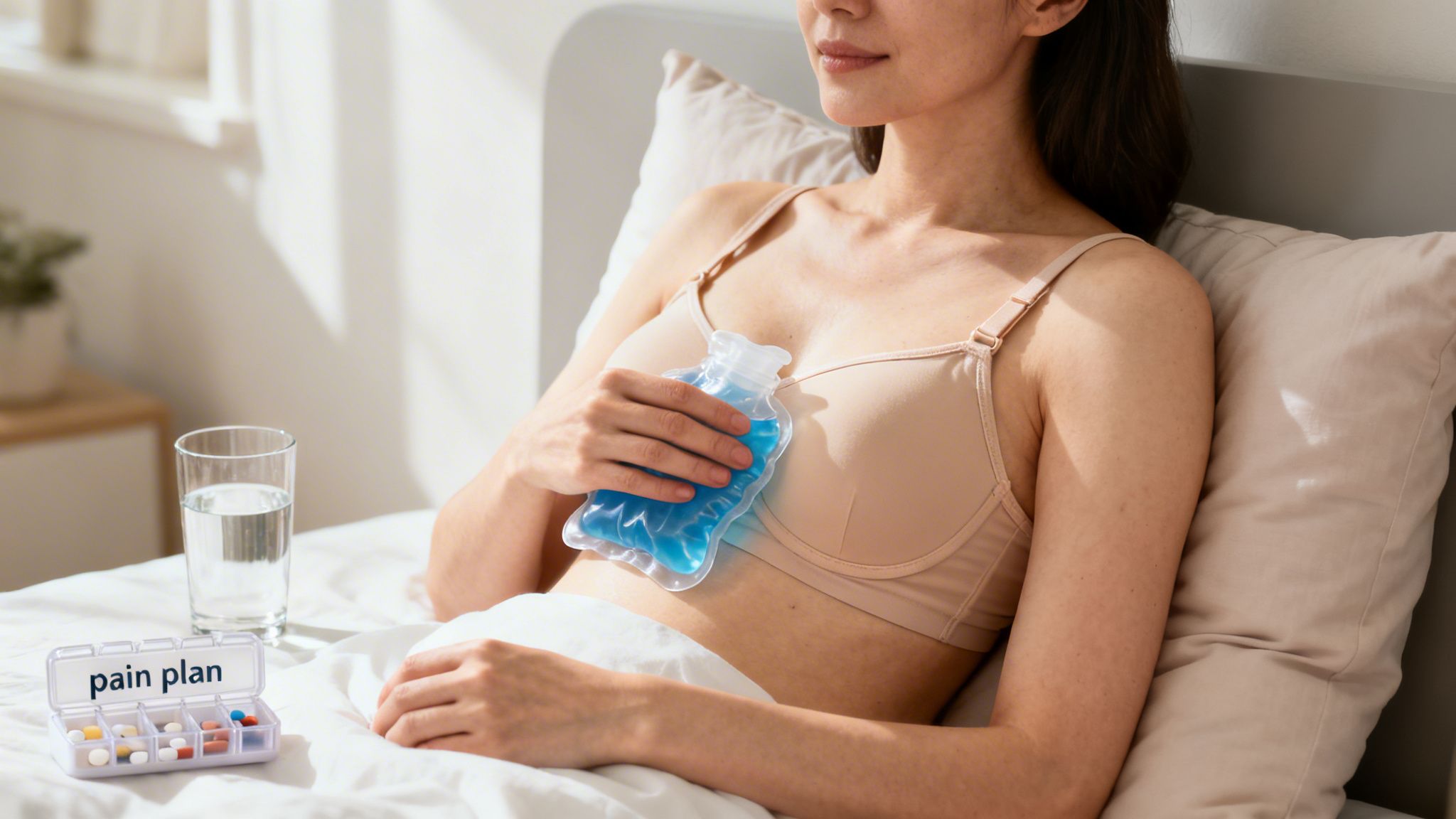
It's completely understandable to have concerns about pain after surgery. The good news is that modern techniques have made managing post-operative discomfort much more effective. Our goal during your breast augmentation recovery isn't to make you completely pain-free, but to keep any discomfort at a low, manageable level so you can rest and heal properly.
To do this, we use a strategy called multimodal pain management. Think of it as tackling discomfort from several different angles at once instead of relying on a single, powerful medication. This approach combines different medications that work together, which dramatically reduces the need for strong narcotics and their potential side effects.
A Modern Approach to Pain Relief
Your pain management plan is designed to stay ahead of the discomfort before it starts. This usually involves a carefully timed schedule of alternating medications.
- Prescription Medication: We will provide a short-term prescription for a stronger pain reliever. This is for the initial, most intense period of discomfort, typically the first 48-72 hours after your procedure.
- Anti-Inflammatories: Medications like ibuprofen are fantastic for reducing the inflammation that causes a lot of the swelling and soreness you'll experience.
- Over-the-Counter Relievers: We often use acetaminophen (Tylenol) in rotation with other medications to provide another layer of relief without adding more anti-inflammatory effects.
By sticking to the schedule Dr. Bain gives you, you'll maintain a steady level of relief in your system. This helps you avoid the sharp peaks and valleys of pain that can happen if you wait until you feel significant discomfort to take your next dose. The result is a much smoother and more comfortable recovery.
Practical Tips for Controlling Swelling
Swelling is simply your body’s natural and expected response to surgery, but getting it under control is a major part of a comfortable recovery. You can expect swelling to peak around day two or three before it starts to steadily go down.
Your surgical bra is your most important tool in the early healing phase. It provides crucial support, limits unwanted movement, and applies gentle, consistent compression to help minimize fluid buildup and take the pressure off your incisions.
Beyond wearing your support garment, there are a few simple things you can do to actively reduce swelling. It's important to understand the difference between heat therapy vs cold therapy, as cold therapy is what's needed right now.
- Use Cold Compresses Correctly: Apply gel packs or even bags of frozen peas to the sides of your breasts and your upper chest area—but never directly onto your skin or incisions. A thin towel in between is perfect. Use them for 15-20 minutes at a time, several times a day, for the first few days to help constrict blood vessels and reduce fluid.
- Stay Hydrated: Drinking plenty of water is absolutely essential. It helps your body flush out excess fluids and toxins, which directly helps reduce swelling and supports the entire healing process.
- Maintain Good Posture: Slouching forward can put more pressure on your chest. Try to sit and stand up straight, which keeps your chest muscles in a more relaxed and natural position.
Understanding Normal Healing Sensations
As your body heals, it's going to send you all sorts of signals, and it's important to know the difference between normal healing sensations and something that might be a concern. Not everything you feel is "pain."
During your breast augmentation recovery, you should expect to feel a variety of new sensations as your tissues and nerves recover. These are all positive signs that your body is doing its job.
- Tightness: A feeling of pressure or a "stretched" sensation across your chest is extremely common. This is just your skin and muscles getting used to their new contour.
- Tingling or Numbness: It's very normal for the skin on and around the breasts, especially near the nipples, to feel numb or have a "pins and needles" feeling as the nerves regenerate.
- Quick 'Zings' or Itching: Occasional sharp but brief "zings" or periods of itching around your incisions are classic signs of nerve endings waking back up and healing.
These feelings will change and fade over the coming weeks. While they might feel a little strange at first, they are a completely normal part of the process and a good sign that your body is right on track.
Caring For Your Incisions, Surgical Bra, and Scars
After your breast augmentation, you have two very important jobs: taking care of your incisions and wearing your surgical bra. How well you follow instructions for these two tasks will have a huge impact on preventing infection, minimizing your scars, and making sure your final results are beautifully shaped.
Think of it this way: the work done in the operating room sets the stage, but your care at home is what ensures a great final outcome. I'll give you precise instructions, but the main goals are always to keep your incisions clean and dry and to keep your new breasts supported.
Your Surgical Bra: More Than Just a Garment
For the first several weeks, your surgical bra is your best friend. It isn’t just clothing; it’s a medical garment I’ve chosen specifically to help you heal correctly. Its job is to provide gentle, constant compression.
This compression does a few critical things:
- Manages Swelling: It helps push excess fluid out of the breast tissue, which is what causes a lot of postoperative discomfort.
- Supports and Stabilizes: The bra holds your new implants securely, preventing them from shifting. This is crucial for ensuring they settle into the right position and don't put tension on your healing incisions.
- Reduces Strain: By supporting the weight of your breasts, the bra takes the pressure off your incision lines, allowing them to heal with less stress.
You’ll need to wear this bra 24/7, including when you sleep, for the amount of time I specify. I know you'll be eager to wear a more attractive bra, but wearing underwire too soon can interfere with healing. A little patience now will lead to much better, more comfortable results for years to come.
Your Incisions and Scar Maturation
The journey from a fresh incision to a faded scar is a long one, often taking a full year or more. Knowing what to expect helps you take the right steps at the right time.
Right after surgery, your incisions will be covered with surgical tape or glue. You must not submerge them in water. That means no baths, no hot tubs, and no swimming until I give you the green light. I’ll provide you with specific directions on how to shower safely, which usually involves letting soapy water run over the area without any direct scrubbing.
The single biggest factor in how well a scar heals is avoiding tension. This is why it’s so important to follow activity restrictions, especially the rules about lifting. It’s not just about preventing an injury—it’s about protecting your incisions from stretching, which is what leads to wider, more obvious scars.
Over the next year, you'll see your scars change:
- First Few Months: The scar will look pink or even reddish and might feel slightly raised. This is a normal part of the body's inflammatory healing response.
- Months 3-6: The color will slowly begin to fade, shifting from red to a lighter pink. The scar will also start to flatten out and feel softer to the touch.
- Months 6-12+: The scar continues to mature, becoming paler, flatter, and far less noticeable. For most of my patients, the final scar becomes a thin, faint line that is very well hidden in the breast crease or armpit.
Once your incisions are fully closed, we can talk about a scar treatment plan. Silicone-based sheets or gels are the most effective options available for scar management. They work by hydrating the scar tissue and creating a protective environment, which helps the scar mature into the faintest line possible. For these treatments to work, you have to be consistent.
When To Call Your Surgeon About Complications
While complications from breast augmentation are not common, particularly with the modern techniques we use, your safety is and always will be our top priority. Part of a smooth breast augmentation recovery is knowing the difference between normal healing and a potential problem. Think of my team and me as your partners in this process; we want you to call if you ever feel that something isn't right.
Trust your instincts. If something feels off or you’re worried, it’s always better to get in touch for reassurance than to wait and wonder. Your only job during recovery is to rest and heal—not to diagnose yourself.
Urgent Red Flags
Some symptoms are serious and require immediate attention. If you experience any of the following, please call our office right away, no matter the time of day.
- Signs of a Hematoma: This isn't just regular swelling. A hematoma typically involves sudden, severe swelling on just one side. That breast might feel intensely painful and unusually hard or firm compared to the other.
- Signs of an Infection: Some redness right at the incision is normal, but be on the lookout for redness that starts to spread, skin that feels hot to the touch, or any unusual drainage from the incision. A fever over 101°F (38.3°C) is a definite red flag.
- Excessive Bleeding: Your incisions shouldn't be actively bleeding. If you see any bleeding that soaks through your surgical bra or dressings, that’s a reason to call us immediately.
Catching these issues early is the key to resolving them quickly and effectively. It protects both your health and the beautiful results we've worked to achieve. To get a more detailed overview of potential issues, I encourage you to read our guide about the risks of breast augmentation surgery.
When to Check In
Other symptoms might not be an emergency, but they still warrant a call to our office during business hours. These are signs we want to know about so we can give you the right advice and make sure your healing is on track.
Think of your recovery as a conversation between you and your body. Normal healing has a certain feel—soreness that improves, swelling that subsides. A complication often feels like a sudden step backward or a symptom that is getting worse instead of better.
Give us a call if you notice:
- Pain That Gets Worse: After the first few days, your discomfort should be gradually getting better. If your pain suddenly spikes or isn't managed by your prescribed medication, we want to know.
- New or Worsening Swelling: If your swelling had started to go down but then suddenly increases again, it's worth a phone call.
- Concerns About Your Incisions: If an incision looks like it’s starting to open up, or if you see any discharge that looks like pus, we need to know right away.
Your breast augmentation recovery is a carefully monitored journey. We are here to support you at every single stage, so please never hesitate to contact us with a question or concern.
Frequently Asked Questions About Recovery
It's completely normal to have a lot of questions as you begin your breast augmentation recovery. Your body is healing, and you’re going to notice changes day by day. We want you to feel confident and informed, so we’ve put together answers to the questions we hear most often from our patients.
Think of this as your roadmap for what to expect. Knowing what's typical can provide tremendous peace of mind during your healing journey.
When Will My Breasts Look and Feel Normal?
This is, without a doubt, the number one question we get. Right after surgery, your breasts are going to sit high on your chest and feel very firm. This is totally normal and is caused by a combination of swelling and the chest muscles being tight.
The "drop and fluff" process, where your implants begin to soften and settle into their final, more natural position, really kicks in after the first few weeks. You'll see the biggest change between weeks three and six. But for the last bit of swelling to disappear and for the implants to fully settle into their pockets, it can take anywhere from three to six months. That’s when you’ll see your final, beautiful shape.
When Can I Wear a Regular Bra or Go Braless?
I know you'll be excited to shop for new bras, but patience is absolutely crucial here. For the first several weeks, your surgical support bra is non-negotiable—you’ll need to wear it 24/7. This isn’t just for comfort; the compression is vital for controlling swelling and making sure your implants heal in the perfect position.
Dr. Bain will give you the green light to switch to a soft, supportive sports bra, which usually happens around the four to six-week mark. You must stay away from underwire bras for at least three months. The wire can dig into and irritate your healing incisions and, more importantly, can interfere with how your implants settle. Going braless for long stretches should also wait until you're fully healed and have Dr. Bain's okay.
What Is the Best Sleeping Position After Surgery?
For the first few weeks, you have to sleep on your back. We also recommend keeping your head and shoulders elevated on pillows. This position is critical for a couple of key reasons:
- It uses gravity to your advantage, helping fluid drain away from your chest to minimize swelling.
- It protects your new breasts from any accidental pressure or strain.
- It keeps your incisions safe from being pulled or stressed while you sleep.
Most patients get clearance to sleep on their side again around the six-week mark, but always wait for Dr. Bain to approve this for you specifically. Stomach sleeping is off-limits for several months until you are much further along in your healing.
When Will Numbness and Tingling Go Away?
It’s extremely common to have some numbness or a change in sensation, particularly around your nipples and along the bottom curve of your breasts. This happens because the tiny sensory nerves in the skin are stretched or temporarily disrupted during the procedure.
When you start to feel tingling, little "zings," or even itching, it's actually a good thing! Those are signs that the nerves are waking up and regenerating. Sensation usually starts coming back within a few weeks, but it's a slow process that can continue for six months to a year. While the vast majority of sensation returns, it is possible to have some minor, permanent changes.
Understanding your implant choices is also a key part of your journey. To learn more, feel free to read our comprehensive guide to saline vs silicone breast implants and their unique qualities.
Ready to take the next step in your journey with a team dedicated to exceptional care and natural-looking results? Schedule your personal consultation with Michael A. Bain, MD today by visiting us at https://www.drbain.com.