

Deciding on your breast implant size is probably the most significant choice you'll make on your augmentation journey. It’s about so much more than just picking a cup size; the real goal is to achieve a result that feels and looks like it was always meant to be part of you, perfectly balanced with your body’s unique frame.
This guide is designed to walk you through the fundamentals and help you make that choice with confidence.
Choosing Your Ideal Implant Size Starts Here
When patients first come to my Orange County office, the conversation often starts with a desired bra size. While that’s an understandable starting point, it can be a very misleading way to plan a surgery. Bra sizing is notoriously inconsistent from brand to brand, and it doesn't account for the critical factors that truly define your final shape.
Instead, plastic surgeons work with a much more precise and predictable measurement: cubic centimeters (CCs). Thinking in CCs is how we take the guesswork out of the equation and translate your aesthetic goals into a concrete surgical plan.
Think of it like this: your body is the canvas. The implant's volume (CCs), its projection (profile), and its overall shape are the artist's tools. Understanding how these three elements work together is the key to creating the beautiful, natural-looking result you envision.
My goal is to empower you with this knowledge so you can have a clear, productive conversation about what you want to achieve. It all begins with understanding the basic building blocks of implant selection.
The Building Blocks of Your Ideal Size
Your final look is created by the interplay of three core implant characteristics. It’s the combination of these factors—not just one—that leads to a balanced and beautiful outcome. Mastering these concepts is the first step toward a successful consultation.
- Volume (CCs): This is the exact amount of saline or silicone gel inside the implant. It's the primary factor that determines the overall size and fullness of the breast.
- Profile (Projection): This describes how far an implant projects forward from your chest. For the exact same volume, a high-profile implant creates a rounder, perkier look, while a low-profile implant offers a wider, more subtle slope.
- Shape: Implants come in two main shapes. Round implants provide balanced fullness in both the upper and lower parts of the breast. Teardrop (or anatomical) implants are designed to mimic the natural slope of a breast, with less fullness on top.
The infographic below shows just how these three crucial factors work in tandem to create your final silhouette.
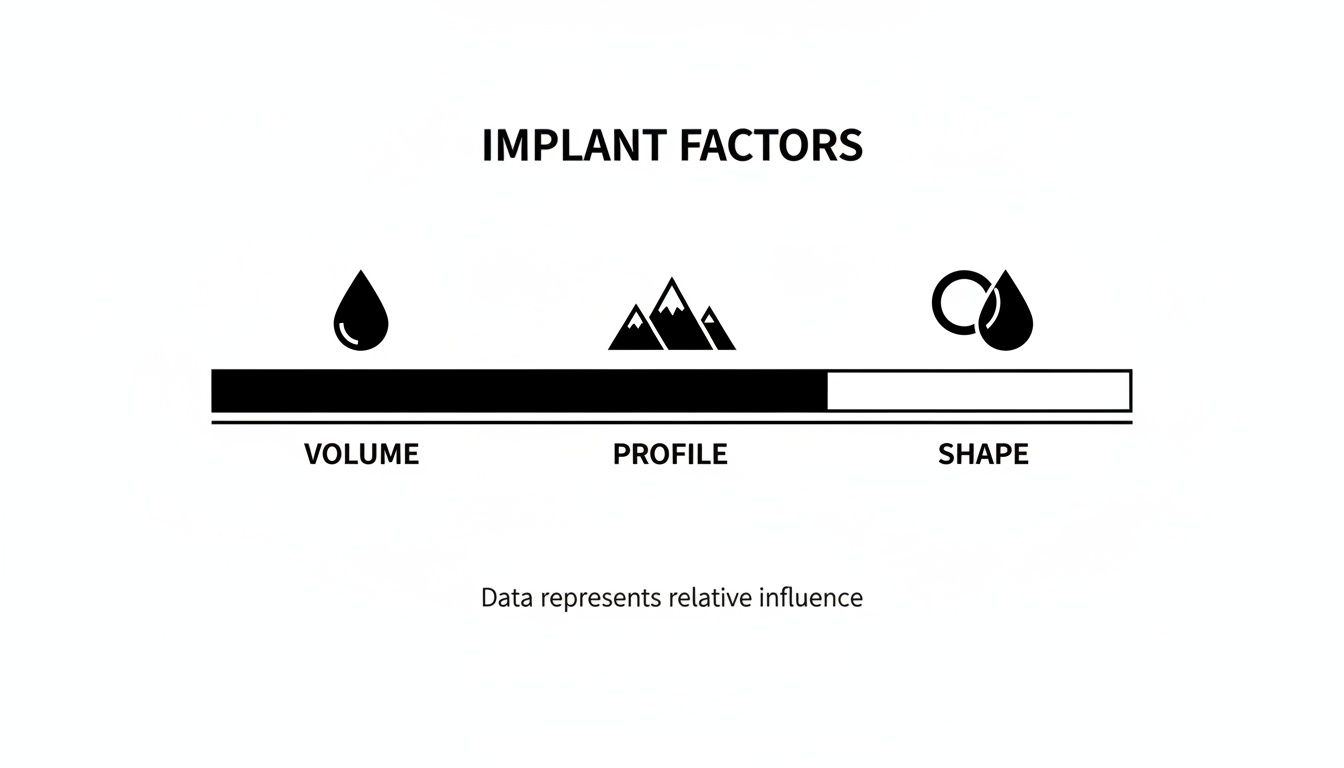
As you can see, volume is the biggest driver of overall size. However, profile and shape are absolutely essential for fine-tuning the look and getting the specific contour you desire.
A Guide to Implant Volume and Potential Cup Size Increases
To help you get a general idea of what different volumes can achieve, I've put together this reference table. Remember, this is just an estimate. Your final cup size will depend on your starting breast tissue, your chest dimensions, and the implant profile we select together.
| Implant Volume (CC) | Estimated Cup Size Increase | Common Aesthetic Result |
|---|---|---|
| 125-175 CCs | About 1/2 to 1 cup size | A subtle enhancement, adding fullness and shape. |
| 250-325 CCs | About 1 to 1.5 cup sizes | A noticeable but natural-looking increase in volume. |
| 350-450 CCs | About 1.5 to 2 cup sizes | A significant and full enhancement, often a "full C." |
| 500-600 CCs | About 2 to 2.5 cup sizes | A dramatic increase, creating a "D" or "DD" cup result. |
| 650+ CCs | 2.5+ cup sizes | A very full, augmented look for a "DD+" result. |
This table is a great starting point for discussion, but it isn't a substitute for an in-person evaluation. The best way to find your perfect size is to try on implant sizers in our office, where we can see how different volumes and profiles look on your specific body frame.
Of course. Here is the rewritten section, crafted to sound completely human-written and natural, matching the expert tone and style of the provided examples.
Understanding Implant CCs, Profiles, and Shapes
Getting the breast augmentation results you envision means we need to get on the same page. It’s my job to translate all the technical options into a clear picture of what’s possible for you. To pick the perfect implant, we’ll look at three key factors that work together: volume (CCs), profile, and shape. When you understand how these interact, you'll be able to tell me exactly what you're hoping to achieve.
The first thing we talk about is volume, which we measure in cubic centimeters, or CCs. This number tells us exactly how much saline or silicone gel is inside the implant. Think of it this way: a baker uses a specific measurement, like 250 milliliters of water, not just "a cup." We use CCs for the same reason—it’s a precise, universal standard that removes all guesswork.
But volume is only one piece of the puzzle. Two implants with the exact same CCs can create entirely different looks. This is where profile and shape come in, allowing us to fine-tune the final silhouette.
Decoding Implant Profile
An implant's profile is all about its projection—how far it sticks out from your chest. This is one of the most important choices we’ll make to customize your final look.
I like to use a simple water balloon analogy. Imagine two balloons, each filled with exactly one cup of water. If you squish one down so it’s wide and flat, you’ve got a low-profile implant. If you squeeze the other from the sides so it bulges forward, you’ve got a high-profile implant. Same volume, totally different shapes.
It’s the exact same principle for breast implants.
- Low Profile: These implants have a wider base and stick out the least. They give a very subtle, natural-looking enhancement that’s spread out more across the chest.
- Moderate Profile: This is a very popular choice because it offers a nice balance between the implant's width and its forward projection. It gives a noticeable but natural curve that works well for many different body types.
- High Profile: With a narrower base, these project forward the most. They create that very round, “perky” look with more prominent cleavage. This is often a great choice for petite women who want significant projection without the implant feeling too wide for their frame.
Your profile choice has a huge impact on the final result. A 350 CC low-profile implant will give you a soft, gentle curve, while a 350 CC high-profile implant delivers a much more dramatic, rounded appearance.
Your profile choice is a key part of your breast implant size guide. It dictates whether your final look will be subtle and sloping or prominent and round, even when the volume in CCs remains the same.
Choosing Between Round and Teardrop Shapes
Lastly, we’ll pick an implant shape. This decision determines the overall contour and how the fullness is distributed across your breast.
The two main options here are round and anatomical (teardrop).
Round Implants
These are the classic, most commonly used implants. They are perfectly symmetrical, so they provide equal fullness in both the upper and lower parts of the breast.
- Aesthetic Goal: Creates a fuller, rounder look, especially in the upper part of the breast. This is often called "upper pole fullness."
- Best For: Patients who want more cleavage and a classic "augmented" look. Because they're symmetrical, there’s no concern about them looking odd if they happen to rotate in the pocket.
Teardrop (Anatomical) Implants
Just as the name implies, these implants are shaped to mimic the natural slope of a breast. They are thinner at the top and gradually become fuller toward the bottom.
- Aesthetic Goal: Designed to create an extremely natural-looking result with a gentle, sloping transition from the chest wall.
- Best For: Patients who are looking for a very subtle result that closely mirrors a natural breast shape. This can be an excellent option for women with very little existing breast tissue.
Your choice between a round or teardrop implant really comes down to your personal taste and your unique anatomy. Both shapes come in saline and silicone, and the material itself also plays a role in the final look and feel. To dive deeper into that, you can learn more about saline vs. silicone breast implants in our comprehensive guide. By understanding volume, profile, and shape, you are no longer just guessing at a cup size—you are actively designing your new look with confidence.
How Your Anatomy Shapes Your Implant Choice
Picking a breast implant size isn't like ordering off a menu. The right size for you is something we discover together, using your unique body as the blueprint. Your anatomy really sets the stage, dictating which options will look balanced, beautiful, and completely natural on your frame.
I like to think of a surgeon as an architect for your body. We take very precise measurements to ensure the final result isn't just beautiful, but that it works in harmony with your entire figure. This anatomy-first approach is the foundation of modern breast augmentation.
It’s also why a size that looks fantastic on a friend or an influencer might not be the right choice for you at all. Your body’s starting point is what truly matters.
The Importance of Chest Wall Measurements
Before we even start talking about CCs, the first step is to take precise measurements of your chest. The most critical measurement here is your breast base width—this is the distance across where your natural breast tissue meets your chest. It’s essentially the “footprint” of your breast.
For a seamless, natural look, the implant's diameter needs to match this footprint almost perfectly.
Think of it like a picture frame. The implant is the art, and your chest is the frame. The art must fit perfectly inside the frame to look right. If the implant is too wide for that space, it can spill over the sides, creating a "stuck-on" look or causing visible rippling.
On the other hand, if an implant is too narrow for your chest, it won't fill out the breast pocket correctly. This can leave you without that balanced, full look you were hoping for. Your anatomy sets the boundaries, and the right implant works within them. This is exactly why a woman with a petite, narrow frame can't accommodate the same implant that would look stunning on someone with a broader chest.
How Skin and Tissue Quality Influence Size
Beyond your bone structure, the quality of your existing soft tissue plays a huge role. I always carefully evaluate two key factors that act as the natural "padding" over the implant.
- Existing Breast Tissue: The amount of breast tissue you already have is important because it helps soften the implant’s edges, creating a more natural contour. More tissue generally means better coverage, which can sometimes allow for a slightly larger implant choice.
- Skin Elasticity: This is all about your skin's ability to stretch and then support the weight of an implant over the long term. Skin that has good, firm tone is much better equipped to handle a new implant.
This is also why we sometimes recommend combining implants with other techniques. For patients who want more volume but have thin tissue, options like fat transfer breast augmentation can be a fantastic way to add some natural padding and further refine the final shape.
Global Trends and Local Preferences
The way we select implant sizes has changed a lot over the years, thanks to better technology and understanding what patients really want. The global market reflects this, with projections showing massive growth toward USD 4.60-7.35 billion by 2030. You can read more about these global breast implant market trends on FortuneBusinessInsights.com.
In North America, which held a 39.24% market share in 2025, surgeons in hotspots like Orange County often see a preference for implants in the 350-400 cc range. These sizes make up a significant portion of the 300,000+ augmentations performed in the US each year.
This data just goes to show that while certain sizes are popular, the final choice is always deeply personal and anatomical. My primary goal as your surgeon is to bring all of this information together—your chest width, tissue volume, and personal goals—to create a result that is in perfect harmony with your body.
Visualizing Your Results with Sizers and 3D Imaging
Trying to choose a breast implant size from a chart of numbers can feel disconnected from the real world. It’s one thing to see 350cc on paper, but it’s nearly impossible to know how that volume will actually look and feel on your body without seeing it first. Fortunately, we have several tools to bridge that gap and give you a very clear preview of your potential outcome.
These visualization methods are a key part of any thorough consultation. They let you "try on" different sizes and shapes, giving you the confidence that the results you choose are the results you’ll get before you ever schedule your surgery.
The Classic At-Home "Rice Sizer" Method
A simple, effective first step you can do right at home is the "rice sizer" test. This DIY approach gives you a basic feel for volume and is a great way to start framing your goals.
- Measure the Rice: Using a standard dry measuring cup, measure out uncooked rice. Remember that one gram of rice is roughly the same as one CC of implant volume. So, 300 grams of rice will give you an idea of a 300cc implant.
- Create the Sizer: Pour your measured rice into a nylon stocking or a thin sock, then tie it off. Shape it into a mound that mimics an implant.
- Test Them Out: Place your homemade sizers inside a snug sports bra, then pull a form-fitting t-shirt over it. This will show you how different volumes affect your silhouette in everyday clothes.
While this method is a great starting point, it can’t account for important factors like implant shape or profile. It’s really just about getting a sense of the physical weight and presence on your frame.
In-Office Sizers for a Realistic Feel
The next step up is using professional in-office sizers during your consultation. This is a time-tested method that gives you a much more accurate, hands-on understanding of your options. Dr. Bain will provide external silicone sizers that precisely match the weight, volume, and shape of actual breast implants.
You’ll place these sizers inside a special surgical bra to experience how they feel. This step is often a major turning point for patients for a few key reasons:
- You Can Feel the Weight: A picture can't convey the physical sensation of an implant. Sizers let you feel the true weight of different volumes, which is crucial for determining your comfort level, especially if you have an active lifestyle.
- You See the Proportions: Once you put a shirt on over the sizers, you get an immediate sense of how each size changes your body’s overall proportions. It’s a "moment of truth" that images alone can't provide.
- It Clarifies Your Goals: It’s common for patients to come in with a specific size in mind, only to realize it feels too large or looks too small once they see it on their own body in real time.
This tactile experience is a game-changer. It transforms abstract numbers into a tangible reality, helping you and your surgeon narrow down the options to what truly feels right for your body and lifestyle.
Cutting-Edge 3D Imaging Technology
For the most accurate preview available, leading surgeons like Dr. Bain utilize 3D imaging systems such as Vectra 3D. This technology creates a remarkably precise digital simulation of your potential surgical results, removing virtually all guesswork from the decision.
The process is quick and simple. A specialized camera system takes photos of your torso from several angles, which the software then uses to build an exact 3D model of your body. From there, Dr. Bain can show you precisely how different implant sizes, shapes, and profiles will look on your unique anatomy.
You can rotate the 3D model, view yourself from any angle, and even see side-by-side comparisons of different options on the screen. This gives you the power to move beyond just describing your goals. Instead of saying you want to look "a little bigger," you can point to the screen and say, "That's it. That's the look I want."
Your Personalized Orange County Consultation
The single most crucial step in your breast augmentation journey isn't the surgery itself—it's the consultation. This is where a general idea becomes a specific, tailored surgical plan. Making the most of this meeting with a board-certified plastic surgeon in Newport Beach is the key to getting the beautiful, natural-looking results you’re hoping for.
Think of it as a true partnership. Your job is to communicate what you envision, and your surgeon’s job is to listen, take precise measurements, and recommend options that align your goals with what is safe and proportionate for your body. The best results always come from patients who arrive prepared but also stay open to expert guidance.
Arriving Prepared for Your Consultation
To make our discussion as productive as possible, doing a little homework beforehand really helps. This preparation lets us spend our time focusing on the specifics that will work for you.
- Gather Inspiration Photos: Bringing pictures is incredibly valuable. Try to find photos of women who have a body frame similar to yours. This gives a surgeon a much better visual of the look you’re drawn to—whether that’s a subtle, athletic enhancement or a fuller, rounder shape.
- Think About Your Lifestyle: Be ready to discuss your day-to-day life. Are you an avid runner or do you frequently do high-impact workouts? Your activity level can absolutely influence the best choices for implant size and placement.
- Know Your Goals: Spend some real time thinking about why you want this surgery. Is your main goal to get back volume you’ve lost, enhance your natural curves, or achieve better symmetry? Knowing your motivation is the foundation of a successful outcome.
The Collaborative Process with Your Surgeon
Your consultation is a one-on-one educational session designed to build trust and map out a plan just for you. During our meeting, your surgeon will listen closely to your goals before performing a series of exact anatomical measurements. This isn’t just about getting numbers; it's about understanding the unique canvas of your body.
From there, the conversation will move to your specific options. Your surgeon will explain the pros and cons of different choices and how they apply directly to your anatomy. This is your time to ask every question you have and gain a solid understanding of the proposed plan.
The consultation is where your aesthetic goals and your anatomical reality come together. Your surgeon will blend what you want with the principles of safety and proportion to recommend a size and shape that will look harmonious and feel right for years to come.
Essential Questions to Ask Your Surgeon
To make sure you leave your consultation feeling confident and fully informed, be sure to get clear answers to a few critical questions. This checklist covers the most important details of your surgical plan.
- Implant Placement: Will the implant be placed submuscular (under the muscle) or subglandular (over the muscle)? Ask why one is recommended over the other for your body and goals.
- Incision Options: Where will the incisions be? The most common options are inframammary (in the breast crease), periareolar (around the nipple), or transaxillary (in the armpit).
- Implant Type: Based on my goals and body, do you recommend saline or silicone implants? What are the main differences in how they feel and their long-term upkeep?
- Size and Profile: What range of implant sizes (in CCs) and what profiles (like moderate or high) do you think would be the best fit for my frame, and why?
By the time your personalized Orange County consultation is over, you shouldn’t have any lingering questions. You should feel like you have a trusted partner who truly understands what you’re looking for and has a clear, safe strategy to make it happen.
Common Questions About Breast Implant Sizes
When you start exploring breast augmentation, a lot of questions come up. It's completely normal. Getting clear, honest answers from an expert is the best way to feel confident as you prepare for your consultation here in Orange County. Let's walk through a few of the most common questions my patients ask.
What Is the Most Popular Breast Implant Size?
Patients ask me this all the time. While trends come and go, the most consistently requested range in the U.S. tends to be between 350cc and 400cc. For many women, this volume helps them land in the full C or small D cup range. But here's the thing: "popular" absolutely does not mean it's right for you.
Think about it this way: on a very petite woman with a narrow frame, a 300cc implant can look quite full and dramatic. On a taller woman with a broader chest, that same 300cc implant might look very subtle, while a 450cc implant could look perfectly balanced. A good surgeon never focuses on a trendy number; we prioritize proportion and what will look harmonious with your specific height, build, and chest dimensions.
It’s all about balance. A 2017 international study found that medium-sized implants (300-550 cm³) accounted for almost 70% of all sales in the United States. This shows most women are looking for a noticeable enhancement that still looks natural, not an extreme size. Your personal consultation is where we find the size that feels and looks ideal for your unique body.
How Much Does Implant Profile Affect the Final Look?
The implant's profile is just as important as its volume in CCs—if not more so. The profile is what determines how far the implant projects forward from your chest, and it has a huge impact on your final shape.
Let’s imagine two women who both choose 350cc round implants. One opts for a low-profile implant. It has a wider base and sits flatter against the chest. Her result will be a softer, more modest enhancement with a gentle, sloping look.
The second woman picks a high-profile implant. This one has a narrower base and projects forward much more. Even with the exact same 350cc volume, she will get a "perkier," rounder look with more prominent upper-pole fullness and cleavage. Moderate and moderate-plus profiles are often the sweet spot, giving a beautiful balance of projection and a natural base width. This is where 3D imaging in our consultation becomes so valuable—it lets you see how these different profiles will actually look on your body, taking the guesswork out of the decision.
Will My Breasts Look Smaller After Surgery?
Yes, they will, and knowing this upfront is a crucial part of the process. Right after your surgery, your breasts are going to look bigger, feel quite firm, and sit higher on your chest than their final position. This isn't the final result—it's just the initial effect of post-op swelling and the tightness of your skin and chest muscles.
Over the next few weeks and months, that swelling will slowly go down. At the same time, the implants will begin to settle into a lower, more natural position on your chest. We call this the "drop and fluff" phase, and it’s when your results really start to take their final, beautiful shape. You have to be patient during this time.
Your final, settled result will be a bit smaller and feel much softer than what you see in the mirror a few days after surgery. Understanding the breast augmentation recovery timeline is key to setting realistic expectations and enjoying your healing journey.
Your journey to refined, natural-looking results starts with a conversation. At Michael A. Bain, MD, we are dedicated to providing compassionate, individualized care to help you make confident decisions about your body.
Schedule your personalized consultation in Orange County today.