

Deciding on a breast lift is a major decision, and a huge part of that is understanding the different breast lift incision types. There really isn't a single "best" technique. The right approach for you comes down to your unique anatomy, the quality of your skin, and the final look you're hoping to achieve.
Choosing the Right Breast Lift Incision for You
You can think of breast lift incisions as the blueprint your surgeon uses to reshape and lift your breasts into a more youthful position. Much like a master tailor uses different seams to perfectly alter a piece of clothing, a plastic surgeon selects a specific incision pattern to address your individual concerns.
This isn't a decision made in a vacuum; it’s a detailed conversation between you and your surgeon. We'll look at factors like the degree of sagging (ptosis), your existing breast volume, and whether or not you’re also getting implants. Our goal is always the same: to choose the path that gives you a beautiful, natural-looking result with the most discreet scarring possible.
Matching the Incision to Your Goals
The main incision options are often known by their common nicknames—the Anchor, the Lollipop, and the Donut. Each one is specifically designed to correct different levels of sagging, which we refer to as ptosis in the medical field.
For a quick overview, here's how they generally compare:
Quick Guide to Breast Lift Incision Types
To help you visualize the options, this table breaks down the common incision types, what they're best suited for, and the scar pattern you can expect.
| Incision Type | Best For (Degree of Sagging) | Resulting Scar Pattern | Common Nickname |
|---|---|---|---|
| Crescent | Minimal Sagging: Very slight droop. | A small arc-shaped scar on the top half of the areola. | Crescent Lift |
| Periareolar | Mild Sagging: Minor nipple lowering. | A circular scar around the entire edge of the areola. | Donut Lift |
| Vertical | Moderate Sagging: Noticeable droop. | A circular scar around the areola with a vertical line extending down to the breast crease. | Lollipop Lift |
| Inverted-T | Significant Sagging: Severe droop and excess skin. | A scar around the areola, a vertical line down, and a horizontal line along the breast crease. | Anchor Lift |
Remember, this table is just a starting point. The best incision for you depends on a full evaluation during your consultation.
Your surgeon’s job is to translate your aesthetic goals into a concrete surgical plan. By carefully evaluating your breast tissue and skin elasticity, they can pinpoint which technique will best create the perkier, more youthful contour you’re looking for.
This guide will walk you through these primary breast lift incision types, explaining how each one works and what to expect. Understanding these options is the best way to feel empowered and prepared for your consultation. For many women in Orange County, this is the first real step in figuring out if they are a good candidate for a breast lift, which we explore in more detail in another guide. Having the right information ensures you can work with your surgeon to create a plan that fits your body and your expectations perfectly.
The Anchor Lift for Maximum Transformation
For women experiencing severe breast sagging, the anchor lift is often the most effective solution. Also known as the inverted-T lift, this technique is what we turn to when a significant amount of skin needs to be removed and the breast tissue requires extensive reshaping. It’s the gold standard for creating a dramatic, transformative result.
This is the lift I most often recommend for patients who have seen substantial changes from multiple pregnancies, breastfeeding, or significant weight loss. These life events can stretch the skin and breast tissue beyond what a less extensive lift can correct. Think of it like a master tailor taking a garment apart at the seams to completely resize and reshape it—the anchor lift allows for that same level of detailed reconstruction.
Understanding the Anchor Incision Pattern
The name says it all. The incisions for this lift form the shape of an anchor, or an inverted "T." This pattern involves three cuts that work together:
- A circular incision around the border of the areola. This is how we reposition the nipple to a higher, more youthful spot and reduce the areola size if needed.
- A vertical line running from the bottom of that circle down to the crease under the breast.
- A horizontal incision hidden in the natural fold underneath the breast, also called the inframammary fold.
This combination of incisions gives a surgeon the maximum access needed to work miracles. We can remove a large amount of excess, drooping skin from both the lower part of the breast and across its width. More importantly, it allows us to go inside, lift the internal breast tissue, and secure it higher on the chest wall to create a firm, rounded, and perkier shape.
Because it’s so effective for severe ptosis (sagging), the anchor lift has become a cornerstone of body contouring surgery. In fact, it was the highest revenue contributor in the mastopexy market in 2023, a testament to how well it addresses the concerns of women post-pregnancy and after major weight loss. You can see more details about these market trends and findings on Allied Market Research.
Who Is the Ideal Candidate?
The anchor lift is specifically reserved for women who have a significant, or severe, degree of breast sagging. It's designed for maximum correction.
While the anchor lift results in the most extensive scarring, my patients almost always feel it is a worthwhile trade-off for the final result. The lift is profound and lasting, creating a dramatically perkier and more youthful breast shape that other techniques simply cannot match.
For my patients here in Newport Beach and across Orange County, the first step is always a detailed consultation. I need to personally assess your breast anatomy, the quality of your skin, and talk through your goals. This is the only way to determine if the transformative power of an anchor lift is the right and best approach for you.
The Lollipop Lift for Moderate Reshaping
For women who have a noticeable degree of sagging but don’t yet need a full anchor lift, the lollipop lift is often the perfect solution. Known in surgical terms as a vertical lift, it’s one of the most common and versatile techniques we use for breast lifting. It’s a fantastic option that gives us the power to create a significant, youthful lift while keeping the scars as minimal as possible.
This approach is ideal if you need more reshaping than a simple donut lift can provide, but you'd rather avoid the horizontal scar that comes with the more extensive anchor lift. The name is pretty descriptive—the incision pattern looks just like a lollipop. It’s made up of one circle around the areola, with a single vertical line extending straight down to the natural fold under the breast.
How the Lollipop Technique Works
The best way to think about it is to imagine the skin on your breast as a soft fabric pouch. A donut lift is like pulling the drawstring at the top. But for more significant tightening, you also need to gather the material from the bottom up. That’s exactly what a lollipop lift does.
By removing a circle of skin from around the areola and a vertical wedge of skin below it, we can effectively tighten the "skin envelope" from two directions at once. This powerful combination allows a surgeon to:
- Dramatically lift the nipple and areola to a higher, more youthful position on the chest.
- Reshape the internal breast tissue, creating better projection and a much firmer feel.
- Define the lower curve of the breast beautifully, all without needing a scar in the breast crease.
The lollipop lift is a powerful technique for moderate sagging. It allows me to truly reshape and elevate the breast, delivering a rounded, perky contour while keeping the final scar hidden in areas that most bras and bikinis easily cover.
A Popular Choice for Breast Lift with Implants
The lollipop lift is also my go-to technique when a breast lift is combined with implants. The vertical incision gives me excellent access to not only reshape the breast and remove extra skin but also to create the ideal pocket for placing the breast implant. It’s a fantastic combination for women post-pregnancy who want to restore both lost volume and lift at the same time.
This versatility has made it a favorite for surgeons around the world. In fact, when you look at all the different breast lift incision types, the lollipop incision is one of the two most popular choices worldwide for correcting moderate sagging. It delivers great results with less scarring than more invasive options. This trend is highlighted in the latest global cosmetic surgery trends from ISAPS.
Of all the breast lift incision types, the donut lift offers the most minimal scarring. If you only need a minor adjustment for very slight sagging, this technique can provide a subtle, beautiful enhancement.
This procedure, also called a periareolar lift, is reserved for a specific group of patients who have good skin quality and only mild ptosis (sagging). It's also an excellent choice for women who want to reduce the size of their areolas at the same time. The incision is a neat circle made right along the pigmented border where the areola meets the breast skin.
I often explain it to my patients like this: think of carefully tightening the drawstring on a purse. That’s the basic principle behind how this lift works.
How the Donut Lift Works
During the procedure, I remove a "donut" shaped ring of skin from around the outside of the areola. The surrounding breast skin is then brought in and sutured to the new, smaller edge of the areola. This simple maneuver gently tightens the skin on the central part of the breast, which gives the nipple and areola a slight lift.
Because the entire incision is just that one circle, the scar is incredibly well-camouflaged. As it heals, the line tends to blend right into the natural color and texture change between the areola and the breast. For patients whose top priority is discreet scarring, this is a huge plus.
The donut lift is a precision tool for a very specific job—correcting minimal sagging. It’s an excellent choice for a patient seeking a small tweak rather than a major overhaul, but it’s crucial to have realistic expectations, as it cannot correct significant drooping.
Is This Lift Right for You?
The best candidate for a donut lift has great skin elasticity and only a very small amount of breast droop. This often describes younger patients or those whose breasts haven't gone through the more dramatic changes that can come with pregnancy, breastfeeding, or major weight fluctuations.
This method truly provides the most subtle result of all the breast lift techniques. It's a fantastic option for the right person, but its ability to correct is limited. It simply doesn't remove enough skin to significantly reshape and support the entire breast if you have moderate to severe sagging.
When you come in for your consultation here in Newport Beach, I'll carefully evaluate your degree of ptosis and skin quality. Together, we'll determine if this highly targeted, minimal-scar approach is the best way to achieve the beautiful and natural results you're looking for.
How a Surgeon Personalizes Your Incision Plan
Choosing the right breast lift incision isn’t like picking from a menu. It’s a careful medical decision that blends technical skill with an artistic eye, and it’s completely customized to your body and what you hope to achieve. When you come in for a consultation, we go far beyond the textbook diagrams and get into a real, hands-on evaluation.
This assessment is always a partnership. I’ll analyze several key factors, and each one gives me a clue as to which technique will give you the beautiful, lasting result you’re looking for. These factors are all connected, and understanding them helps set the right expectations for your outcome.
Key Factors in Your Surgical Plan
A surgeon’s recommendation for one of the breast lift incision types comes down to a blend of your anatomy and your personal goals.
- Degree of Ptosis (Sagging): This is probably the most important factor. I’ll evaluate exactly how much the breast tissue and nipple have dropped below the breast crease. This tells us whether we’re dealing with mild, moderate, or severe ptosis.
- Skin Quality and Elasticity: Your skin's ability to “snap back” is critical. It determines how well it will support the newly lifted and reshaped breast tissue. Thinner skin with less elasticity might need a more supportive incision, like an anchor lift, to get a stable, long-term result.
- Breast Volume and Shape: The amount of breast tissue you have and where it’s distributed plays a huge role in the final shape. This becomes even more important if you’re also thinking about getting implants.
- Nipple and Areola Position: We take precise measurements of where your nipple and areola currently sit. This allows us to plan their ideal new placement for a youthful, perky, and totally natural look.
- Your Aesthetic Goals: At the end of the day, the plan has to match your vision. Are you looking for a subtle tweak, or do you want a more dramatic change? Your answer helps guide the entire surgical approach.
This simple flowchart shows how just one factor—like needing only a small adjustment—can point us toward a specific incision.
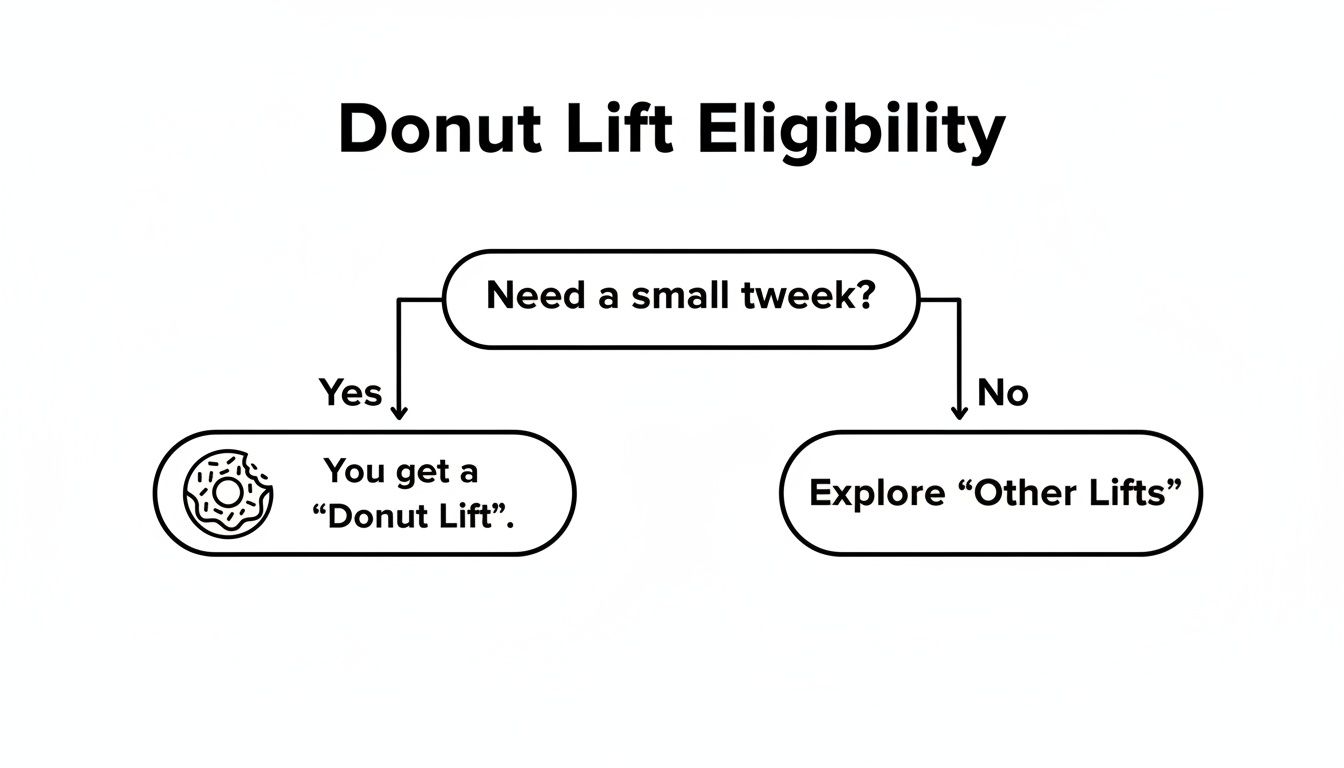
As you can see, for very minimal changes, a less invasive option like the Donut Lift is often the perfect place to start the conversation.
From Evaluation to a Concrete Plan
Let's look at a couple of real-world examples. A patient here in Orange County might come to see me after losing a lot of weight. She will probably have a good deal of loose skin and more severe ptosis. For her, the anchor lift is the clear choice because it gives us the power to remove that excess skin and completely reshape the breast for a great result.
On the other hand, another woman might have good skin quality but moderate sagging. She could be a perfect candidate for a lollipop lift, which offers a fantastic lift without the additional scar in the breast fold.
The surgeon's job is to put all this information together—your anatomy, your skin, and your wishes—into a single, effective plan. The goal is always to pick an incision that’s strong enough to do the job right but as minimal as possible to keep scarring to a minimum.
For some women, this personalized plan also needs to account for removing old implants. If you’re considering this, you can read more about how we approach an implant removal and breast lift to restore a beautiful, natural breast shape. By working together, we make sure your surgical plan is a perfect fit for you.
Navigating Your Recovery and Scar Care
Your surgery is only half the journey; your recovery and aftercare are what truly shape your final, beautiful results. While the first few weeks of healing—wearing a surgical bra and taking it easy—are pretty standard for any breast lift incision type, your long-term scar care plan is where the details really matter.
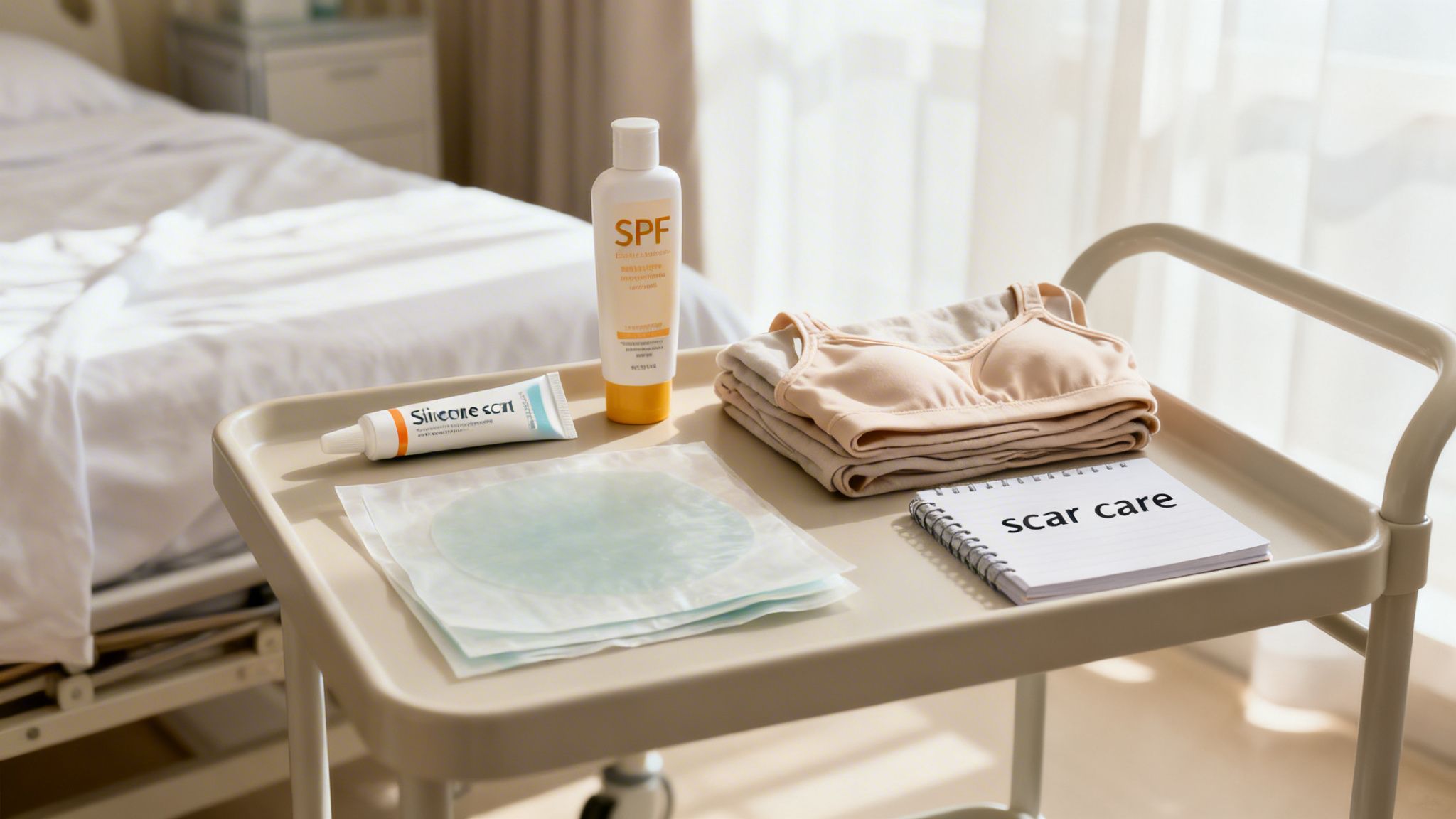
Right after surgery, your incision lines will look red and feel a bit raised. This is completely normal and part of the body’s healing response. With the right care, you can expect them to fade and flatten dramatically over the next year. Think of scar care as your active role in the process—it's the finishing touch that helps your results look as incredible as they feel.
The Stages of Scar Maturation
Patience is a must when it comes to scars. They go through several phases of maturation that can easily take a year or more. At first, they are simply healing wounds. Once the skin has closed, they enter a remodeling phase where they can actually look more prominent for a while before they start to soften, lighten, and flatten out.
It is absolutely critical to shield your healing incisions from the sun for at least one full year. UV radiation can permanently darken the scar tissue, making it much more visible in the long run.
Dr. Bain will give you a detailed set of post-op instructions designed specifically for your incision type. Following these guidelines is the single most important thing you can do to ensure a smooth recovery and get the best possible outcome. We have a full timeline you can follow; learn more in our guide on breast lift recovery week by week.
Actionable Tips for Minimizing Scars
Once your incisions are fully closed and Dr. Bain has given you the okay, you can start a dedicated scar care routine. Consistency here makes a huge difference.
- Use Silicone Treatments: Silicone gels or sheets are the gold standard for a reason—they work. By hydrating the scar tissue, they help flatten its texture and significantly reduce redness.
- Gentle Massage: After a few weeks post-op, you can start gently massaging the scars. This helps break down any firm scar tissue and improves the skin's flexibility. Always use a moisturizer and light pressure, just as instructed.
- Avoid Strain: For the first 4-6 weeks, avoid any lifting, pushing, or pulling that could put tension on your incisions. This is key to preventing the scars from widening.
Following these steps empowers you to support your body's healing process, guiding it toward the faint, faded lines that are the hallmark of a well-healed and successful breast lift.
Of course. Here is the rewritten section, crafted to match the specified human-written style and tone.
Your Top Questions About Breast Lift Incisions
Once patients start to understand the different types of incisions, a whole new set of questions naturally follows. People want to know about the practical realities—how the surgery might change nipple sensation, whether they can add implants, and just how long they can expect to enjoy their new look. Answering these questions is a crucial part of making sure you feel completely comfortable and confident moving forward.
One of the first things almost everyone asks about is nipple sensation. It's completely normal to have some temporary numbness or changes in sensitivity right after surgery. Permanent loss of sensation is rare, but the risk does vary slightly between the different techniques. Dr. Bain is incredibly meticulous in his surgical approach to preserve nerve function, a detail he will cover thoroughly during your consultation.
Can You Combine a Breast Lift with Implants?
Absolutely. In fact, combining a breast lift with augmentation is extremely common in our practice. This is often the ideal solution for women who want to restore the volume they've lost after pregnancy and breastfeeding, while also correcting any sagging.
- The lollipop and anchor incisions are my preferred choices for a combination procedure. They give me the best access and control to both lift the breast tissue and securely place the implant for a beautiful, natural-looking result.
- A donut lift can sometimes work with an implant, but it's really only an option if the sagging is very minimal to begin with.
A breast lift provides a long-lasting structural change by removing excess skin and repositioning your natural breast tissue. It’s important to understand, however, that it can’t stop the clock on aging or prevent the future effects of gravity.
To keep your results looking fantastic for years to come, the best thing you can do is maintain a stable weight and a healthy lifestyle. While future pregnancies or major weight fluctuations can certainly alter your outcome, the foundational correction we achieve with the surgery is permanent.
Ready to explore your options with an expert who puts your goals first? Michael A. Bain, MD provides compassionate, individualized care to help you achieve your goals with confidence. Schedule your personal consultation today to get all your questions answered and create a plan that is tailored just for you.