

Facing breast reconstruction can feel overwhelming, but I want you to know this from the start: insurance coverage is not a privilege, it's your legal right. Thanks to a crucial federal law, if your insurance plan covers mastectomies, it is also required to cover all stages of your breast reconstruction.
Understanding Your Rights to Insurance Coverage

When we start talking about the financial side of breast reconstruction, everything circles back to one key piece of legislation: the Women's Health and Cancer Rights Act (WHCRA). This federal law, passed back in 1998, is the foundation for all breast reconstruction insurance coverage.
Think of it as a mandate for wholeness. The law ensures that your journey after a mastectomy is treated as a medical necessity, not just an elective cosmetic choice.
The impact of this act was immediate and profound. Before the WHCRA, getting reconstruction covered was a constant battle. Afterward, access changed dramatically. We saw immediate reconstruction rates jump from around 11% in the early 2000s to over 30% by 2012 as the law took full effect.
A Quick Guide to Your WHCRA Protections
To make it simple, the WHCRA requires group health plans, insurance companies, and HMOs that cover mastectomies to also provide benefits for your reconstructive surgery. This protection is yours whether you choose to have reconstruction right away or years down the road. Here's a quick summary of what that means for you:
| Covered Service | What This Means for You |
|---|---|
| Reconstruction of the Mastectomy Site | All surgical stages to rebuild the breast where the mastectomy was performed are covered. |
| Contralateral (Opposite) Breast Surgery | Any procedures on the other breast needed to create a symmetrical appearance are included. |
| Prostheses and Complications | This covers external breast forms (prostheses) and treatment for related physical complications, like lymphedema. |
This table gives you a snapshot, but the core idea is that the law is designed to cover the entire process of restoring your form and symmetry.
Essentially, WHCRA ensures that your treatment plan is dictated by your medical needs and your surgeon's recommendations—not by an insurer's narrow definition of "reconstruction." It covers the full scope of what it takes to create a natural and symmetric result.
It’s important to know the difference between these mandated reconstructive procedures and purely cosmetic ones, because the definitions can sometimes feel a bit blurry. For example, a breast lift on the non-reconstructed breast to achieve symmetry is typically covered. However, a separate procedure done purely for aesthetic enhancement, without a medical or symmetrical reason, might not be.
Our guide on whether insurance covers breast reduction surgery provides more detail on how insurers determine what is "medically necessary." Understanding these rights from the beginning empowers you to be your own best advocate on this journey.
What Breast Reconstruction Insurance Actually Covers
Knowing your legal rights is the first step. Now, let’s talk about what those rights actually mean in terms of covered services. Your insurance coverage is meant to be a complete toolkit for rebuilding what was lost after a mastectomy—not just for a single operation, but for the entire journey of restoring your shape and symmetry.
This means your policy is required to cover all the necessary stages of reconstruction, from the very first procedure to the final touches. It’s a multi-step process, and your coverage is designed to be there for you at every point along the way.
The Core Components of Coverage
At its foundation, your insurance must cover the essential procedures needed to create a new breast mound. This includes all related surgeries, whether you decide on implant-based reconstruction or prefer to use your own tissue in what we call autologous reconstruction.
Many patients choose implant-based methods. In fact, by 2020, over 60% of the 137,808 breast reconstruction procedures performed in the U.S. involved implants or tissue expanders. It's the most common path, and coverage for it is standard. You can read more about these reconstruction statistics to see just how common these insured procedures are.
Here’s a breakdown of the reconstruction types and what’s typically included:
- Implant-Based Reconstruction: This is usually a two-stage process. Your coverage will include the first surgery to place a tissue expander (a temporary implant that gently stretches the skin), all the follow-up visits for saline fills, and the final surgery to swap the expander for a permanent breast implant.
- Autologous (Flap) Reconstruction: This is an advanced technique where your own tissue from another part of your body (like the abdomen) is used to create a new, natural-feeling breast. Coverage includes complex microsurgical procedures like the DIEP flap, which is the most common flap surgery today. While it’s a longer and more involved operation, it is fully covered as a standard of care.
Coverage isn't a-la-carte; it’s a complete package. The law requires insurers to cover all stages of reconstruction, from the initial surgery to the final touches. This ensures that the process is seen through to completion.
Beyond the Breast Mound: What Else Is Covered?
Reconstruction is about more than just rebuilding a breast; it's about restoring a sense of balance and wholeness. Federal law gets this, and it mandates coverage for procedures that are essential for achieving a complete and symmetrical outcome.
This is a critical part of your breast reconstruction insurance coverage that many patients don't realize is available to them. It ensures the final result looks and feels as natural as possible.
Symmetry Procedures for the Other Breast
To create a balanced and harmonious look, your surgeon might need to perform a procedure on your non-mastectomy breast. In this context, these are not "cosmetic" surgeries; they are a required part of a medically necessary reconstruction.
Coverage typically includes:
- Breast Lift (Mastopexy): To match the position and shape of the reconstructed breast.
- Breast Reduction: To match the size of the newly created breast.
- Breast Augmentation: To increase the size of the natural breast to achieve better symmetry.
Finishing Touches and Revisions
The journey doesn’t always end with the main surgery. Insurance also covers the final, crucial steps that complete the restoration.
- Nipple and Areola Reconstruction: This includes creating a new nipple mound and areola, often done with skill and artistry through 3D tattooing, to complete the natural appearance of the breast.
- Revision Surgeries: Sometimes, adjustments are needed to improve symmetry or correct an issue from the initial surgery. If complications come up, these revisions are considered medically necessary and are covered.
Understanding the full scope of what's available helps you and your surgeon create a truly comprehensive plan. For a deeper look into the financial aspects, you can review our guide on the cost of breast reconstruction.
How to Get Your Breast Reconstruction Approved: The Preauthorization Process
After your consultation, the next big step is getting your insurance company's official approval for the surgery. This is called preauthorization, and while it might sound like a mountain of paperwork, it's a process my team and I handle for our patients every single day. Think of it as our way of proving to your insurer that every part of your planned reconstruction is medically necessary.
The entire process kicks off right after we've met and decided on a surgical plan. My office staff are experts at this. They’ll gather all the necessary documentation and build a strong case to send to your insurance provider.
To help you feel more in control during this phase, it’s useful to have a basic grasp of what prior authorization entails. This knowledge really helps you partner with my administrative team as we work to get your procedure covered.
The Letter of Medical Necessity
The most important part of this package is the Letter of Medical Necessity. I personally write this letter for each of my patients. It’s not just a form letter; it’s a detailed story explaining exactly why your reconstruction is essential for both your physical health and your emotional well-being.
The letter connects your breast cancer diagnosis and mastectomy directly to the surgical plan we’ve created together. It justifies each recommended procedure, serving as the main argument for why your breast reconstruction insurance coverage should be approved.
Understanding CPT Codes
Along with my letter, my office submits a list of Current Procedural Terminology (CPT) codes. You can think of these five-digit codes as a universal shorthand that doctors use to tell insurance companies exactly what procedures are planned.
Every single part of your reconstruction, from placing the implant to nipple reconstruction and tattooing, has its own unique CPT code. Your insurance company uses these codes to check that everything we've planned is a covered benefit under your policy and the WHCRA. My billing team is meticulous about this—getting the codes right is absolutely critical.
Below is a simple diagram showing the key stages of reconstruction that are typically covered.
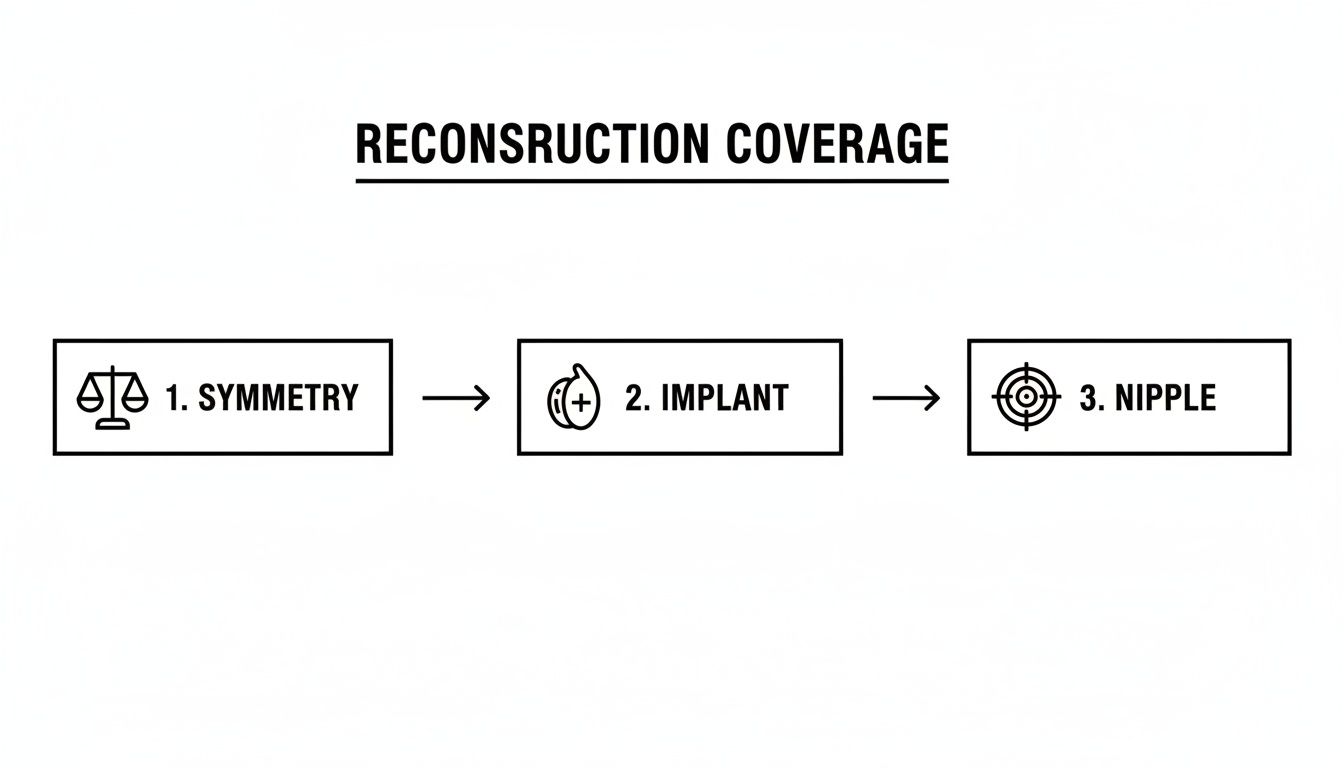
As you can see, a complete reconstruction isn't just about the new breast mound. It also includes procedures to create symmetry with your other breast and the final, finishing touches of nipple and areola reconstruction.
Your Document Checklist
While my team handles the submission, having your own documents organized can make everything go smoother. I always tell my patients to keep a dedicated folder for all their insurance and medical paperwork. It helps you stay on top of things and feel prepared.
Here’s a quick list of what my office will typically need to assemble your preauthorization request:
- A clear copy of your Insurance ID Card (front and back)
- Physician’s Orders (the official prescription for your surgery)
- The Letter of Medical Necessity from me
- Pathology Reports from your mastectomy that confirm your diagnosis
- My Clinical Notes from our consultation and any other appointments
- A List of CPT Codes for every procedure in your surgical plan
A Quick Word of Advice: Getting your surgery approved is a team effort. When you understand the process and keep your own records in order, you help us build the strongest possible case for your coverage. It’s the best way to ensure a smooth path to approval.
The good news is that while the process is detailed, approval rates are solid. Recent data from the Centers for Medicare & Medicaid Services projects a 12% increase in coverage approvals for breast reconstruction between 2024 and 2026. This trend shows a better understanding of the procedure's importance, but it still depends entirely on getting the documentation perfect.
Once we submit the completed package, the waiting begins. It can take a few weeks for your insurance company to review everything. During this time, feel free to check in with my office for updates. Consistent communication is the best way to keep things moving forward.
What to Do When Your Coverage Is Denied

Getting that denial letter from your insurance company can feel like a punch to the gut. It’s incredibly frustrating, especially after everything you’ve already been through with your diagnosis and treatment planning. But take a deep breath—an initial denial is rarely the final word.
It's better to think of a denial not as a hard "no," but as a request for more information. Most of the time, it just means a reviewer needs more specific medical details, or even that a simple clerical error occurred along the way. With a clear and strategic approach, we can challenge the decision and get you the breast reconstruction insurance coverage you are legally entitled to.
It also helps to know a little about how insurance companies work. When your claim first arrives, it often gets a first pass from software designed for automated claims processing. This software might flag something for a human reviewer, who might then deny it simply because a specific piece of paperwork is missing. The appeals process is your chance to fill in those gaps.
The First Step: Your Internal Appeal
Your first move is always the internal appeal. This is simply a formal request asking your insurance company to take a second look at your case. You’re asking for a new set of eyes—usually a medical director within the company—to review all the facts.
By law, your denial letter has to spell out exactly why the claim was rejected and give you clear instructions on how to start an appeal. Look closely for the deadlines. You typically have within 180 days from the date you received the denial to file.
This is where you and our office become a team. We’ve been through this process with many patients in Orange County and know how to navigate it effectively. We’ll be your strongest advocates.
Your appeal packet should always include:
- The Original Denial Letter: This is the starting point for your entire argument.
- A New Letter from Your Surgeon: My letter will directly counter the insurer's reasons for denial, explain the medical necessity, and cite federal law (WHCRA).
- Supporting Medical Records: We'll include pathology reports, my clinical notes, and any photos that make your case undeniable.
- Patient Letter (Optional but Powerful): A personal letter from you, explaining how this affects your daily life, can add a human element that a reviewer can’t ignore.
Crafting a Powerful Appeal Letter
When my office helps a patient appeal a denial, our approach is methodical and built on facts. The whole point is to make it as simple as possible for the reviewer to reverse the decision and say "yes."
Think of the letter as a firm but respectful argument. It should start by clearly stating you are appealing the denial for a specific procedure. Then, we will systematically break down each reason they gave for the denial and refute it with medical evidence from your chart.
A successful appeal is a conversation backed by facts. It's not an emotional plea, but a logical presentation of medical necessity. Your goal is to give the reviewer the exact information they need to overturn the original decision.
If the Internal Appeal Fails: External Review
If your insurance company still says no after the internal appeal, don't lose hope. You have another powerful option: an external review. This is where your case is handed over to an Independent Review Organization (IRO).
An IRO is a third-party group of doctors who have absolutely no connection to your insurance company. They review everything, and their decision is legally binding. Your insurer has to provide you with the information to request this external review. It’s a great way to get your case in front of a truly neutral party.
Navigating insurance can be a headache, and sometimes out-of-pocket costs are part of the journey. For more on handling these expenses, you can read our guide on how to finance cosmetic surgery, which has tips that can also help with uncovered parts of reconstructive procedures. Just remember, you have rights and resources at every single step.
Coverage for Symmetry and Prophylactic Mastectomy
When we talk about breast reconstruction, the conversation often focuses on the breast affected by cancer. But that’s only half the story. A truly successful reconstruction isn't just about replacing what was lost—it's about restoring a sense of wholeness and balance.
Federal law, specifically the Women's Health and Cancer Rights Act (WHCRA), recognizes this. The protections go far beyond a single breast, ensuring coverage for procedures that create symmetry and even for preventative mastectomies in high-risk situations.
The goal of reconstruction is restoration. This includes restoring balance and symmetry, which is why procedures on the contralateral (opposite) breast are a mandated part of your breast reconstruction insurance coverage.
Why Symmetry Procedures Are Medically Necessary
Imagine your surgeon beautifully reconstructs one breast, but it doesn't match the size, shape, or position of your natural breast. The end result would feel unbalanced and incomplete. This isn't about cosmetic "perfection"—it's a fundamental part of the reconstructive process.
For this reason, if your surgeon recommends a procedure on the non-cancerous breast to create a more even and natural appearance, your insurance plan is required to cover it. These are not considered optional add-ons; they are part of the complete reconstructive plan.
Commonly covered symmetry procedures include:
- Breast Lift (Mastopexy): To raise the natural breast so it sits in line with the newly reconstructed one.
- Breast Reduction: To reduce the size of the larger, natural breast, creating a balanced silhouette.
- Breast Implant: To augment the natural breast, making its size and shape a closer match to the reconstructed breast.
Your surgeon's office will code and submit these procedures as part of your overall treatment, confirming their status as medically necessary.
Coverage for Prophylactic Mastectomy
For some women, the risk of developing breast cancer is exceptionally high. In these cases, a prophylactic mastectomy—the preventive removal of one or both breasts—is a powerful option to dramatically lower future risk. This isn't a decision made lightly; it's based on strong medical evidence.
To establish that a prophylactic mastectomy is medically necessary, your doctor will need to provide clear documentation. This often includes things like:
- A positive test for a high-risk genetic mutation like BRCA1 or BRCA2.
- A significant and well-documented family history of breast or ovarian cancer.
- A personal history of lobular carcinoma in situ (LCIS) combined with other risk factors.
The rule here is simple: if your insurance plan covers the prophylactic mastectomy as a medically necessary procedure, then it must also cover the breast reconstruction that follows. You are entitled to all the same rights and coverages under the WHCRA.
This approach is becoming more common. In fact, projections show that by 2026, bilateral reconstruction procedures will be a major force in the market, with an expected growth rate of 4.7% CAGR. This shift is driven by both better insurance coverage and more women choosing prophylactic surgery to achieve symmetry and reduce their long-term cancer risk. To learn more, you can check out the latest findings on rates of breast reconstruction after mastectomy.
Partnering With Your Surgical Team for a Smooth Process
Think of my office staff as your personal advocates for navigating the insurance process. While you need to focus on your health, my administrative team—who are deeply experienced with Orange County insurance networks—will manage the complex paperwork and phone calls required by your provider.
From the moment we determine your surgical plan in your consultation, my team steps in. We act as the main point of contact for your insurance company, handling the entire preauthorization process. This is designed to take the administrative weight completely off your shoulders.
Your Office's Role in Securing Approval
My staff has spent years building relationships and understanding the specific requirements of the insurance plans and hospital systems here in our community. This local knowledge, especially with major providers and hospitals like Hoag Memorial, helps us get things done efficiently.
We take care of several crucial steps for you:
- Preauthorization Management: We compile and submit the full preauthorization request. This includes a detailed letter of medical necessity, your clinical records, and the specific billing codes for your planned procedures.
- Direct Insurer Communication: If your insurance company has a question or requests additional documents, they call us, not you. My team knows exactly what medical justifications are needed to keep the process moving and prevent a denial.
- Hospital and Billing Coordination: We work directly with the surgical and billing departments at the hospital to make sure every aspect of your care is approved and seamlessly coordinated.
Our goal is to create a smooth path from your consultation to your approved surgery. We handle the red tape so you don’t have to.
You can consider my team your personal navigators. We know the system, we speak the language of insurance, and we are committed to getting you to your destination—a fully approved reconstruction—with as little stress as possible.
Planning for Every Financial Aspect
Your initial consultation is about more than just your surgical plan; it's also the right time to have a clear financial discussion. While our primary objective is to get your procedure fully covered, it’s important to plan for potential out-of-pocket costs like deductibles and copayments.
Please bring up any concerns you have about these expenses. My patient coordinator is here to walk you through financing options that many of our patients find helpful for managing their portion of the costs.
By working together from the very beginning, you can move forward with the peace of mind that comes from knowing all the details are being handled by an experienced team that is completely dedicated to your well-being.
Frequently Asked Questions About Reconstruction Coverage
As you move through your reconstruction journey, practical questions about insurance are bound to come up. It's completely normal. Let’s tackle some of the most common concerns I hear from my patients right here in my Orange County office.
Are Revision Surgeries Covered by Insurance?
Yes, they absolutely should be. Your reconstruction journey doesn't always end with the first surgery. Follow-up procedures to correct a complication, improve symmetry, or treat an issue like capsular contracture are not cosmetic—they are medically necessary.
Your surgeon’s detailed documentation is what proves this medical necessity to your insurance carrier. The Women's Health and Cancer Rights Act (WHCRA) was written to cover all stages of reconstruction, and that includes the necessary revisions to achieve a safe, complete, and symmetrical result.
What Happens If My Preferred Surgeon Is Out-of-Network?
This is a common scenario and, while it adds a layer of complexity, it's often manageable. If you have a PPO plan, you likely have some benefits for out-of-network care, but you can expect a higher deductible and out-of-pocket maximum. HMO plans are much stricter and typically won't cover out-of-network care unless it's a true emergency.
Before you make any decisions, the first step is always to call your insurance provider to get the specifics of your plan. In certain situations, we can request a "network gap exception" for you. This is an argument we make on your behalf, demonstrating that a specialist with the required skills isn't available within your network. My office staff is very experienced in helping patients build this case.
A Quick Note on Nipple Reconstruction: The final stage of breast reconstruction often involves creating a new nipple and areola, sometimes with advanced 3D tattooing. Because this is considered the completion of the process, it is a mandated benefit covered by insurance under the WHCRA.
What If I Change Insurance Plans During My Reconstruction?
Life happens, and switching jobs or insurance plans mid-reconstruction is more common than you might think. Don't panic. Under the WHCRA, your new insurance provider is still legally obligated to cover the remaining stages of your reconstruction.
The key thing to know is that your new plan will require a completely new preauthorization process. It is vital that you let your surgeon's office know about the insurance change the moment it happens. This allows my team to get the new paperwork submitted immediately, so we can work to prevent any delays in your care. A little proactivity here goes a long way toward a smooth transition.
At the office of Michael A. Bain, MD, my experienced team considers it our job to be your dedicated partner in navigating these insurance complexities. We handle the entire preauthorization and appeals process for our Orange County patients, so you can focus on what truly matters—your health and recovery. To learn more about our compassionate approach to reconstructive care, visit us at https://www.drbain.com.