

Facing a mastectomy is a profound and difficult experience. Understanding your next steps is a powerful part of the process, and it all begins with knowing the main breast reconstruction options after mastectomy. The primary choices involve using either implants or your own body tissue, and deciding on the timing—either immediate reconstruction (at the same time as the mastectomy) or delayed reconstruction (months or even years later).
Your Path Forward After a Mastectomy Diagnosis
Receiving a breast cancer diagnosis is overwhelming, and the decisions that follow are deeply personal. There is no single "right" path for every woman. This guide is here to provide clear, supportive information about breast reconstruction, helping you move forward and reclaim a sense of wholeness.
We want to give you the knowledge you need to have confident, productive conversations with your surgical team and make the choice that feels right for you.
Understanding the Journey Ahead
Your path forward involves several key decisions. It's not just about which procedure to choose, but also about the timing, the recovery process, and what you hope to achieve. For additional support, a comprehensive guide to breast cancer after surgery recovery and wellness can be an invaluable resource.
Here are the main points we will cover to help you feel prepared:
- Types of Reconstruction: We'll break down the difference between implant-based reconstruction and autologous reconstruction, which uses your own tissue.
- Surgical Timing: You'll learn about immediate versus delayed reconstruction and the reasons why one might be a better fit for your situation.
- The Decision Process: We will offer insight into the factors—like your health, body type, and lifestyle—that help determine the best path for you.
- Recovery and Wellness: Knowing what to expect during recovery is crucial for both physical and emotional healing. The average hospital stay is 1-3 days, though this can be longer if reconstruction is done at the same time as your mastectomy.
The most important first step is gathering good information. Understanding your breast reconstruction options after mastectomy allows you to become a partner with your surgeon in making choices that align with your personal goals.
Of course, the financial aspect is also a key part of planning. To get a clearer picture of the investment involved, you can learn more about the cost of breast reconstruction in our detailed guide. Ultimately, every decision is yours to make, on your own timeline, with the full support of your medical team.
The Two Main Paths in Breast Reconstruction
When it comes to breast reconstruction after a mastectomy, you really have two main roads you can go down. The choice is fundamentally between using breast implants or using your own body tissue, a technique we call autologous or "flap" reconstruction.
These two approaches are very different, and understanding them is the first real step in figuring out what’s right for you. Each path can lead to a beautifully restored breast shape, but the surgery, recovery, and what it’s like to live with long-term are worlds apart.
This flowchart maps out the typical journey, showing how reconstruction fits into the bigger picture after your initial diagnosis and treatment decisions.
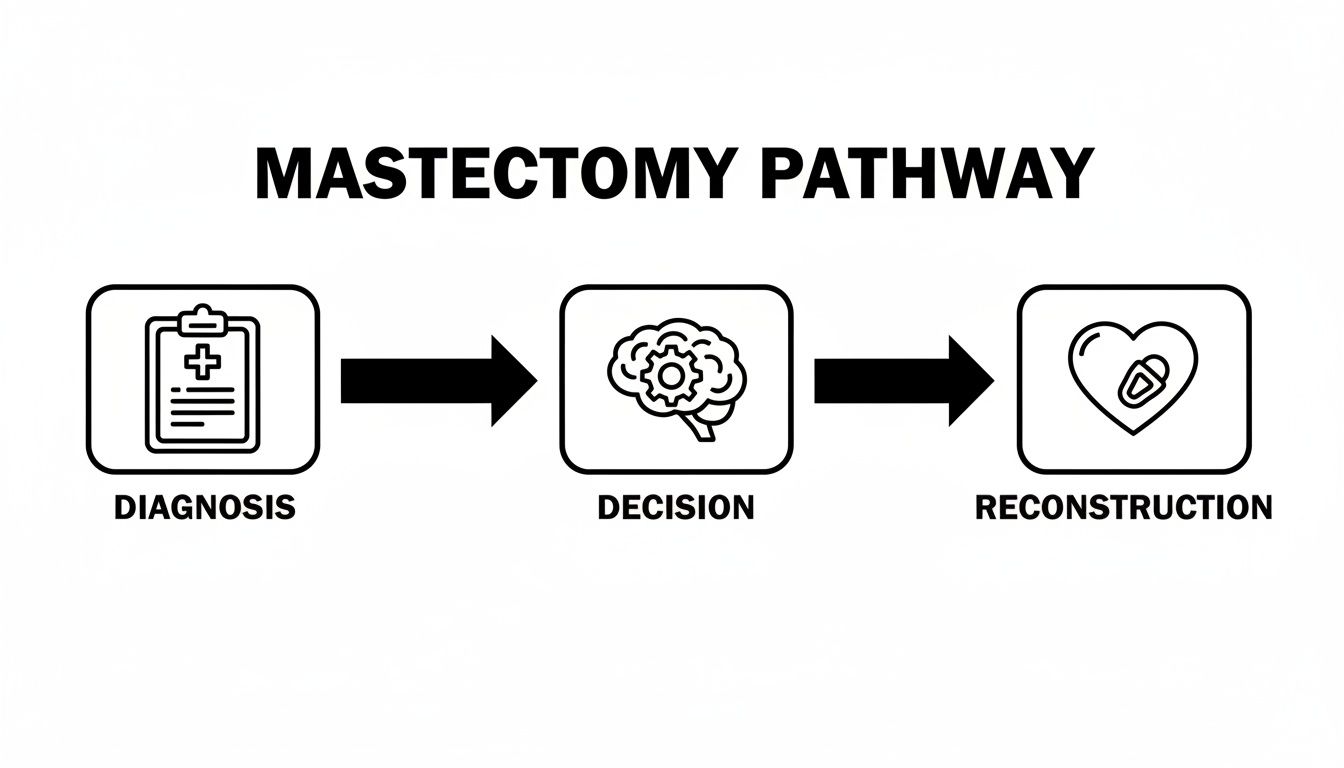
As you can see, reconstruction isn't an afterthought. It’s a deliberate step that you and your care team will plan for, right alongside your cancer treatment.
Implant-Based Reconstruction Explained
This is, by far, the most common type of breast reconstruction performed today. The goal here is to create a new breast mound using a saline or silicone gel implant. Most of the time, this happens in two stages.
First, during the mastectomy surgery, a device called a tissue expander is placed under the chest muscle. Think of it as a small, empty balloon. Over the next few weeks and months, we gradually inject salt water (saline) into the expander through a tiny port. This gently stretches the skin and muscle, creating a pocket that’s perfectly sized for the final implant.
The second surgery is much less involved. We simply remove the tissue expander and replace it with the permanent breast implant, finalizing the shape and feel of your new breast.
This two-step process allows your body to recover from the mastectomy and prepares the chest for an implant that fits well and looks natural. Sometimes, we can do a "direct-to-implant" reconstruction, placing the final implant at the same time as the mastectomy, but this is only an option in specific cases.
Autologous (Flap) Reconstruction Explained
Autologous reconstruction, or flap surgery, is a more advanced technique where we rebuild the breast using a section of your own skin, fat, and sometimes muscle. We call this section of tissue a "flap." It's most commonly taken from the lower abdomen, but the back, thighs, or buttocks are also options.
There are two main ways we can move this tissue:
- Pedicled Flap: The tissue is tunneled under the skin to the chest while remaining connected to its original blood supply.
- Free Flap: The tissue and its blood vessels are completely detached from the donor area. We then use microsurgery to carefully reconnect those tiny arteries and veins to a new blood supply in the chest.
Flap surgeries are definitely more complex procedures than implants, and the initial recovery is longer. However, the result is a breast made entirely of your own living tissue. This means it will feel softer, warm to the touch, and will even change size with you if you gain or lose weight—it ages with you, just like the rest of your body.
Of all the breast reconstruction options after mastectomy, implants are currently the most prevalent. In the United States, tissue expander and implant combinations are the leading technique, accounting for 65% of total reconstructions and making up 60.6% of the 137,808 procedures performed in 2020. This popularity is driven by both cosmetic and reconstructive surgeries, with about 88,000 implants used for post-cancer reconstruction annually. You can read more about the market trends in breast reconstruction to understand their widespread use.
Exploring Autologous Flap Reconstruction Procedures
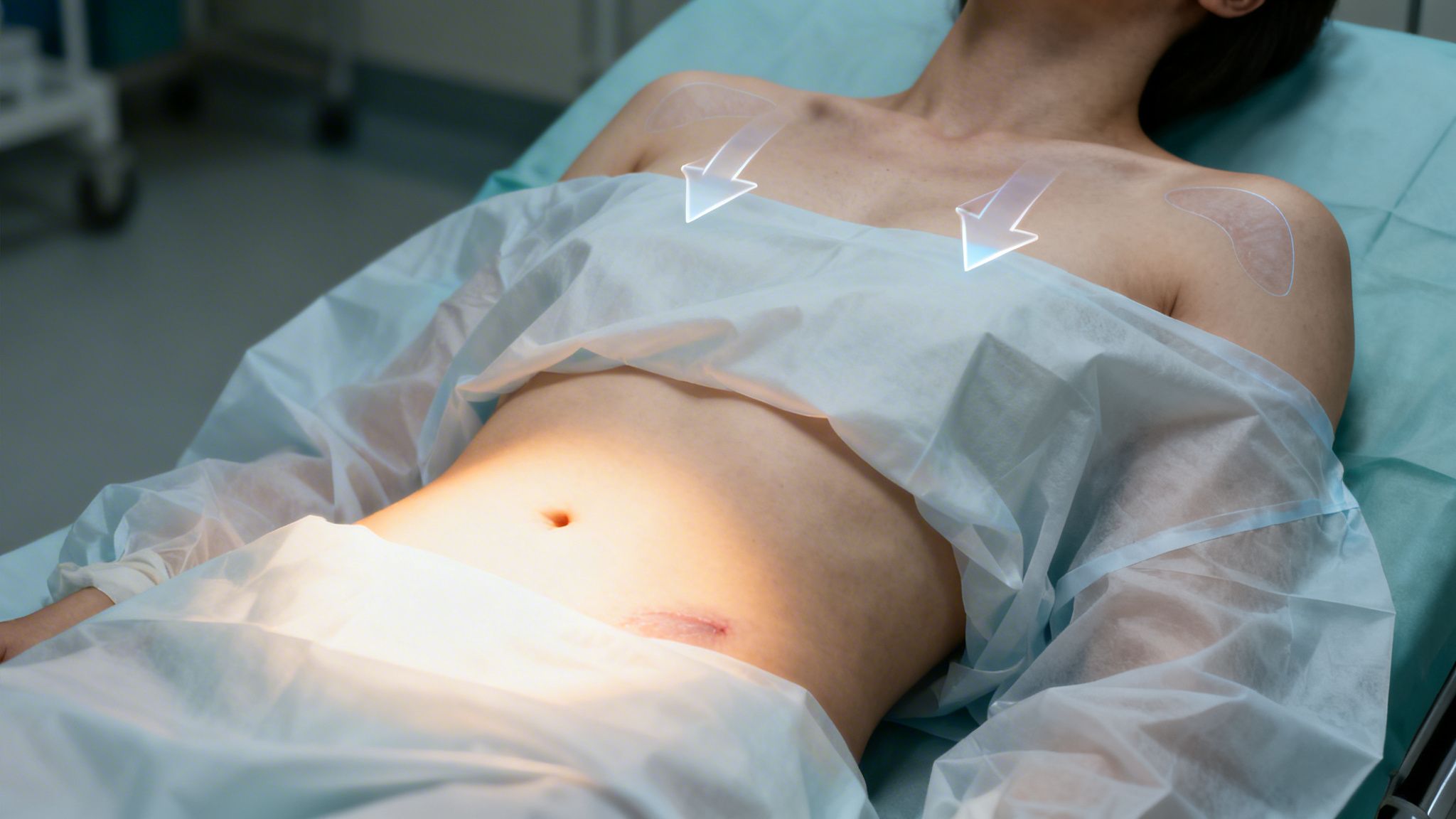
While implants are a fantastic option, many women are drawn to a more natural approach called autologous reconstruction. This technique uses your own living tissue to rebuild the breast—in essence, you become your own tissue donor. We call this flap surgery. A plastic surgeon will carefully move a "flap" of skin, fat, and its blood supply from one area of your body to your chest.
The result is a new breast mound that feels warm, soft, and completely natural. And because it's your tissue, it will fluctuate with you, gaining or losing weight just like the rest of your body. This is a powerful reason why so many women consider these more involved procedures.
The Art of Microsurgery in Flap Procedures
The most advanced flap surgeries today are free flaps, and they hinge on an incredible skill: microsurgery. Think of it like moving a delicate plant from one part of your garden to another. It's not enough to just dig up the plant (the tissue flap); you have to painstakingly reconnect its tiny roots (the blood vessels) to a new water source so it can thrive.
Using a high-powered microscope, your surgeon will detach the flap along with its tiny artery and vein. They then reattach these hair-thin vessels to a new blood supply in the chest. It's this delicate, precise work that ensures the transferred tissue stays alive, healthy, and integrated.
Common Types of Abdominal Flaps
For many women, the most popular donor site is the lower abdomen. This is often a welcome two-for-one, as the procedure combines breast reconstruction with the cosmetic perks of a tummy tuck.
DIEP Flap (Deep Inferior Epigastric Perforator Flap): This is widely considered the gold standard in autologous reconstruction. Your surgeon takes only skin and fat from the lower belly, meticulously working around and preserving the underlying rectus abdominis muscle (your "six-pack"). Because it's a muscle-sparing procedure, recovery tends to be faster and core strength is better protected.
TRAM Flap (Transverse Rectus Abdominis Myocutaneous Flap): An older but still very effective technique, the TRAM flap takes skin, fat, and a portion of the rectus abdominis muscle. It can be performed as a "pedicled" flap (where the tissue is tunneled under the skin) or a "free" flap. Since muscle is involved, there is a higher risk of abdominal weakness or hernias down the road.
Key Takeaway: The main difference between a DIEP and TRAM flap is muscle preservation. A DIEP flap is a muscle-sparing procedure, which is a major advantage for maintaining long-term abdominal strength and a smoother recovery.
Other Donor Site Options
What happens if you don't have enough extra tissue on your abdomen? Not a problem. Your surgeon has several other excellent options, each using a different part of the body to create your new breast.
Latissimus Dorsi Flap
This procedure borrows a section of skin, fat, and muscle from your upper back, right below the shoulder blade. It's usually done as a "pedicled" flap, where the tissue is simply tunneled to the chest while remaining connected to its original blood supply.
The latissimus flap itself is often quite thin, so it’s frequently paired with a small breast implant to achieve the desired size and projection. This makes it a hybrid approach, giving you the natural feel of your own tissue with the volume of an implant. The scar is usually easy to hide along your bra line on your back.
Exploring Other Flap Techniques
If the abdomen and back aren't suitable, surgeons can source tissue from other areas. These are less common, but they are incredibly valuable breast reconstruction options after mastectomy for the right person.
GAP Flap (Gluteal Artery Perforator Flap): This technique uses skin and fat from the buttocks. It can be a superior GAP (from the upper buttock) or an inferior GAP (from the lower buttock, near the crease).
TUG/VUG Flap (Transverse/Vertical Upper Gracilis Flap): This flap sources tissue from the inner thigh, sometimes including the thin gracilis muscle. The resulting scar is typically well-hidden in the groin crease.
Choosing the right flap procedure is a very personal decision that starts with a detailed conversation with your surgeon. They will carefully evaluate your body, your medical history, and your goals to recommend the donor site and technique that will give you the best possible outcome. While the surgery is more complex and the recovery is longer than with implants, the truly life-like result is a compelling benefit for many women.
A Closer Look at Implant-Based Reconstruction
When it comes to breast reconstruction after a mastectomy, using implants is the most common road women take. This is a very reliable and well-established method. Compared to using your own body tissue (flap surgery), implant reconstruction is a less complex surgery, which usually means a shorter initial recovery time.
The whole thing is typically done in two separate stages. However, some women might be good candidates for what's called a single-stage, or 'direct-to-implant,' procedure. For most patients, though, the first step is all about creating the perfect foundation for the final implant.
The Standard Two-Stage Process
The most common approach for implant reconstruction involves two surgeries. This gives your body the necessary time to heal and allows us to create the best possible cosmetic outcome.
Stage One: Placing the Tissue Expander
The first surgery happens right after your mastectomy. Once the breast surgeon has removed the breast tissue, the plastic surgeon steps in to place a tissue expander beneath your chest muscle and skin.
You can think of a tissue expander as a temporary, empty implant—like a small, deflated balloon. It has a tiny, built-in port just under the skin that allows your surgeon to gradually fill it over time.
Over the next several weeks and months, you’ll come into the office for regular visits. During these appointments, we'll inject a sterile salt-water solution (saline) into that port. This process slowly and gently stretches the skin and muscle, creating a soft, well-defined pocket that will eventually hold your permanent implant. This gradual expansion is key to getting a natural shape and avoiding a tight feeling.
Stage Two: The Exchange Surgery
After a few months, once the tissue pocket is the right size and your body has healed, you'll come in for a second, much simpler outpatient surgery. In this procedure, the tissue expander is removed and replaced with the permanent breast implant you’ve chosen. This is also our chance to make any final adjustments to improve symmetry and overall shape.
Comparing Implant-Based vs. Autologous Reconstruction
Making this decision can feel overwhelming, so let's break down the key differences between using implants and using your own tissue. This table gives you a quick, side-by-side look to help clarify things.
| Factor | Implant-Based Reconstruction | Autologous (Flap) Reconstruction |
|---|---|---|
| Surgery Time | Shorter, less complex initial surgery. | Longer, more complex surgery. |
| Recovery | Faster initial recovery from the first stage. | Longer initial recovery period. |
| Number of Surgeries | Typically two stages; may require future surgeries. | Often one major surgery, but revisions are common. |
| Scars | Scars are limited to the breast area. | Scars on the breast and at the donor site (e.g., abdomen). |
| Feel & Appearance | Can feel less natural; potential for rippling. | Feels and ages more like natural breast tissue. |
| Long-Term Upkeep | Implants are not lifetime devices; may need replacement. | Results are generally permanent; no implant maintenance. |
| Ideal Candidate | Good for women who want a quicker recovery or lack donor tissue. | Best for women seeking a more natural result who have adequate donor tissue. |
Ultimately, there's no single "best" option—only what's best for you. We'll discuss your anatomy, lifestyle, and aesthetic goals in-depth during your consultation to find the right path.
Modern Techniques in Implant Reconstruction
Surgical techniques are always getting better, and implant reconstruction is no different. We now have more advanced tools to create a breast mound that looks and feels more natural.
A major step forward is the use of Acellular Dermal Matrix (ADM). This is a special surgical mesh, almost like a scaffold or an internal bra that helps support and position the implant.
Using an ADM can:
- Create a more natural-looking slope and contour.
- Add an extra layer of tissue coverage over the implant.
- Help prevent the implant from rippling or moving out of place.
Another modern option is direct-to-implant reconstruction. With this single-stage procedure, we place the final, permanent implant at the same time as the mastectomy, completely skipping the tissue expander. This is a great choice, but only for a select group of patients—usually those with smaller breasts and good skin quality who won't need radiation therapy.
Choosing Your Implant: Saline vs. Silicone
When it's time for your second surgery, you'll need to decide on the type of permanent implant. The two main choices are saline and silicone, and each has a different feel.
- Saline Implants: These have a silicone outer shell but are filled with sterile salt water after they're placed. They often feel a bit firmer.
- Silicone Implants: These come pre-filled with a silicone gel that very closely mimics the feel of natural breast tissue.
Your surgeon will walk you through the pros and cons of each. For a more detailed breakdown, have a look at our guide on saline vs. silicone breast implants.
The need for these procedures is clear. The global market for breast reconstruction, valued at USD 1.77 billion in 2025, is expected to climb to USD 2.67 billion by 2030. Post-mastectomy reconstruction accounts for a huge 68.85% of this market, showing just how vital this surgery is for women as they recover and regain their sense of self. You can discover more insights about the growing breast reconstruction market and what's driving it.
Deciding on the Timing of Your Surgery
Beyond choosing how to rebuild your breast, one of the biggest decisions you'll make is when to have the surgery. This isn't just a scheduling question—the timing of your reconstruction has real-world effects on your cancer treatment, your recovery, and your emotional path forward.
Essentially, you have two main timelines for breast reconstruction options after mastectomy: doing it right away (immediate) or waiting until later (delayed).
The right choice comes down to your specific cancer treatment plan, your overall health, and simply when you feel ready. There’s no single answer that fits everyone, and both paths have their own set of pros and cons.
The Immediate Reconstruction Option
Immediate reconstruction means your plastic surgeon starts rebuilding your breast during the very same operation as your mastectomy. For many women, this is a powerful and positive option.
One of the most significant psychological benefits is waking up from surgery with a breast mound already there. This can profoundly ease the sense of loss that comes with a mastectomy.
This approach also combines surgical steps. This can mean fewer total surgeries and often leads to better cosmetic results, since the surgeon has the best chance to preserve your natural skin. A major analysis of over 1.5 million mastectomy patients showed that 32.7% opted for immediate reconstruction. You can read the research on breast reconstruction rates to see the full findings on this trend.
However, immediate reconstruction isn’t the best path for every patient.
If your treatment plan includes radiation after your mastectomy, your surgeon will likely advise against placing a final implant right away. Radiation can damage the skin and tissue, which significantly increases the risk of complications like hard scarring (capsular contracture), implant failure, or a result that just doesn't look or feel right.
The Delayed Reconstruction Option
Delayed reconstruction is exactly what it sounds like—the procedure happens months, or even years, after your mastectomy and after your cancer treatments are finished. This timeline gives you the space to focus on one thing at a time: first your cancer, then your reconstruction.
Choosing to wait can be a very wise decision for several reasons:
- Focus on Healing: It allows your body to fully recover from the mastectomy and any other therapies like chemo or radiation, without the added physical stress of another surgery.
- Time for Decision-Making: You have more time to breathe and carefully think through all your breast reconstruction options after mastectomy without feeling rushed into a choice.
- Better Results After Radiation: If you need radiation, waiting is key. It lets your skin heal and settle, which leads to much better and more predictable reconstructive results when you are finally ready.
The main downside for some women is living with a flat chest during that in-between period, which can be an emotional challenge. However, this approach puts you in complete control over when you choose to move forward. Your emotional and physical readiness are what matter most.
No matter which timeline you're leaning toward, it's vital to know how it will be covered. You can check out our guide on breast reconstruction insurance coverage for more detailed information. This decision is deeply personal, and the best timing is whatever is right for your health and your life.
Partnering With Your Surgeon to Make the Right Choice
Learning about breast reconstruction after a mastectomy can feel like a crash course in a subject you never wanted to study. You’ve now learned the key differences between implants and using your own tissue (autologous flaps), the timing of surgery, and what to expect from each path. The final step is taking all that information and creating a plan that’s right for you. That process starts with the most important conversation you’ll have—the one with your plastic surgeon.
There is no single "best" choice written in a medical textbook. The right answer comes from an open, honest discussion that takes into account your body, your lifestyle, and what you hope to achieve. Medical factors like your radiation history, overall health, and available donor tissue are part of the equation. But just as crucial are your personal feelings about how you want to look and feel for years to come.
Preparing for Your Consultation
Think of your consultation as more than just an appointment; it's a partnership. This is where you and your surgeon work together to design a surgical plan. To get the most out of this meeting, it pays to come prepared.
The goal is to find a board-certified plastic surgeon with deep experience in post-mastectomy reconstruction and build a relationship based on trust. This collaboration is the key to a result that doesn’t just restore your body, but also helps bring back your confidence and sense of self.
To help you get started, we've put together a list of essential questions. Don't hesitate to print this out and bring it with you. Take notes. This is your time to get the clarity you need.
Essential Questions to Ask Your Surgeon
Your time with the surgeon is valuable. Having questions ready helps ensure you cover everything you need to know to make a confident decision.
Questions About Experience and Recommendations:
- Based on my specific medical history, body type, and cancer treatment, which type of reconstruction do you think will give me the best result and why?
- How many of these procedures (like a DIEP flap or direct-to-implant) do you perform a year?
- Can I see before-and-after photos of your patients who have a similar body and had the surgery you're recommending for me?
Questions About the Procedure and Recovery:
- What does the recovery timeline really look like? When can I realistically expect to get back to work and my normal life?
- What are the most common risks or complications you see with this specific surgery?
- How will my pain be managed right after surgery? The initial recovery from mastectomy can take 2-4 weeks, so having a clear pain management plan is crucial.
- Will I need physical therapy to get my full range of motion back?
Questions About Long-Term Outcomes:
- What can I expect the scars to look like on my breast and on the donor site (if we're using my own tissue)?
- How will the reconstructed breast change or age over time, especially compared to my other breast?
- If I go with implants, what does long-term care look like? Will they need to be monitored or eventually replaced?
Having this open dialogue is what empowers you to move forward. It allows you to make a choice for your body and your future with confidence.
Frequently Asked Questions About Reconstruction
It’s completely natural to have a lot of questions as you think about breast reconstruction after a mastectomy. This is an incredibly personal journey, and our goal is to give you the clear, honest information you need to make decisions that feel right for you. Here are some of the questions we hear most often from our patients.
Will My Reconstructed Breast Have Feeling?
This is a huge quality-of-life question, and the honest answer is: it depends. The first thing to understand is that during the mastectomy itself, nerve endings are cut. This means the skin on your chest area will be numb right after surgery, regardless of your reconstruction choice.
From there, the potential for returning sensation really comes down to the type of reconstruction you have.
Implant Reconstruction: An implant is an object, so the breast mound itself won't have any nerve connections or feeling. Over time, some sensation might return to the overlying skin, but it's often limited.
Flap Reconstruction: Because these procedures use your own living tissue, there's a much better chance for sensation to return over the months and years following surgery. Some advanced microsurgical techniques even allow us to reconnect nerves from the flap to your chest, which can potentially restore a significant amount of feeling. This isn't a guarantee, but it offers a possibility that isn't available with implants.
What Is Recovery Really Like?
The recovery process looks very different for implant-based surgery versus autologous flap surgery. As a general rule, the more complex the operation, the more involved the initial recovery will be.
With implant reconstruction, the recovery is typically faster. Most patients are back to light, daily activities within a couple of weeks. You’ll have restrictions on exercise and heavy lifting for about four to six weeks. For the first week or two, managing the surgical drains is a key part of the early healing process.
With flap surgeries, you're healing in two places: your chest and the donor site (usually your abdomen). This makes the initial recovery more demanding. A hospital stay of a few days is standard, and it will likely take six to eight weeks before you feel ready to get back to all of your normal activities.
What About Nipple and Areola Reconstruction?
For many women, having a nipple and areola created is the finishing touch that helps the reconstructed breast feel whole and complete. This is usually a minor outpatient procedure done several months after your main surgery, once the breast mound has healed and settled into its final position.
We can use a small amount of your own skin from the reconstructed breast to build a new, projected nipple. Then, for the areola, 3D medical tattooing has become a true art form. A skilled tattoo artist can create an incredibly realistic appearance with custom color, shading, and detail.
Is It Okay to Not Reconstruct?
Absolutely. Choosing not to have reconstruction surgery is a perfectly valid and empowering decision. This is often called "going flat." There is no medical requirement to reconstruct your breasts—this is 100% your choice, about your body.
The most important thing is that you feel confident and comfortable. The right decision is the one that best suits your personal goals, your lifestyle, and your sense of self.
Your journey, your body, and your goals are unique. At Michael A. Bain, MD, we're here to provide compassionate, one-on-one care to help you explore every option with confidence. Schedule your personal consultation today to discuss the best path forward for you.