

When you're considering breast reconstruction, one of the first and biggest questions is always about the cost. It's a topic that can feel just as daunting as the surgery itself. The total cost of breast reconstruction isn't a single flat fee; it's a combination of several essential services. Generally, you can expect implant-based procedures to range from $15,000 to $35,000 per breast, while the more intricate autologous flap reconstructions can fall between $40,000 and $70,000 or more.
Your Guide to Understanding Breast Reconstruction Costs

Talking about the financial side of your surgery shouldn't be confusing. This guide is here to break it all down, giving you clarity and confidence. It helps to think of it like building a custom home; the final price isn't just one number. It’s a detailed breakdown of costs for the architect, the premium materials, the skilled crew, and the state-of-the-art workshop needed to get the job done right.
In the same way, the total price for your reconstruction includes several different professional fees and medical costs. Every single one is critical for ensuring your procedure is safe, successful, and gives you a result you can feel good about. By understanding what goes into the total, you'll be much better prepared for your consultation and financial planning.
What Goes Into the Total Cost
The comprehensive quote you'll receive is actually a summary of multiple fees. While every patient’s surgical plan is tailored to them, the main cost drivers are consistent:
- The Surgeon’s Fee: This covers the experience, detailed planning, and surgical skill of your board-certified plastic surgeon.
- The Anesthesia Fee: This is for the anesthesiologist’s services, ensuring you are safe and comfortable throughout the entire surgery.
- The Facility Fee: This fee covers the use of the operating room, the dedicated nursing staff, and all the sterile surgical equipment.
- Material Costs: This is the price of the breast implants or tissue expanders if they are part of your reconstruction plan.
It's crucial to remember that breast reconstruction is a medical necessity, not a cosmetic choice. The Women's Health and Cancer Rights Act (WHCRA) of 1998 is a federal law that requires most group insurance plans that cover mastectomies to also cover all stages of breast reconstruction.
Estimated Breast Reconstruction Cost Components
The two primary methods for reconstruction—using implants versus using your own tissue (autologous)—have very different demands on time and resources, which you’ll see reflected in the cost. Autologous procedures, such as a DIEP flap, are far more complex and take much longer, requiring specialized microsurgical skills. That's why they tend to have a higher price tag.
To give you a clearer picture, here is a breakdown of what to expect for each type of procedure. Remember, these are estimates, and your final cost will depend on your specific surgical plan, where you live, and the details of your insurance coverage.
| Cost Component | Implant-Based Reconstruction (Est. Range) | Autologous (Flap) Reconstruction (Est. Range) |
|---|---|---|
| Surgeon's Fee | $7,000 – $15,000 | $20,000 – $40,000+ |
| Anesthesia Fee | $2,000 – $5,000 | $5,000 – $10,000+ |
| Facility Fee | $4,000 – $10,000 | $10,000 – $20,000+ |
| Implants/Expanders | $2,000 – $5,000 | N/A |
| Total Per Breast (Est.) | $15,000 – $35,000 | $40,000 – $70,000+ |
In the following sections, we’ll dive deeper into each of these components so you have all the information you need to move forward with your reconstruction journey.
Decoding Your Surgical Quote Line By Line

When you receive a surgical quote, it can look a lot like a foreign language. Seeing all the line items and medical terminology at once can feel overwhelming, but each one of those charges covers a critical part of your procedure, ensuring your safety and a successful outcome.
Think of it like getting a detailed estimate for a custom home. Your surgical quote is simply an itemized list of all the experts, materials, and specialized environments needed to do the job right. Let's break down what each of these items actually means.
The Surgeon's Fee
The first and typically largest number you’ll see is the surgeon's fee. This isn't just for the time your surgeon spends in the operating room. It’s a comprehensive fee that reflects years of specialized training, board certification, and the specific complexity of the technique you’ve chosen.
This fee covers all the meticulous pre-operative planning, the actual performance of the surgery, and all the essential follow-up appointments required to monitor your healing process. A more intricate procedure like a DIEP flap, which requires advanced microsurgical skill, will understandably carry a higher surgeon’s fee than a more direct implant-based reconstruction.
The Anesthesia Fee
The anesthesia fee covers the cost of a board-certified anesthesiologist and their team. Their only job during your surgery is to focus entirely on your safety and comfort.
This fee includes the pre-operative consultation where they create an anesthesia plan just for you, the administration and constant monitoring of your anesthesia during the procedure, and managing your vitals as you wake up in the immediate post-op period. The cost is usually based on time—longer, more complex surgeries require more anesthesia time and therefore a higher fee.
The Facility Fee
The facility fee is what you pay for the use of the operating room and all its resources, whether it’s in a hospital or an accredited outpatient surgery center. This is a significant charge because it covers everything needed to maintain a sterile, safe, and efficient surgical environment.
This all-inclusive fee pays for the state-of-the-art operating room itself, the highly trained nursing and technical staff, sterile surgical instruments, and all the supplies used during your procedure.
Essentially, this fee guarantees that the highest standards of safety and care are met from the moment you arrive until you leave.
Other Important Line Items
Beyond those three main charges, your quote will likely have a few other line items for the specific "materials" used in your reconstruction.
- Implants or Tissue Expanders: For implant-based reconstruction, this is the direct cost of the devices themselves.
- Pathology Fees: Any tissue removed during surgery is often sent to a laboratory for analysis by a pathologist, and this fee covers that service.
- Post-Surgical Garments: The cost for specialized compression bras or binders needed for your recovery might be listed here.
Finally, when reviewing your quote and insurance information, a critical number to identify is your maximum out-of-pocket limit. This is the absolute most you will have to pay for covered services in your plan year, and knowing it helps you accurately forecast your total financial responsibility.
How Insurance Shapes Your Financial Journey
When it comes to the cost of breast reconstruction, your insurance plan is the single most powerful factor. Understanding its role isn't just a good idea—it's absolutely essential for moving forward with confidence. The total price for surgery can seem overwhelming, but the good news is your insurance plan is set up to cover the vast majority of these medically necessary costs.
This isn't just a courtesy; it's the law. A landmark piece of federal legislation, the Women's Health and Cancer Rights Act (WHCRA) of 1998, requires group health plans and individual plans that cover mastectomies to also provide coverage for all stages of breast reconstruction.
However, it's crucial to understand that "coverage" doesn't mean "free." The law makes sure your insurance company helps pay, but your personal financial responsibility—what you actually pay from your own pocket—is determined entirely by the specifics of your individual plan.
Understanding Your Insurance Plan
Your financial journey will be defined by a few key terms. Getting comfortable with this language will empower you to become your own best advocate and help you avoid any surprises down the road.
- Deductible: This is the fixed amount you must pay out-of-pocket for your healthcare before your insurance plan begins to pay its share.
- Co-insurance: Once you've met your deductible, you and your insurance company share the cost of care. For example, a common split is you paying 20% while your plan covers the remaining 80%.
- Out-of-Pocket Maximum: This is the absolute most you will have to pay for covered services in a single plan year. After you hit this cap, your insurance plan pays 100% of all covered costs.
The type of insurance you have also makes a big difference in both your access to care and your financial experience. While these cost-sharing principles apply across the board, you can learn more about insurance coverage for related procedures to see how these concepts are applied in other situations.
The Impact of Insurance Type on Reconstruction Rates
The differences between insurance plans aren't just theoretical; they have a real-world impact. A compelling study from North Carolina that looked at 5,381 women found that 56% of those with private insurance went on to have breast reconstruction.
In stark contrast, only 10% of women on Medicare and 11% of those on Medicaid had the procedure. Even after adjusting for other factors, the data was clear: Medicaid patients had a 76% lower chance of receiving reconstruction than women with private insurance. You can read more about these reconstruction disparities on ascopost.com.
This data highlights a critical reality: the type of insurance plan a patient has can dramatically influence their ability to access reconstructive care, making it vital to understand your specific benefits.
In-Network vs. Out-of-Network Surgeons
One of the most important parts of your insurance plan is the "network" status of your surgeon. An in-network provider has a contract with your insurance company and has agreed to accept a pre-negotiated rate for their services. This almost always results in much lower out-of-pocket costs for you.
An out-of-network provider, on the other hand, does not have this contract. While your plan might still offer some level of coverage, it will be at a significantly lower rate, leaving you responsible for a much larger part of the final bill. The difference between in-network and out-of-network costs can easily be thousands of dollars.
We know this process can feel complex, and that’s why our dedicated patient care team is here to help you through it. We work directly with your insurance provider to verify your benefits, help you understand your financial responsibility, and secure all the necessary pre-authorizations for your surgery. Our goal is to make sure you get every benefit you're entitled to and that your financial path is as clear and predictable as possible.
Comparing The Costs Of Implant And Flap Reconstruction
When it comes to breast reconstruction, one of the biggest decisions you'll make is which surgical path to take. The two main routes—implant-based reconstruction and autologous flap reconstruction—come with very different price tags, both upfront and over the long haul. Getting a clear picture of these differences is crucial for making a choice that feels right for you physically, emotionally, and financially.
Implant-based surgery almost always looks like the more affordable option at first glance. The operation itself is shorter and less complex, which means the initial bills for the surgeon, anesthesia, and facility are lower. It’s a bit like leasing a car; the down payment is smaller, making it easier to get started.
But just like a lease, there can be long-term costs. Breast implants aren't lifetime devices. Down the road, you may need revision surgery or a full replacement, which is a form of long-term "maintenance" you have to factor in.
The Lifetime Cost Of Autologous Reconstruction
On the other hand, autologous reconstruction, like a DIEP flap, is more like buying a high-end, durable car outright. The initial investment is much higher. Why? Because it’s a significantly longer and more intricate procedure that demands specialized microsurgical skills to move your own tissue and painstakingly reconnect all the tiny blood vessels.
The major benefit here is that this method uses your body's own living tissue to build the new breast. Once healed, it becomes a permanent, natural part of you. This often means you can avoid future surgeries related to implant issues, which can make the higher upfront cost more economical over a lifetime.
Of course, surgery isn't the only path forward. It's always good to be aware of all your choices, including non-surgical ones like exploring prosthetic options.
Why Prices Vary So Dramatically
It's not just the surgical technique that determines the final cost—where you have the surgery is a huge factor. A massive analysis of commercial insurance rates across nearly 1,000 hospitals found that prices for the exact same reconstruction procedures could vary by as much as 18 times between facilities.
The research showed that in markets with less hospital competition, facilities could charge over $4,000 more on average for the same surgery. This is a powerful reminder to do your homework on facilities, not just surgeons.
This chart really drives home how much insurance coverage can influence a patient's journey, which is a core part of any cost conversation.
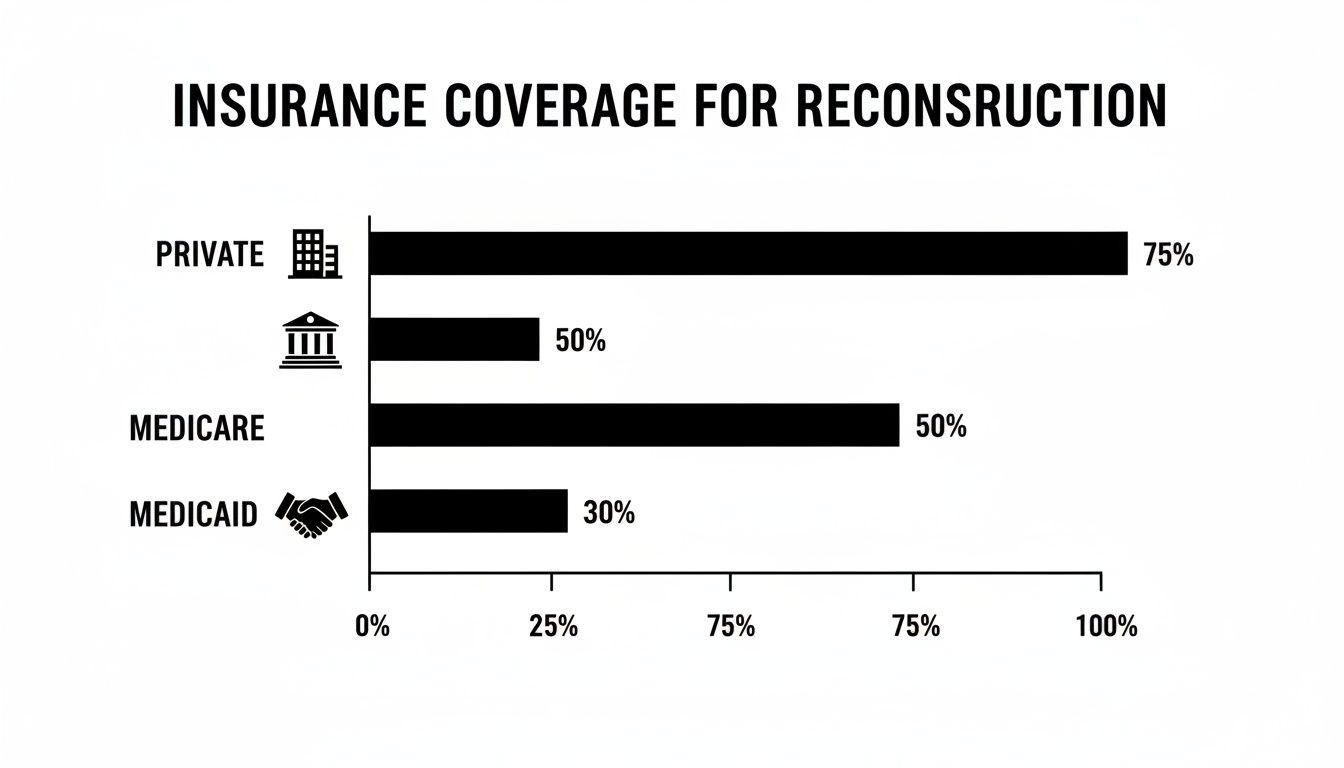
As you can see, patients with private insurance have much higher rates of reconstruction compared to those on public plans like Medicare and Medicaid. This highlights the financial hurdles many women face.
Financial & Clinical Comparison
To give you a clearer side-by-side view, let’s break down the key differences between the two main approaches. We've put together a table to help you weigh the pros and cons of each.
Keep in mind, we can also use techniques like fat transfer to fine-tune the final shape and add volume. You can read more about how fat transfer works in our detailed guide on the topic.
Financial & Clinical Comparison: Implant vs. Flap Reconstruction
| Factor | Implant-Based Reconstruction | Autologous (Flap) Reconstruction |
|---|---|---|
| Upfront Cost | Lower | Higher |
| Long-Term Costs | Potential for revisions, replacements | Minimal to none |
| Surgical Complexity | Lower | Very high (microsurgery) |
| Recovery Time | Shorter | Longer, more intensive |
| Longevity | Not permanent, may require future surgery | Permanent, uses living tissue |
| Look & Feel | Can look and feel less natural | Most natural look and feel |
Ultimately, there is no single "best" answer here—only the one that is best for you. This decision should come from a thoughtful conversation with your surgeon, where you can openly discuss your goals and balance the immediate costs against the long-term physical and financial realities of each procedure.
Planning for Additional Procedures and Hidden Costs
Breast reconstruction isn't a single event; it's a journey that often involves multiple stages. The initial surgery is just the beginning. To get a realistic sense of the total cost, we need to look at the follow-up procedures that create symmetry and the "hidden" expenses that pop up during recovery.
Many patients are surprised that procedures on the other, non-reconstructed breast are considered medically necessary. This isn't just for cosmetic reasons—it’s about restoring physical balance. Thankfully, federal law agrees, which makes insurance coverage for these critical finishing steps possible.
Creating Balance with Symmetry Procedures
The Women's Health and Cancer Rights Act (WHCRA), passed back in 1998, was a true turning point for patients. It legally requires insurance plans that cover mastectomies to also cover all stages of breast reconstruction. This includes any procedures needed on the opposite breast to create a symmetrical result.
This law made a huge difference in access to care. In fact, immediate reconstruction rates nearly doubled from 20.8% in 1998 to 37.8% by 2008. You can read more about these important findings on reconstruction access at pmc.ncbi.nlm.nih.gov.
So, if you have reconstruction on one side, your insurance is also required to cover work on the other breast to match it. This might involve a:
- Breast Lift (Mastopexy): To raise the natural breast so it sits at the same height as the new one.
- Breast Reduction: To make the natural breast smaller for better balance.
- Breast Augmentation: To use an implant to increase the size of the natural breast.
These secondary procedures aren’t considered cosmetic. They are an essential part of the reconstructive process, helping to create the most natural and balanced outcome possible.
The Finishing Touches: Nipple and Areola Reconstruction
The very last surgical step for most patients is reconstructing the nipple and areola. We typically do this a few months after the main breast mound has healed and settled into its final position. It’s a highly artistic procedure that really restores a sense of normalcy and completion for many women.
This is almost always a minor procedure done in an outpatient setting or even right here in the office with just local anesthesia. Since the WHCRA mandates coverage for "all stages of reconstruction," this final, important step is covered by insurance. The cost is much lower than the primary surgery, but it's still a piece of the overall financial puzzle.
Accounting for Hidden Recovery Costs
The costs don't stop when you leave the operating room. It's smart to plan ahead for some of the other expenses that are part of the recovery process. These can include:
- Prescription Medications: You’ll need pain relievers and antibiotics, which usually come with co-pays.
- Specialized Garments: For several weeks, you will need to wear specific compression bras or binders to help with swelling and support the healing tissues.
- Physical Therapy: Some patients need help from a physical therapist to get their full range of motion back in their arm and shoulder.
- Time Off Work: Recovering from reconstruction means taking time away from your job. Depending on your benefits, this can have a real financial impact.
Knowing about these costs ahead of time makes the whole process less stressful. If you’re worried about managing any out-of-pocket expenses, our team is here to walk you through the different possibilities. You can start by reviewing our guide on financing options available at our practice.
Common Questions About Breast Reconstruction Costs
Trying to make sense of the financial side of breast reconstruction can feel like a whole separate journey. Once you start looking at the individual costs, a new set of questions almost always comes up about insurance, future surgeries, and other details. We've put together this guide to give you clear, direct answers to the questions we hear most often from our patients here in Orange County.
Knowing what to expect helps you walk into your consultations feeling prepared and confident. This is about giving you the practical information you need to plan for your care.
Is Nipple Reconstruction Covered By Insurance?
Yes, in almost every case, nipple and areola reconstruction is a covered procedure. It’s not seen as an optional or cosmetic extra, but as a key part of completing the entire reconstructive process. The federal Women's Health and Cancer Rights Act (WHCRA) mandates that if an insurance plan covers mastectomies, it must also cover all stages of reconstruction that follow.
This final step is what helps bring back a natural and complete look to the breast. The procedure is usually done a few months after the main breast mound has been created, which gives the tissues time to heal and settle into their final shape and position.
In many cases, nipple reconstruction is a minor procedure that can be done right in the office with local anesthesia or in an outpatient surgery center. While the cost is much lower than the initial surgery, its coverage under WHCRA means patients don’t have to worry about a surprise financial hurdle to get these important finishing touches.
What if My Insurance Company Denies My Procedure?
Getting a denial for pre-authorization from your insurance company can be incredibly frustrating, but it’s so important to know that this is often just the start of the conversation, not the end of it. A denial is not a final "no," and we can frequently get them overturned.
Many times, a denial is triggered by something simple like a missing form or the insurance company needing more clinical details to confirm the procedure is medically necessary. This is exactly why it is so critical to work with a surgical practice that has deep experience with insurance navigation.
An experienced patient care team will get to work on the appeals process for you right away. This usually involves a few key steps:
- Submitting a Formal Appeal: We write a detailed response that directly tackles the reason your insurance company gave for the denial.
- Providing a Letter of Medical Necessity: Your surgeon will personally write a letter explaining the specific medical reasons why your procedure is essential for your health.
- Sharing Supporting Documentation: We'll gather your clinical notes, imaging results, and any other evidence that makes your case stronger.
- Conducting a Peer-to-Peer Review: If we need to, your surgeon will get on the phone directly with a medical director at the insurance company. This lets us explain the details of your case in a way that just can’t be done on paper.
Remember, an initial denial is a common hurdle, not a roadblock. A dedicated surgical team will be your strongest advocate, working tirelessly to secure the coverage you are entitled to.
Will I Have to Pay for Future Revisions?
This is a very important question when you're looking at the long-term cost of breast reconstruction. The answer usually comes down to why the revision is needed and what type of reconstruction you had. The good news is that the WHCRA requires insurance to cover revisions needed to fix complications or to maintain symmetry between the breasts over time.
For example, if you have implant-based reconstruction and develop a complication like capsular contracture a few years down the road, the surgery to fix it is typically covered. Likewise, if natural aging causes one breast to look different from the other, a procedure to restore that balance is also usually covered.
It’s important to know, however, that coverage will always depend on the specific insurance plan you have at that future time. Policies can and do change. This is a big reason why many patients think carefully about the long-term financial picture. Autologous reconstructions, like a DIEP flap, have a much lower chance of needing future surgeries related to the reconstruction itself, which is a major point to consider when looking at the total lifetime investment.
Are There Financing Options for Out-of-Pocket Expenses?
Yes, absolutely. We know that even with good insurance, out-of-pocket costs from deductibles, co-insurance, and non-covered items can be a real financial burden. Our practice is dedicated to making sure these costs don't prevent you from getting the exceptional care you need.
To help you manage your part of the cost of breast reconstruction, most premier plastic surgery offices in the Newport Beach area offer flexible financing options. We have long-standing partnerships with trusted third-party medical financing companies like CareCredit and Alphaeon.
These services work a lot like a credit card that's just for healthcare costs. They let you break down your upfront, out-of-pocket expenses into a series of predictable monthly payments. Many of these companies offer promotional plans with 0% interest or extended low-interest financing, which makes budgeting for your procedure much more manageable. Our patient care coordinator would be happy to walk you through the simple and confidential application process.
At the practice of Michael A. Bain, MD, we believe that a well-informed patient is an empowered patient. If you are in the Newport Beach or greater Orange County area and have more questions, we invite you to schedule a compassionate and thorough consultation. Dr. Bain and our dedicated team will take the time to answer every question, explain your options in detail, and help you create a plan that aligns with your personal, medical, and financial goals. Visit us online to learn more at https://www.drbain.com.