

That first week is the most hands-on part of your entire facelift recovery timeline. It’s where you’ll see the most dramatic day-to-day changes, moving from initial puffiness to the big milestone of having your sutures removed. Think of this week as laying the groundwork for the incredible, lasting results to come.
Your job is simple: rest. My team and I will handle the rest, providing you with a clear set of instructions to manage your symptoms and let your body do its natural healing work. It can feel like a bit of a journey, but knowing what’s coming each day makes it all feel much more predictable.
Days 1 and 2: The Initial Rest Period
Right after your procedure here in Newport Beach, you’ll feel tired and groggy. That's perfectly normal. Your only priority is to get home and rest with your head elevated on two or three pillows. This simple step uses gravity to your advantage, helping to keep that initial swelling to a minimum.
You’ll have a soft, compressive dressing around your head and neck. This protects the incisions and gives your skin gentle support. Any discomfort you feel is usually handled well with the pain medication I prescribe. It’s absolutely essential to have a friend or family member stay with you for these first 24-48 hours to help with simple tasks so you can focus completely on resting.
Days 3 and 4: Hitting Peak Swelling
This is typically when swelling and bruising will be at their most noticeable. When you look in the mirror, you’ll see a puffy reflection—this is an expected and positive sign that your body is sending all its healing resources to the area. Don’t be discouraged. This is temporary and has no bearing on your final, beautiful outcome.
You should still be prioritizing rest, but now is a good time to start taking short, slow walks around your house. This light movement is great for promoting circulation, which helps speed up healing and reduces the risk of any complications. As you feel more comfortable, you can often switch from prescription pain medication to an over-the-counter option.
To help you visualize the journey, here’s a quick day-by-day summary of what to expect during this first week.
Quick Guide to Your First 7 Days of Facelift Recovery
| Day | Key Symptoms | Care Instructions | Activity Level |
|---|---|---|---|
| 1 | Grogginess, tightness, mild discomfort. | Rest with head elevated on 2-3 pillows. Take prescribed pain medication. | Bed rest. Assistance needed. |
| 2 | Swelling and bruising begin to appear. | Continue head elevation and rest. Stay hydrated. | Minimal activity, very short walks inside the house. |
| 3 | Peak swelling and bruising. | Maintain head elevation. You may be able to switch to Tylenol. | Gentle walking around the house is encouraged. |
| 4 | Swelling begins to slowly subside. | Keep incisions clean and dry per instructions. | Light household activity, continue short walks. |
| 5 | Noticeable decrease in swelling and bruising. | Continue to follow all care instructions. | Feeling more like yourself. Still no strenuous activity. |
| 6 | Tightness remains, but you look and feel much better. | Prepare for your first post-op visit. | Continue light activity. No bending or lifting. |
| 7 | Suture removal day! | Attend your post-op appointment with Dr. Bain. | Major milestone. Many patients feel ready for the next phase. |
This table provides a snapshot, but remember that everyone's healing path is unique.
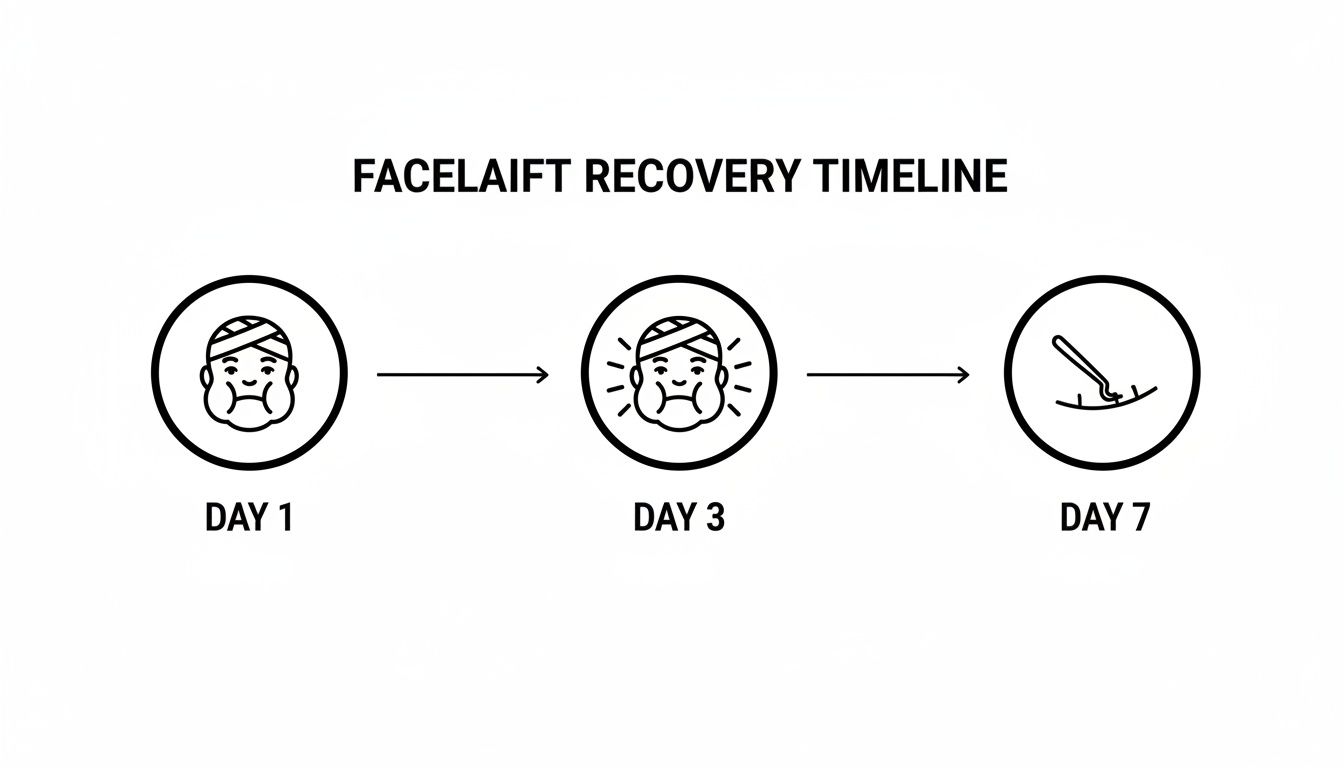
As you can see, the initial phase is short, and you'll be turning a corner before you know it.
Days 5 to 7: Turning a Corner
By day five, you’ll start to see a real difference. The swelling and bruising will have gone down significantly, and you'll begin to notice the first hints of your new, refined jawline and neck. For most of my patients, this is a huge morale boost.
Around day seven, we hit a major milestone: your first post-op appointment. During this visit, I’ll remove your drains and stitches. This is a quick and straightforward process, but it marks the official end of the most intensive recovery phase. By this point, about 50-60% of the visible bruising has typically faded.
You’re now well on your way. For more detailed tips on staying comfortable, you can review our guide on how to manage pain after surgery. The hardest part is over, and the next stage of healing is about to begin.
Weeks 2 to 4: Returning to Daily Life
If the first week of your facelift recovery is all about dedicated rest, this next phase is where you really start to feel like yourself again. Between weeks two and four, the most obvious signs of surgery start to fade quite dramatically. This is when you'll catch the first exciting glimpses of your refreshed, natural-looking results.
Think of this as your transition period. You’re moving away from focused healing and carefully rejoining the rhythm of your daily life. The most significant change you’ll see is a major reduction in swelling and bruising. While some puffiness and a feeling of tightness will stick around for a bit longer, the elegant new contours of your jawline and neck will become more defined each day. It’s an incredibly rewarding part of the journey.
Becoming Socially Presentable
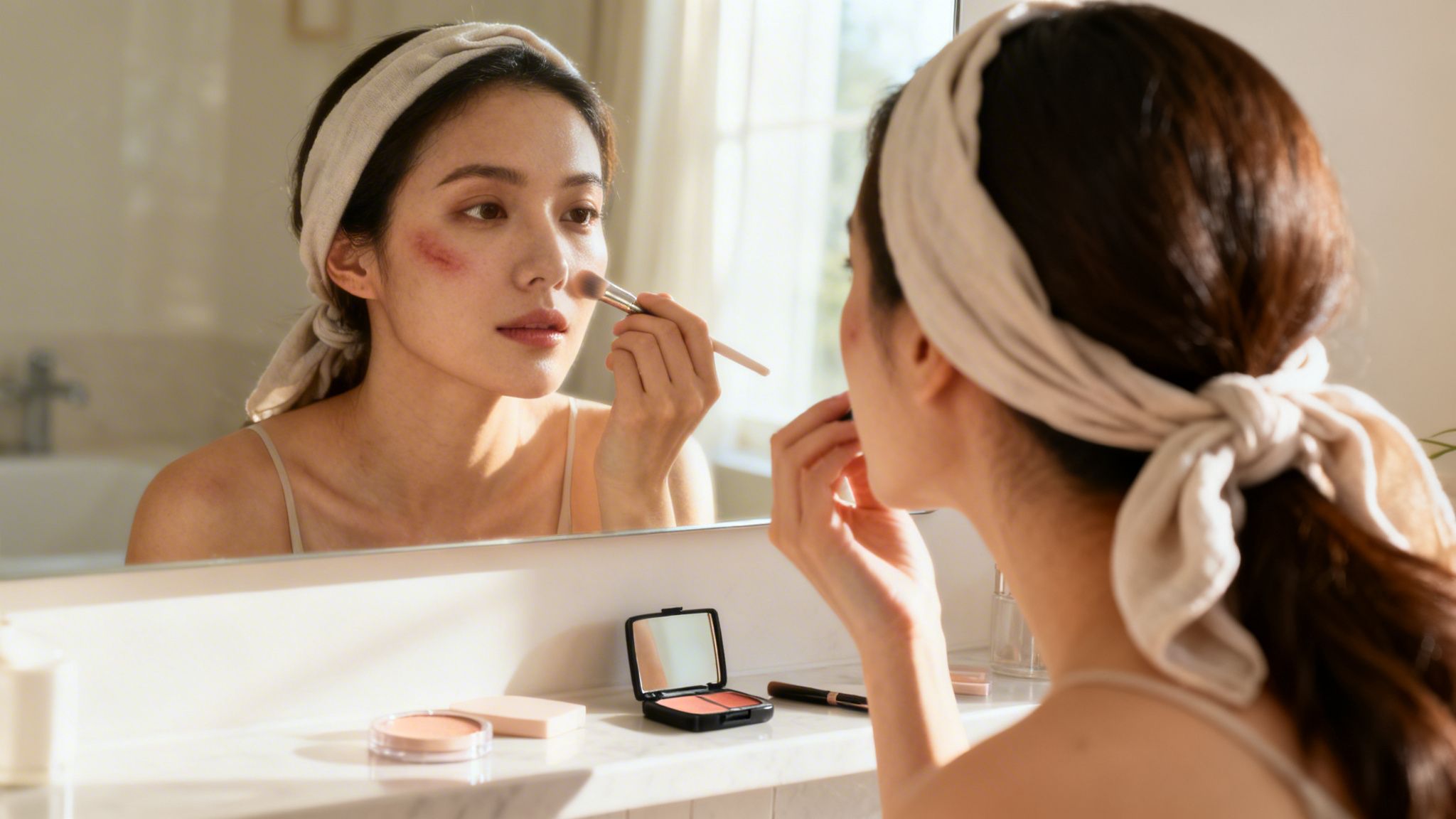
As you move into the second week, you’ll probably notice a big boost in both your energy and your confidence. Many of my patients hit a point where they feel "socially presentable" right around the 10-day to two-week mark. At this stage, any bruising that’s left has often faded from a darker color to a faint yellow or pink hue, which is much easier to cover.
As your surgeon, I'll give you specific guidance, but this is typically when you can start using makeup again. A high-quality, mineral-based concealer can work wonders to camouflage any lingering signs of surgery. This allows you to run errands or meet a friend for lunch without feeling self-conscious.
This is a huge psychological milestone. Getting back to your routine, even in small ways, helps you feel normal again and marks a clear turning point in your recovery.
Returning to Work and Light Activity
When you can return to work really depends on what you do for a living. By the second week, about 70% of patients feel comfortable enough for light social outings, and this often extends to their professional life. The rise in facelift procedures, which grew by 8% nationally in 2023, is partly due to these modern techniques that allow for quicker, more manageable recoveries. For my Orange County patients with desk jobs, getting back to work between days 10 and 14 is a very common and realistic goal.
However, if your job is physically demanding, you'll need to be a bit more patient. Your body is still healing, and certain activities are strictly off-limits to protect your results.
- Avoid Strenuous Exercise: Do not start high-impact cardio, heavy lifting, or any activity that significantly raises your heart rate and blood pressure.
- No Heavy Lifting: This includes groceries, small children, and weights at the gym. Lifting puts a strain on your healing tissues and incisions.
- Listen to Your Body: I always encourage light walks to promote circulation, but you have to pay close attention to any feelings of tightness or discomfort. If you feel it, it’s time to rest.
Properly caring for your incisions is absolutely essential during this stage to ensure they heal into fine, discreet lines. You can check out our detailed instructions in this guide on how to care for incisions after surgery.
Understanding the Emotional Journey
As the initial swelling goes down, you’ll start to see a new you emerging in the mirror. This can be an emotional experience. It’s perfectly normal to feel a mix of excitement and a little bit of impatience as you wait for the last traces of your surgery to disappear.
Remember that feelings of tightness and some intermittent numbness, especially around your ears and jawline, are completely normal. These sensations are positive signs that your nerves are regenerating and healing. By the end of the fourth week, the vast majority of swelling will be gone, and you’ll have a very clear picture of the beautiful, long-lasting results we achieved for you.
Months 1-3: Your Final Results Take Shape
After the first month of healing, you enter what most patients find to be the most exciting part of the recovery process. The majority of the swelling and bruising has faded, and you really start to see the refined, natural-looking results of your surgery.
This is when the underlying work Dr. Bain performed on the deeper tissues becomes visible. The last 10-20% of swelling gradually disappears, allowing the sharp, clean contours of your jawline and neck to fully emerge. It’s a subtle but steady improvement day by day.

The One-Month Milestone
Reaching your first month post-op is a major turning point. At this stage, you’ll have a very clear picture of your outcome, with about 80-90% of the swelling gone. Many of our patients find that this is when friends start to comment on how rested or refreshed they look, without being able to guess that they had surgery.
By week three, most patients are already at a point where any remaining discoloration can be easily covered with light makeup. This is when many of our Newport Beach patients feel comfortable returning to their professional and social lives. You can learn more about the typical recovery stages on yamasakifacialplasticsurgery.com.
Incision Maturation and Sensation Returning
Two other key things happen during this period: your incisions continue to heal, and normal sensation starts coming back to the skin.
Incision Maturation: Dr. Bain strategically places all incisions within the hairline or natural skin creases to ensure they are well-hidden. During months 1 to 3, you will see these lines fade from pink to a much lighter, flatter, and less noticeable state.
Return of Sensation: It is completely normal to have some numbness around the ears and along the jawline after a facelift. This is temporary. As the nerves heal, this numbness is often replaced by tingling or itching—these are good signs that the nerves are "waking up."
The return of sensation is a natural process as the tiny nerve endings regenerate. While it can take up to a year for feeling to be 100% normal everywhere, the most significant progress happens during these months.
Getting Back to Exercise and Protecting Your Results
While you were cleared for light walking early on, this is the phase where Dr. Bain typically allows a return to more strenuous activities. Getting back to your fitness routine is a big step toward feeling completely like yourself again.
A General Timeline for Resuming Exercise:
- Weeks 4-6: You can usually reintroduce moderate cardio, like jogging or using an elliptical. It’s important to avoid any movements that cause strain or a feeling of pressure in your face and neck.
- Weeks 6-8: Depending on your healing, you can often start light weightlifting again. Always start with lower weights than you’re used to and increase gradually.
- By Month 3: Most patients are cleared for all normal activities, including high-impact exercise and strenuous workouts, without restrictions.
Protecting your skin from the sun is non-negotiable from this point forward. Healing incisions are very sensitive to UV light, which can cause them to darken and become permanently more visible. A high-SPF, broad-spectrum sunscreen must become part of your daily routine to protect your investment for years to come.
Long-Term Healing and Enjoying Your Investment
After the first few weeks of active healing, your facelift recovery enters its final and most rewarding phase. This period, from the three-month mark to a full year, is all about the subtle, final maturation of your results. The dramatic weekly changes are behind you, and now it's time to watch the elegant, long-lasting rejuvenation you've been waiting for settle in.
Think of this phase as the final polishing. The heavy lifting is done, and now the last of the deep swelling is resolving, bringing out the ultimate definition in your jawline, cheeks, and neck.
The Final Refinements Settle In
Between months three and six, the last significant changes happen, though they're much more subtle than what you saw in the early weeks. Any residual puffiness, often only noticeable to you, finally melts away. This is when your skin and the underlying tissues completely "settle" into their new, lifted position.
Many of our patients report feeling 80-90% healed by month two or three as this deep swelling disappears. Your cheeks settle into a more youthful contour, and incisions that were faint pink marks begin to fade into fine, pale lines. Techniques like the SMAS or deep plane facelift, which Dr. Bain mastered during his training at UCLA, might have a slightly longer visible recovery, but they pay off with incredibly stable, long-lasting results.
Scar Maturation and a Return to Normal Sensation
A key part of this long-term phase is seeing your scars fully mature. Dr. Bain is meticulous about placing incisions within natural hairlines and skin creases, making them exceptionally hard to spot once they've healed.
- Months 3-6: Your incision lines will continue to soften, flatten, and fade from pink to a pale, skin-toned color.
- Months 6-12: The scars reach their final appearance. They become whisper-thin and very difficult to see, even when you're looking for them.
Once Dr. Bain gives you the go-ahead, you can help this process along. Products like silicone scar patches can hydrate the healing skin and encourage a flatter, less noticeable scar.
At the same time, the last bit of numbness will fade. While most feeling returns within the first few months, it's normal for small, isolated spots—usually around the ears—to take up to a year to feel completely normal again. This is just the final step in your body's nerve regeneration process.
Protecting Your Results for Years to Come
A facelift turns back the clock, but it can't stop time altogether. How you care for your skin and your health from here on out will have a huge impact on how long you enjoy your refreshed look.
By the six-month mark, you are essentially seeing your final result. Statistics show that an incredible 98-99% of all swelling is gone, and the tissues have settled into their new position. What you see in the mirror is the beautiful, stable outcome that, with proper care, can last for a decade or more.
To get the most out of your procedure, we advise patients to focus on three key things:
- Serious Sun Protection: This is the single most important thing you can do. UV rays are the number one cause of premature aging. Using a broad-spectrum SPF 30+ sunscreen every single day is non-negotiable for protecting your skin's elasticity.
- A Professional Skincare Regimen: Now is the time to support your skin with high-quality products. We can recommend medical-grade skincare with ingredients like retinoids and vitamin C to help maintain collagen and keep your skin firm and glowing.
- A Healthy Lifestyle: It’s simple but true: a balanced diet, regular exercise, and staying hydrated support your skin from the inside out. It is also critical to avoid smoking, which dramatically speeds up the aging process and can compromise your results.
Adopting these habits ensures your facelift isn't just a short-term fix, but the beginning of a new chapter of lasting confidence.
Understanding Your Follow-Up Schedule
Your facelift recovery isn't something you go through alone. While your body is doing the hard work of healing, my team and I are with you every step of the way. Think of your follow-up appointments as a crucial partnership—a series of check-ins designed to monitor your progress, answer your questions, and ensure you feel confident and supported.
This schedule is predictable for a reason. It provides a steady rhythm for us to track your healing and for you to have peace of mind. Our expertise combined with your commitment to the post-op plan is what leads to a safe, successful result.
Your Post-Op Appointment Schedule
Each visit to our Newport Beach office has a clear purpose. We’ll be tracking everything from the initial healing of your incisions to the moment we celebrate your final, beautifully refreshed appearance. While we might adjust the timing slightly based on your personal progress, this is the typical schedule my facelift patients follow.
- First Post-Op Visit (Days 1-3): This is your very first check-up, usually within a day or two after surgery. I will carefully remove the bulky dressings, get a first look at your incisions, and make sure your healing is off to a great start.
- Suture Removal (Days 7-10): This is always a big day for my patients. We’ll remove any remaining stitches, which is a simple, quick process. It marks the end of that very initial, intensive healing period and always provides a huge morale boost.
- One-Month Visit: By now, a lot of the swelling has gone down. This is an exciting appointment where we can really start to see your new facial contours emerge. It’s also when I can typically clear you to resume more of your normal activities.
- Three-Month Visit: At the three-month mark, your results are looking much more refined. We’ll check on how your incision lines are maturing and fading, and we can address any questions you have as you get back into the full swing of your life.
- Six-Month and One-Year Visits: These final check-ins are all about appreciating your long-term results. By your one-year appointment, the healing process is complete, scars have faded beautifully, and you are fully enjoying the natural, revitalized look we worked to achieve.
Knowing the Difference Between Normal and a Concern
One of the most important parts of a smooth recovery is learning to "read" the signals your body is sending. It's absolutely vital to know what’s a normal, expected part of the healing process and what might be a sign of a complication that needs my immediate attention.
Most of the sensations you’ll feel—like tingling or tightness—are actually good signs that your body is healing properly. But your safety is always my number one priority. Knowing how to tell the difference will allow you to rest easier and know exactly when to pick up the phone.
Your recovery should always feel like it's moving forward. You’ll have good days and some not-so-good days, but the overall trend should be one of steady improvement. If you ever feel like you’ve taken a sudden, major step backward, that’s always a reason to call our office.
To help you feel confident in what you're experiencing, I’ve put together this straightforward comparison of normal symptoms versus potential warning signs.
Normal Healing vs. Signs of Complication
| Symptom | Normal Healing Signs | Potential Complication (Call Dr. Bain) |
|---|---|---|
| Pain | Mild to moderate discomfort that gets better each day and is easily controlled with your prescribed medication. | Severe, persistent, or worsening pain that isn't touched by your medication. |
| Swelling | Swelling that peaks around day 3-4 and then consistently starts to go down. It's normal for it to be a bit uneven. | A sudden increase in swelling that is dramatic, painful, or significantly worse on just one side of your face. |
| Bruising | Bruising develops in the first few days, changes color from purple/blue to green/yellow, and mostly fades over 1-2 weeks. | A large, hard, and painful area of bruising (a hematoma) that seems to appear quickly and get bigger. |
| Incisions | Some redness, mild itching, and tiny scabs are all part of the process. The lines will look pinkish as they heal. | Significant redness spreading out from the incision, any yellow or green drainage, a foul odor, or a fever (above 101°F). |
| Numbness | Temporary numbness, tingling, or "pins and needles" around the ears, jaw, and neck is very common as nerves wake back up. | Complete loss of muscle movement on one side of your face (for instance, you can't smile evenly). This is very rare. |
Above all, trust your instincts. If something just doesn't feel right or you find yourself worried at any point in your facelift recovery, please do not hesitate to contact my office. We would always rather you call and let us reassure you than have you sit at home and worry. Your active role in your own care is what ensures a safe and truly remarkable outcome.
Answering Your Facelift Recovery Questions
It’s only natural to have questions about what to expect after your surgery. I find that the more my patients know about their facelift recovery timeline, the more at ease they feel throughout the healing process. Here, I’ve answered some of the most practical, day-to-day questions I hear from my patients here in Orange County.
How Soon Can I Shower and Wash My Hair?
This is always one of the first questions I get. That first shower can make you feel human again, and we want you to get back to that simple routine as soon as it's safe. In general, you can typically shower and gently wash your hair within 2-3 days after your surgery, which is usually right after we remove the initial bulky dressing at your first post-op visit.
When you do take that first shower, it's all about being gentle.
- Keep the water lukewarm. Hot water can make swelling worse, so stick to a mild temperature.
- Let the water run over your head indirectly. Don't spray the showerhead directly onto your face or incision lines.
- Use a gentle shampoo. A simple baby shampoo is perfect for the first couple of weeks.
- Pat, don't rub. When you get out, use a clean, soft towel to gently pat the areas around your incisions dry. Absolutely no rubbing.
When Will I Look 'Normal' Again?
This is a big question, and "normal" is a little different for everyone. But the visual stages of healing follow a very predictable path. It helps to think of it not as a single moment, but as a gradual transition from looking "post-op" to looking "socially ready."
For most patients, that "socially ready" point happens around the 10-14 day mark. At this stage, the most significant swelling and bruising have subsided. With a bit of makeup or concealer, you'll likely feel comfortable heading back to work or out to dinner with friends.
The final, refined results take a bit longer to emerge. By one to three months, about 80-90% of the swelling is gone, and you’ll start to see the elegant, new contours we worked to achieve. At six months, you’re not just back to "normal"—you’re seeing the beautiful, refreshed final result.
What Can I Do to Minimize Scarring?
My surgical technique is designed from the very beginning to hide your scars. I meticulously place incisions within your natural hairline and the organic creases around your ears, making them as inconspicuous as possible. That said, what you do at home is just as important for getting those incisions to fade into nearly invisible lines.
Your number one tool against scarring is sun protection. Healing skin is incredibly vulnerable to UV light, which can cause incisions to darken permanently. You must be diligent about using a broad-spectrum SPF 30+ every single day—this is non-negotiable.
Beyond sunscreen, carefully follow all the incision care instructions we give you. This means keeping them clean, letting small scabs fall away on their own, and never picking at them. Once I give you the okay, some patients find that silicone-based gels or sheets can help keep the new skin hydrated, promoting flatter, paler scars. Many patients are focused on the facelift itself, but it's also helpful to understand how it stacks up against other options. You can learn more about how a neck lift vs. a facelift differs in our detailed guide.
Is Numbness After a Facelift Permanent?
It is completely expected to have some numbness after a facelift, particularly around your cheeks, ears, and jawline. This occurs because the tiny sensory nerves in the skin are temporarily disrupted during surgery. The good news is that this is almost never permanent.
Think of it like the nerves needing to "reboot." As they regenerate over the coming weeks and months, you’ll notice the numbness is often replaced by other feelings like tingling or a "pins-and-needles" sensation. These are actually positive signs that the nerves are waking back up.
Most of this numbness resolves within the first 2-3 months. It’s not unusual for a few very small, isolated numb spots to linger for up to a year, but these areas almost always continue to improve. Permanent, significant numbness is an extremely rare complication.