

Fat transfer breast augmentation is a fascinating procedure that offers a two-for-one benefit: it uses your own body fat to subtly enhance breast size and shape. The process involves carefully removing excess fat from an area where you don't want it—like the abdomen or thighs—and then strategically placing it in the breasts to create a fuller, more balanced look.
Unlike traditional implants, this technique delivers a very organic-looking result while contouring the donor site at the same time.
A Natural Approach to Breast Enhancement
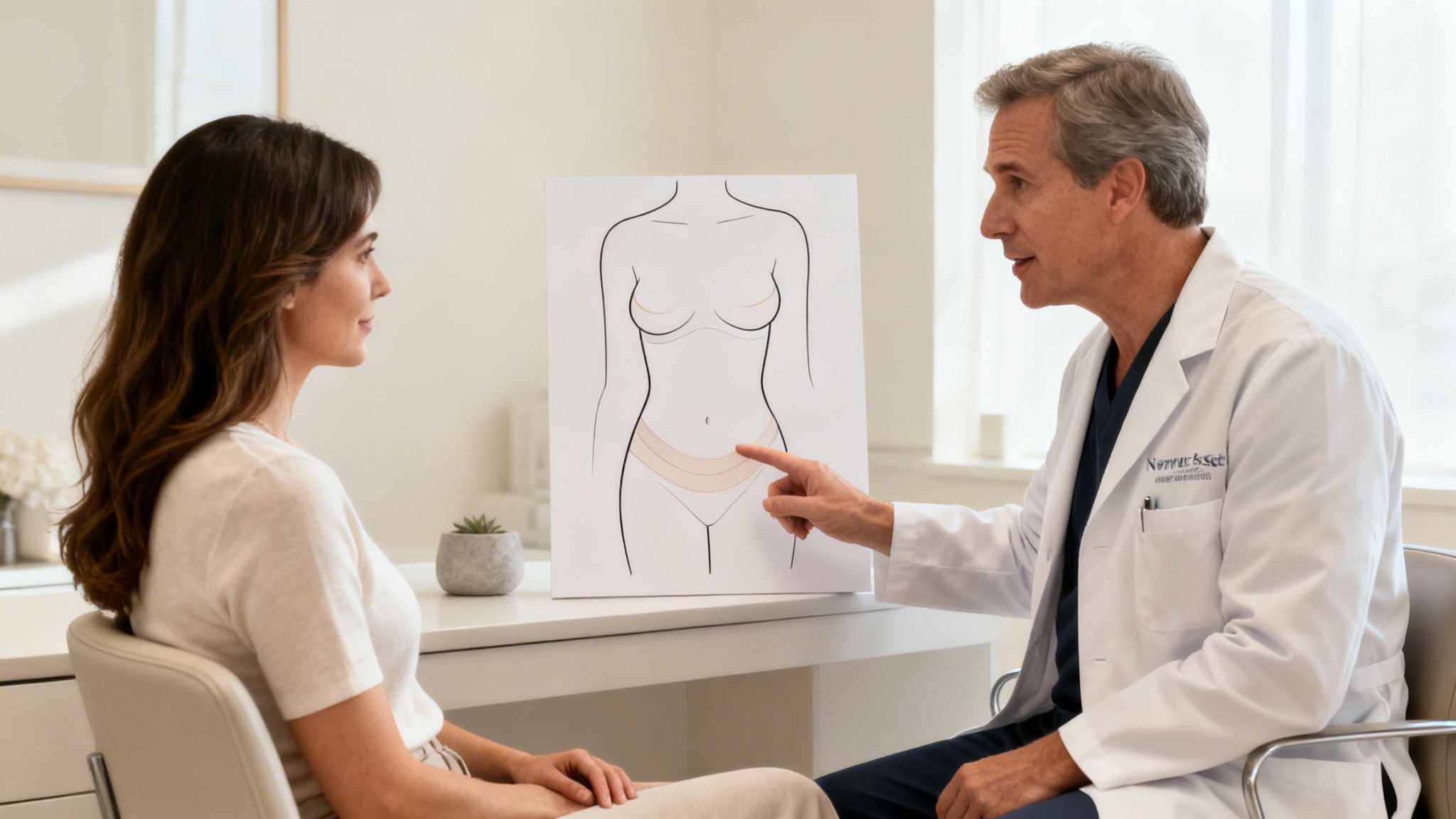
You can think of fat transfer breast augmentation as a natural sculpting process. Instead of introducing a foreign object, your surgeon is essentially relocating your body's own resources to refine your contours. It’s really a holistic approach to body shaping, addressing two aesthetic goals in a single procedure.
The concept itself is pretty straightforward. First, unwanted fat is gently removed from a donor area using liposuction. This fat is then purified to isolate only the healthiest, most viable fat cells.
Finally, these purified cells are meticulously injected into the breasts to add volume, improve symmetry, and create a soft, natural result. The entire process avoids any concerns related to implants and delivers an enhancement that both looks and feels like your own tissue.
The Growing Preference for Natural Results
The popularity of fat transfer has been on the rise for a while now, which reflects a broader trend toward more natural-looking outcomes in cosmetic surgery. Fat grafting is now one of the fastest-growing techniques in breast augmentation, with more women choosing it over traditional implants every year. It really highlights the demand for procedures that use a patient's own tissue instead of synthetic materials.
At our Newport Beach practice, we see patients who desire a modest, proportional enhancement. They value the two-in-one benefit of slimming a stubborn area while adding subtle, natural-looking volume to their breasts.
Choosing between fat transfer and implants is a big decision, and it’s important to understand the differences. You can learn more about the distinct approaches by reading articles that compare a general Breast Augmentation Vs Fat Transfer. This can help clarify which path aligns best with your specific goals.
This guide will walk you through every step of the fat transfer breast augmentation journey. With the expertise of Dr. Michael A. Bain, we'll cover who makes an ideal candidate, what the surgical steps involve, and what you can realistically expect from your results right here in Orange County.
Determining If You Are An Ideal Candidate
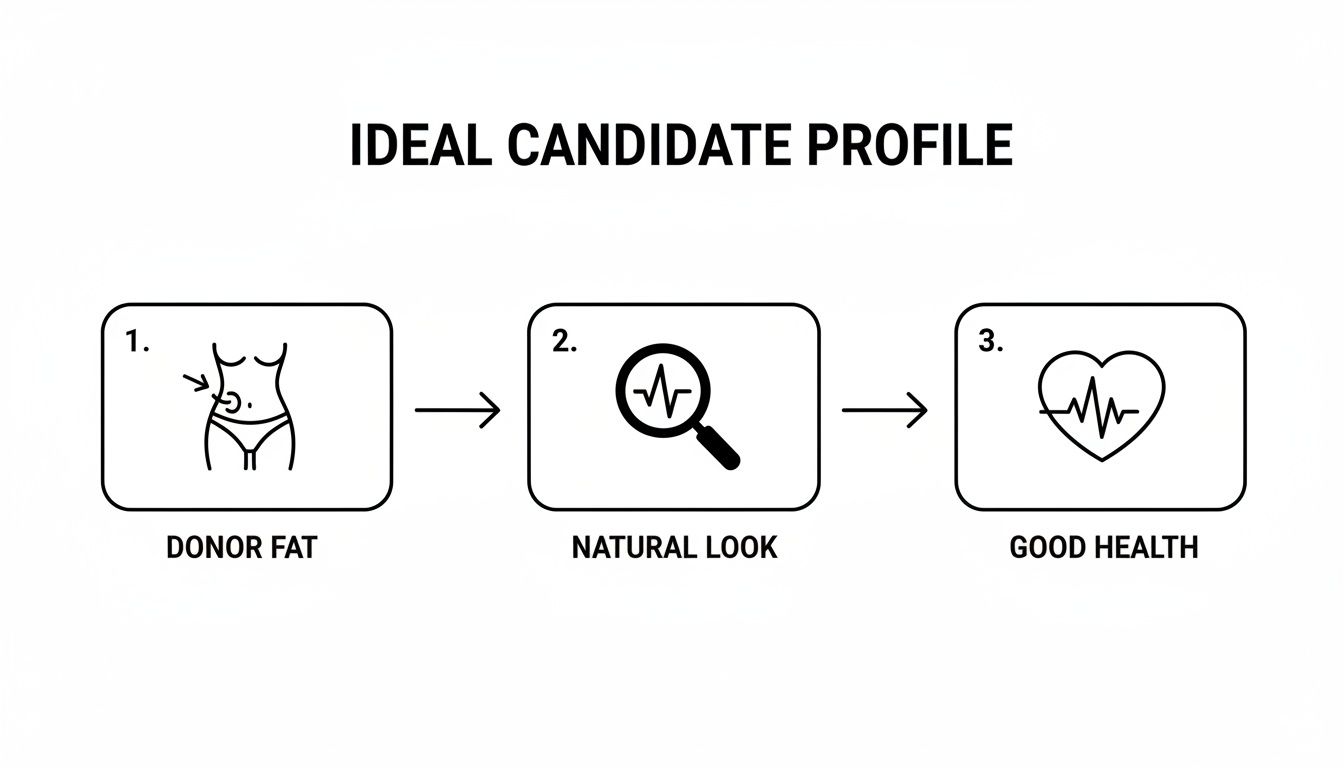
A desire for fuller breasts is just the starting point. With fat transfer breast augmentation, your own anatomy takes center stage—your body fat becomes the “material” that sculpts a natural result. Unlike implants, success here hinges on having the right foundation: enough donor fat in the right places.
Think of the process like commissioning a sculptor. The artist—your surgeon—needs quality clay. In this case, that clay is excess fat harvested safely from your own body.
The Foundation: Enough Donor Fat
Before anything else, we’ll confirm you have sufficient harvestable fat. Common areas include:
- Abdomen
- Flanks (Love Handles)
- Hips
- Thighs
If you’re very lean or your body fat percentage is low, there simply won’t be enough “material” to create a noticeable change. During your consultation, Dr. Bain will examine these zones to make sure your goals align with what nature can provide.
An ideal candidate often discovers a two-for-one benefit: enhanced breasts and a more contoured silhouette.
Your Aesthetic Vision: Realistic Expectations
This procedure is built for subtlety. You can expect roughly a one cup size increase per session. If you’re dreaming of a dramatic, multi–cup jump, traditional implants might be a better route.
The perfect candidate for fat transfer typically wants to:
- Restore volume lost after pregnancy or weight fluctuations
- Refine shape and improve breast symmetry
- Enjoy a soft, natural feel indistinguishable from native tissue
- Skip synthetic implants and their ongoing maintenance
Here, it’s all about refining proportions rather than creating a brand-new look.
Your Overall Health And Lifestyle
Your general well-being plays a lead role. The ideal candidate is:
- In good overall health
- A non-smoker (tobacco use can impair fat cell survival)
- At a stable weight (major fluctuations can alter results)
In Dr. Michael A. Bain’s Newport Beach practice, we take time to review your medical history, discuss your lifestyle, and map out a plan that ensures safety and effectiveness.
Ready to find out if fat transfer breast augmentation is your next step? Schedule a comprehensive evaluation with board-certified plastic surgeon Dr. Michael A. Bain in Newport Beach. Together, we’ll explore your anatomy, set realistic goals, and create a strategy tailored just for you.
Your Three-Step Surgical Journey Explained
A fat transfer breast augmentation is really a blend of two different disciplines: meticulous science and skilled artistry. The surgeon has to play both roles, carefully navigating three distinct stages to create a result that looks and feels completely natural. Understanding exactly what happens in the operating room can help you feel much more confident and prepared for your own journey.
The entire process boils down to three core steps. First, we carefully harvest the fat. Second, we purify it to get the highest quality cells. And third, we artistically place it to enhance your breast contours. Every single stage is handled with incredible detail to maximize your safety and give you the best possible outcome.
Stage 1: Harvesting the Donor Fat
The first step of the journey is liposuction, but it’s a much more gentle and refined version than what we use for aggressive body contouring. The main goal here isn’t just to remove fat; it’s to carefully preserve healthy, living fat cells. Dr. Bain uses specialized, low-pressure techniques to gently extract fat from a pre-selected donor area, which is often the abdomen, thighs, or flanks.
This gentle approach is absolutely critical. It minimizes trauma to the delicate fat cells, which dramatically increases their chances of survival after they’re transferred to the breasts. We make small, discreet incisions in the donor area and use a thin tube called a cannula to gently suction out the fat. This step gives you the dual benefit of slimming down the donor site while collecting the very material we need for your breast enhancement.
Stage 2: Purifying the Harvested Fat
Once the fat is collected, it isn’t ready for injection just yet. The tissue we harvest is actually a mix of pure fat cells, some broken cells, excess fluid, and trace amounts of blood. This is where the "scientist" part of the job really comes into play. The mixture is placed into a centrifuge—a machine that spins at incredibly high speeds to separate everything by density.
This purification process isolates the most valuable part of what we've collected: the dense, healthy, and fully intact fat cells. We carefully remove all the unwanted elements, like oil from ruptured cells and leftover anesthetic fluid.
This purification step is non-negotiable for a successful fat transfer breast augmentation. Injecting unprocessed fat can lead to lower survival rates, lumpiness, and less predictable results. Only the highest quality "liquid gold" fat is used for the final placement.
By concentrating only the healthiest cells, Dr. Bain ensures that the transferred tissue has the best possible chance to establish a new blood supply and become a permanent, living part of your breasts.
Stage 3: Placing the Purified Fat
The final stage is where true artistry takes over. With the purified fat prepared and ready, Dr. Bain meticulously injects it into the breasts. This isn't just about filling the area to add volume; it requires a deep understanding of breast anatomy and a good eye for aesthetic balance.
Using a very fine cannula, the fat is placed in tiny micro-droplets throughout the breast tissue in multiple, distinct layers. This technique, often called micro-grafting, is crucial for a few key reasons:
- Maximizes Survival: Placing small parcels of fat ensures each one is close to a blood supply, which is essential for the cells to live and integrate.
- Creates Smooth Contours: Layering the fat allows for precise sculpting, preventing any lumps and creating a smooth, natural-looking shape.
- Enhances Shape and Symmetry: The surgeon can strategically add volume exactly where it’s needed most—whether it's to improve symmetry, fill out the upper pole of the breast, or enhance cleavage.
This methodical placement is what turns a simple volume addition into a true enhancement of your natural form. Planning for this procedure always involves considering how much fat can be safely harvested. You can learn more in our detailed guide on how much fat can be removed with liposuction. Here at our Newport Beach facility, every step of this three-stage process is governed by strict safety protocols, ensuring you receive the highest standard of care from beginning to end.
Benefits and Limitations: What to Realistically Expect
When you're thinking about a fat transfer breast augmentation, having a clear and balanced perspective is your best tool. This surgery comes with a unique set of pros that really appeal to women looking for a natural enhancement, but it has its own specific limitations, too. Understanding both sides helps you set realistic goals and make a decision you'll feel great about.
The biggest benefit, without a doubt, is how natural the results are. Because the added volume comes from your own living tissue, your breasts will look, feel, and even age just as they normally would. There's no foreign object, which means you get to sidestep all the concerns that come with implants.
Celebrating the Unique Advantages
The most talked-about advantage of using your own fat is just how authentic the final result is. Your enhanced breasts will be soft to the touch and will move naturally with your body. It's a seamless look and feel that synthetic implants just can't quite match.
Beyond the aesthetics, there are some real safety benefits. By not using implants, you completely eliminate the risks associated with them, like:
- Rupture or Leakage: There's simply no device that can fail over time.
- Capsular Contracture: This condition, where scar tissue hardens around an implant, is not a factor.
- Implant Replacement: Implants often need to be replaced after 10-15 years. With fat transfer, the fat that successfully takes is there to stay.
And, of course, you get the amazing two-in-one benefit of body contouring. The liposuction used to gather the fat also slims down the donor area, whether it's your stomach, love handles, or thighs. Many patients say this is one of the best parts of the whole process—improving two areas of the body in a single surgery.
The core appeal of a fat transfer breast augmentation lies in its promise of an authentic, long-lasting result without the maintenance or risks tied to synthetic implants. It is a harmonious approach to refining your natural silhouette.
Understanding the Procedure's Limitations
While the benefits are fantastic, it's just as important to know what this procedure can't do. The main limitation is how much bigger you can go. A fat transfer is really for a subtle, modest enhancement—typically an increase of about one cup size per session.
This is because there's a limit to how much fat can be safely moved and, more importantly, how much of that fat will be able to establish a new blood supply and survive in its new home. If you're hoping for a dramatic increase of two or more cup sizes, traditional breast implants are likely a better fit for achieving those goals.
Another key factor to understand is fat cell survival, sometimes called "fat resorption." Not every fat cell we transfer is going to make it. On average, you can expect 50% to 80% of the transferred fat to become a permanent part of your breast tissue. The rest is safely and naturally absorbed by your body over the first few months. A skilled surgeon plans for this by slightly overfilling the area to make sure the final result settles right where you want it. You can also explore the potential risks of any breast surgery in our detailed article about the risks of breast augmentation surgery.
The Rise of Hybrid Breast Augmentation
What if you want the predictable volume of implants and the natural feel of fat? For many patients, a hybrid approach is the perfect solution. This technique combines a smaller implant with a layer of your own fat grafted over it.
The implant does the heavy lifting, providing the core volume and projection you want. The fat transfer then acts as a natural, soft tissue blanket, camouflaging the implant's edges and creating a much more organic look and feel. This method is becoming incredibly popular, with fat grafting now used in 12% of all augmentations. That's a 30% increase since 2018, showing just how much women appreciate this combined approach. It really allows patients to enjoy the "best of both worlds," getting a significant size increase with a remarkably natural finish.
Navigating Your Recovery and Final Results
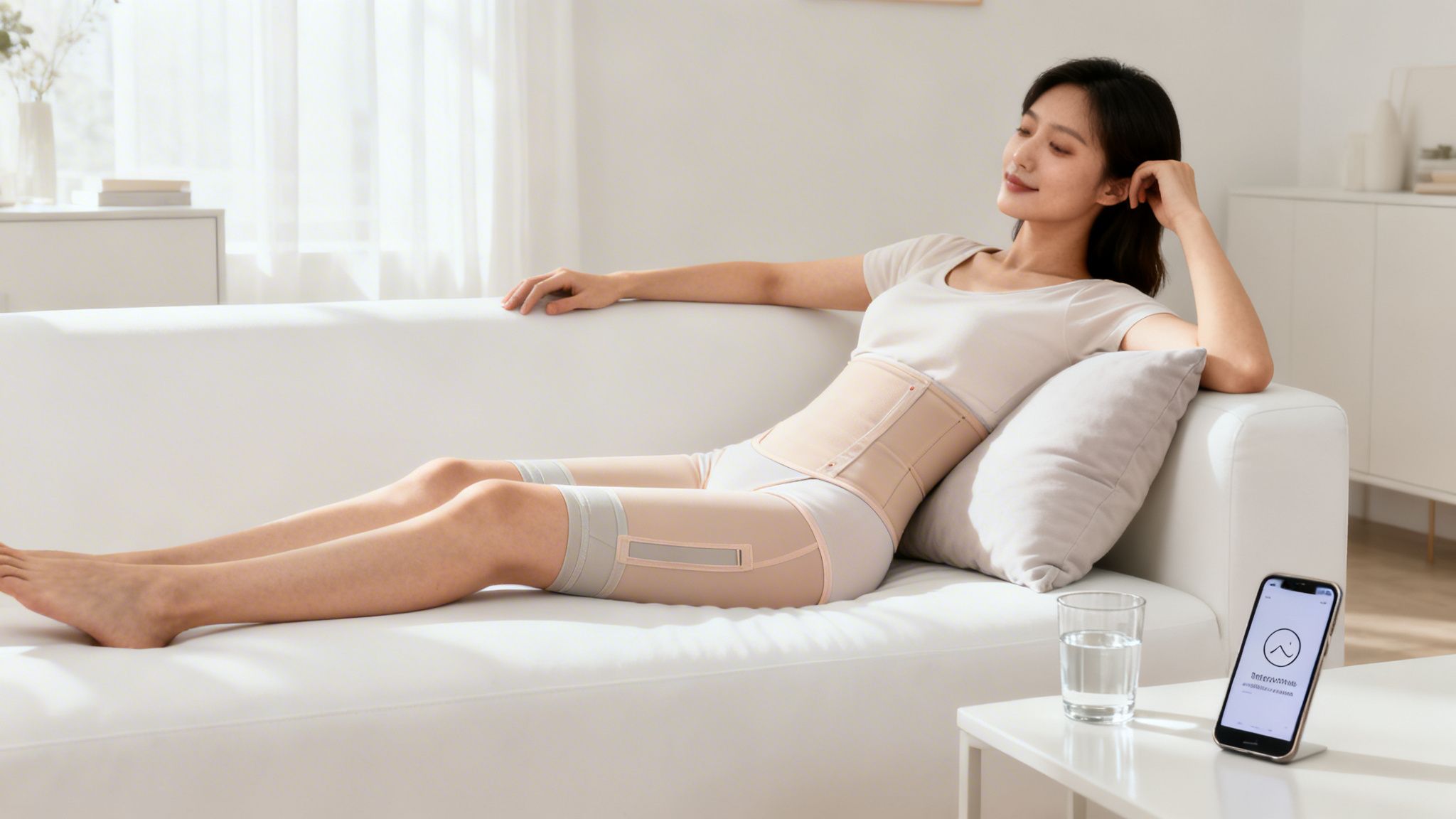
The journey to your final, beautiful result continues well after you leave the surgical suite. Understanding the recovery from a fat transfer breast augmentation is key to feeling confident and ensuring your body heals properly. This phase is all about patience, as your body needs time to accept the newly placed fat cells and for all the initial swelling to go down.
Right after the procedure, you can expect some swelling, bruising, and mild discomfort in both your breasts and the donor sites where we performed liposuction. This is a completely normal part of the healing process. We will give you specific instructions to manage this, which usually involves pain medication and wearing special compression garments.
The First Few Weeks: Your Initial Healing Phase
The first week is really dedicated to rest. You’ll need to put any strenuous activity on hold and just focus on letting your body recover. Wearing your compression garment is absolutely crucial during this time; it helps manage swelling at the liposuction sites and gives the healing tissues the support they need.
Most of our patients feel well enough to head back to a desk job and light daily routines within 7 to 10 days. That said, it's vital to listen to your body and avoid pushing yourself too soon. You'll have some specific rules to follow:
- No Strenuous Exercise: High-impact activities and any heavy lifting are off-limits for at least four to six weeks.
- Sleep on Your Back: This is a must. You have to sleep on your back to avoid putting any pressure on your breasts, which could harm the delicate, newly transferred fat cells.
- Gentle Movement Is Good: We encourage light walking to promote good circulation, but anything more vigorous has to wait for your surgeon’s green light.
This procedure’s dual benefit—slimming one area while enhancing another—is a major reason it’s become so popular. We’re seeing a rapid expansion of fat grafting in the market, especially with procedures like buttock augmentation, which is projected to grow at a rate of 12.5% annually.
The Road to Final Results
Patience truly is the most important part of your recovery. The breasts you see in the mirror a week after surgery are not your final result. Swelling can take several weeks to fully subside, and the transferred fat needs time to "take."
Think of the transferred fat cells as newly planted seeds. They need time to establish roots—in this case, a permanent blood supply—to survive and thrive. This integration process happens over several months.
Your final breast shape and size will gradually emerge between three and six months after your surgery. During this time, a percentage of the fat cells will be naturally and safely absorbed by your body. An experienced surgeon always accounts for this by slightly overfilling the breasts, ensuring your final volume aligns perfectly with your goals.
To get a clearer picture of aesthetic outcomes and understand what's typical for various breast procedures, it can be helpful to review this medically accurate guide on breast augmentation before and after results. It will help you visualize the healing journey and appreciate the subtle, beautiful changes as they unfold.
Choosing Your Surgeon in Orange County
The success of your fat transfer breast augmentation comes down to one thing more than any other: the skill and artistry of your surgeon. This procedure isn't just about moving tissue around. It’s a delicate combination of body contouring with liposuction and then meticulously grafting that fat, layer by layer, to create a new breast shape. In a competitive area like Orange County, picking the right surgeon is the most important decision you'll make.
A surgeon’s experience directly shapes the two outcomes that matter most: how much of the transferred fat survives, and the final, sculpted look of your breasts. The gentle harvesting, careful purification, and strategic injection of the fat cells all demand a practiced hand. It’s the only way to get a smooth, natural, and long-lasting result.
The Importance of Board Certification
When you start looking for a surgeon, board certification from the American Board of Plastic Surgery is the absolute gold standard. It’s non-negotiable. This certification means a surgeon has dedicated years to specialized training focused only on plastic and reconstructive surgery. It's a tough standard to meet, and it assures you that you're in the hands of a real specialist with proven expertise.
To get a better sense of what separates the great from the good, check out our guide on what sets the best plastic surgeons in Orange County apart.
Dr. Michael A. Bain brings that certified expertise to the table, but he also combines it with a sharp artistic eye—something you can't teach. This is crucial for creating beautiful, proportional results that truly fit your body.
A Patient-Centered Experience in Newport Beach
Here in our Newport Beach practice, your journey starts with a thorough, unhurried consultation. Dr. Bain really takes the time to listen to what you're hoping to achieve. He'll evaluate your anatomy and make sure you have a crystal-clear understanding of what this procedure can realistically do for you. This kind of collaboration is the foundation for results that don't just look natural, but also feel completely "you."
The ideal surgical outcome is one where technical precision meets artistic vision. For fat transfer, this means creating a result that is so natural it appears as though it has always been a part of you.
From that first conversation all the way through your final follow-up appointment, our entire team is here to provide dedicated, compassionate care. We are absolutely committed to your safety, comfort, and total satisfaction.
Ready to see what’s possible? We invite you to schedule a personal consultation with Dr. Bain to discuss your goals for a fat transfer breast augmentation.
Frequently Asked Questions
It’s completely normal to have more questions, even after learning all the details. Here, we’ll tackle some of the most common things patients ask about fat transfer breast augmentation here at our Newport Beach practice. My goal is to make sure you feel totally informed and confident in your decision.
We'll cover how long you can expect your results to last, the reality of fat survival rates, and what this means for your future breast health screenings.
How Long Do Fat Transfer Breast Augmentation Results Last?
This is one of the best parts of the whole procedure—your results are considered permanent. Once the transferred fat cells settle in and develop a new blood supply in the breast tissue, they become a living part of you. This whole process usually wraps up within the first three to six months.
After that point, these fat cells will act just like any other fat in your body. That means if you have a major weight swing, they can grow or shrink accordingly. But unlike implants that might need to be replaced years down the road, these integrated fat cells are there to stay. The real key to keeping your beautiful results is maintaining a stable weight.
What Percentage Of The Transferred Fat Will Survive?
Fat survival is a huge factor in the final outcome, and while it’s a little different for everyone, modern techniques have made it much more predictable. Generally speaking, you can expect a fat cell survival rate somewhere between 50% and 80%. The cells that don't make it are simply and safely reabsorbed by your body.
An experienced surgeon like myself will use a very meticulous and gentle approach for harvesting and purifying the fat. This ensures we're only transferring the healthiest, strongest cells that have the best chance of survival.
To plan for the fat that won't survive, a skilled surgeon will strategically overfill the breasts just a bit during the procedure. This is a crucial step that ensures once everything has healed and settled, your final result is exactly what we discussed in your consultation.
Does Fat Transfer Interfere With Mammograms?
This is a really important and valid question. The short answer is that when a fat transfer is done by a qualified, board-certified plastic surgeon, it should not get in the way of detecting breast cancer. The procedure can sometimes lead to benign things like microcalcifications or oil cysts in the breast, which, on a mammogram, can sometimes mimic signs of cancer.
However, experienced radiologists are very skilled at telling the difference between these normal post-surgical changes and anything that might actually be suspicious.
For your safety and peace of mind, it’s absolutely essential to follow two simple steps:
- Always tell your mammography technician that you've had a fat transfer breast augmentation.
- Choose a surgeon who understands the proper injection techniques to minimize any potential interference with future imaging.
Patient safety is always our number one priority. You'll be fully briefed on all the necessary breast health screening protocols before we ever move forward with surgery.
At Michael A. Bain, MD, my team and I are here to give you clear, honest information and exceptional care every step of the way. If you have more questions or you’re ready to see what’s possible, let’s schedule a personal consultation at my Newport Beach office. Visit us at https://www.drbain.com to get started.
Enhanced by the Outrank app