

Once you've made the exciting decision to move forward with cosmetic surgery, the next practical step is figuring out how to pay for it. The question of how to finance cosmetic surgery often comes down to a few common routes: using your personal savings, looking into medical credit cards, applying for a personal loan, or using a practice's in-house payment plan. With a little planning, the procedure you want is often more within reach than you might imagine.
Planning the Financial Side of Your Procedure

Thinking about the financial aspect shouldn't overshadow the excitement of your journey. This guide is designed to give you a clear, straightforward look at the different ways you can fund your surgery, so you can move forward with confidence. We'll cover everything from using your own savings to specialized medical financing.
It's a good time to be considering a procedure. The global cosmetic surgery market is valued at roughly $156 billion in 2024 and continues to grow. For patients, this growth means more competition and, as a result, more flexible and accessible financing options than ever before.
Quick Overview of Cosmetic Surgery Financing Paths
Here's a quick look at the most common ways to pay for your procedure. Use this table to spot the options that might work best for you.
| Financing Method | Best For | Key Consideration |
|---|---|---|
| Personal Savings | Patients who want to avoid debt and interest payments completely. | Requires planning ahead to save the full amount before scheduling surgery. |
| Medical Credit Cards | Those who can pay off the balance within a 0% APR promotional period. | High interest rates can kick in if the promotional period ends with a balance. |
| Personal Loans | Individuals who prefer a fixed monthly payment and a clear payoff schedule. | Requires a good credit score to secure a low-interest rate. |
| In-House Payment Plans | Patients looking for a simple, direct financing option through the practice. | Availability and terms vary by surgeon; may require a significant down payment. |
Each of these paths offers different benefits, and the right one for you will depend on your personal financial situation and how you prefer to manage large expenses.
Laying the Groundwork for a Smooth Process
Before you start applying for financing, it's always a good idea to have your finances in order. Your credit score is one of the most important factors in getting approved for a loan or credit card with favorable terms. A higher score almost always means a lower interest rate, which can save you a significant amount of money over time.
A common misconception is that cosmetic surgery is an out-of-reach luxury. The truth is, with the right financial strategy, it can be a manageable and worthwhile investment in your well-being.
For many patients, taking some time to improve their credit is a key first step. If you're not sure where to begin, a comprehensive credit education guide can be an excellent resource for understanding the fundamentals. Ultimately, finding the right financing comes down to the same principle as choosing a surgeon: you need to understand how to balance cost with quality to make a decision you'll be happy with for years to come.
Building a Realistic Budget for Your Procedure
Figuring out how to pay for cosmetic surgery starts with one thing: knowing the true total cost. That price list you might see online for a surgeon’s fee? That’s only the beginning. To avoid any financial stress when you should be focused on healing, you need to build a budget that covers everything from start to finish.
The most important document you’ll get is a detailed, itemized quote from your surgeon’s office. This breaks down exactly where your money is going and is the foundation for your entire financial plan.
Breaking Down the Core Costs
For any major procedure, whether it's a tummy tuck or breast augmentation, your total investment is really a combination of a few key services.
- Surgeon’s Fee: This is the largest single cost, covering my time, expertise, and the actual performance of your surgery.
- Anesthesia Fee: The anesthesiologist is a critical part of the surgical team, ensuring your safety and comfort. Their services are billed separately.
- Facility Fee: This fee covers the use of the state-of-the-art operating room, the recovery area, and all the clinical staff who support your procedure at the hospital or surgery center.
These three items make up the bulk of the cost, but overlooking the "smaller" expenses is a common mistake that can throw a budget off track.
Accounting for Hidden and Recovery Expenses
So many patients get caught up in the cost of the surgery itself that they completely forget to budget for everything that comes before and after. These costs might seem small individually, but they add up quickly and are absolutely essential for a safe, smooth recovery.
Think about things like pre-operative lab work and any medical clearances you might need. After your surgery, there will be prescription medications to pick up, like pain relievers and antibiotics. You’ll also need to purchase specialized items like compression garments—these are non-negotiable for controlling swelling and helping your body heal correctly.
Don't forget to factor in any time you’ll need to take off from work, as this can directly impact your income during your recovery period.
I always tell my patients to plan for the unexpected. A smart financial plan includes a buffer of 10-15% of the total surgical cost. This cushion is there to cover these recovery-related expenses and anything else that might pop up, so you can rest without worrying about money.
Before you commit to a financing plan, it’s a good idea to get a clear picture of your own financial health. Calculating your debt-to-income ratio is a simple way to see what you can comfortably afford each month.
And, for patients looking into procedures that may have a medical necessity component, like breast reconstruction after a mastectomy, it's important to understand how those costs differ. You can learn more about the specific cost considerations in our detailed guide.
With a detailed cost estimate in your hands, the next conversation is always about how to make it happen. Figuring out how to pay for your cosmetic surgery is a crucial part of the process, and it’s about finding a strategy that aligns with your personal finances and comfort level. Let's walk through the most common and effective ways patients fund their procedures.
The most straightforward path, of course, is using personal savings. This is the only method that completely sidesteps interest, fees, and the credit application process. When you pay with cash, your financial journey ends the day of your surgery, which offers a great deal of peace of mind as you begin your recovery.
That said, saving the entire amount can take a good deal of time, which might mean postponing your procedure longer than you’d like. It also means using a significant portion of your cash reserves, which can feel unsettling if you don't have a separate, healthy emergency fund to rely on.
This decision-making process can be a lot to juggle, and this chart helps visualize how to weigh your options.
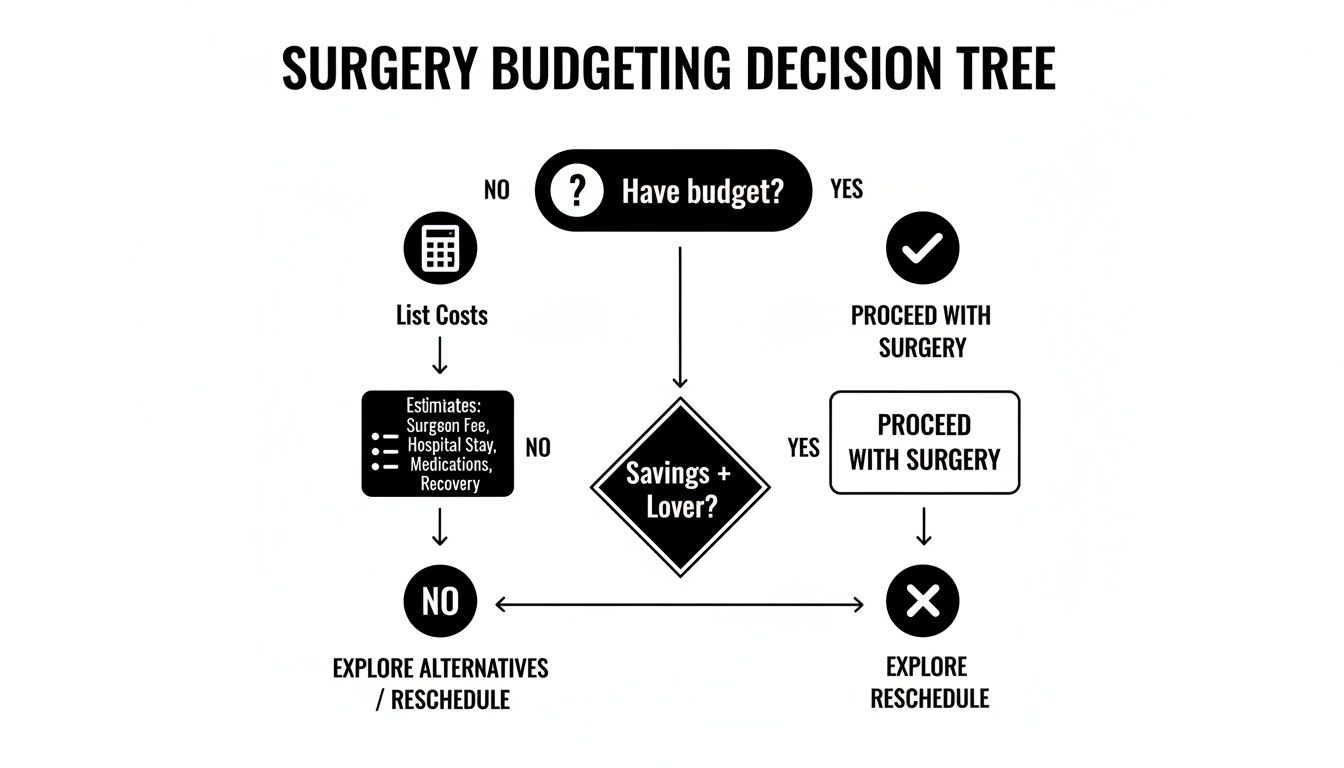
As you can see, having that clear, all-in budget is the foundational step that guides whether you should tap into savings or start exploring financing.
To make the choice clearer, let's compare the most popular financing methods side-by-side. Each option has its own set of pros and cons, and what works beautifully for one person might not be the best fit for another.
Comparing Popular Cosmetic Surgery Financing Methods
A direct comparison of the key features of different financing options to help you decide which is the best fit for your financial circumstances.
| Financing Option | Typical Interest Rate | Best For | Potential Pitfall |
|---|---|---|---|
| Personal Savings | 0% | Paying without debt or interest. | Can deplete cash reserves and delay the procedure. |
| Medical Credit Card | 0% Intro Rate (then 25%+) | Short-term financing for disciplined payers. | High deferred interest if not paid off in time. |
| Personal Loan | 6% – 20% | Predictable, fixed monthly payments. | Requires a good credit score for the best rates. |
| Practice Payment Plan | 0% | Spreading costs out before surgery. | The full balance must be paid before the procedure date. |
| HELOC | 8% – 13% | Lower interest rates for homeowners. | Uses your home as collateral; risk of foreclosure. |
| Standard Credit Card | 18% – 30% | Convenience and earning rewards. | Very high interest rates can quickly inflate costs. |
Ultimately, your credit score, savings, and personal comfort with debt will point you toward the right solution. Consider these options carefully before making a commitment.
Medical Credit Cards vs. Personal Loans
A very popular route is a medical credit card, like CareCredit. These cards are designed for healthcare expenses and often come with attractive promotional periods offering 0% interest for 6, 12, or even 24 months. If you’re confident you can pay off the entire balance before that promo period ends, it’s a fantastic, interest-free way to cover your surgery.
The critical thing to watch for is deferred interest. If even $1 remains on your balance when the promotional window closes, interest is charged retroactively on the entire original amount. With rates often hitting 26% or more, a great deal can quickly become a major financial headache.
A personal loan from a bank, credit union, or online lender offers a more predictable alternative. You receive a lump sum of cash upfront with a fixed interest rate, a fixed monthly payment, and a definite payoff date. This stability makes budgeting straightforward and completely removes the risk of a surprise interest bomb.
In-House Payment Plans and Insurance
Many practices, including ours, offer in-house payment plans. These are simple agreements where you make regular payments directly to our office in the months before your surgery. There’s typically no formal credit check, and the only major requirement is that the total balance is paid in full before your procedure date.
It's also worth a quick check on insurance. While most cosmetic procedures aren't covered, some surgeries that also serve a medical function might qualify for partial coverage. A breast reduction, for instance, can sometimes be deemed medically necessary. You can learn more in our complete guide to insurance coverage for breast reduction.
Navigating the Financing Application Process
Once you’ve settled on a financing path that feels right for you, it’s time to tackle the application. This part can feel a little daunting, but with some simple preparation, you can significantly improve your chances of getting approved. At the end of the day, lenders just want to see that you have a stable financial picture, and the application is your chance to show them.
Before you even start filling out forms, it's smart to know exactly where you stand. A good first step is checking your credit score and taking a close look at your full credit report. You can usually get this for free from annual reporting services or even through your credit card company. Scan it for any mistakes—things like incorrect late payments or accounts you don't recognize—and dispute them right away. Sometimes, fixing even a small error can give your score a nice little boost.
Next, you’ll want to figure out your debt-to-income (DTI) ratio. This is a number lenders care a lot about. It’s a simple comparison of your total monthly debt payments to your gross monthly income. A lower DTI is a great sign to lenders that you can comfortably handle a new payment.
Getting Your Paperwork in Order
Lenders will always need to verify the financial information you provide. Having all your documents organized and ready to go before you apply does more than just speed things up; it shows the lender you’re organized and serious about your financial commitments.
Generally, you should plan on gathering:
- Proof of Income: Your two most recent pay stubs are usually all you need. If you happen to be self-employed, plan on providing your last two years of tax returns.
- Bank Statements: Having two or three months of recent statements on hand helps verify your income and demonstrates a steady cash flow.
- Identification: A valid, government-issued ID like a driver’s license or passport is always required.
When you apply for financing through a plastic surgeon’s office, the patient coordinator is your best ally. They have direct relationships with lenders and know exactly what makes an application strong. They can often help you frame your financial situation in the most favorable way.
How Our Patient Coordinators Can Help
Applying directly through our office gives you a real advantage. Here at Dr. Bain’s practice, our patient coordinators have helped hundreds of patients through this exact process. They have a deep understanding of the financing partners we work with, from CareCredit to various personal loan providers.
They’re here to help you:
- Pinpoint the Right Lender: Based on your specific financial situation, they can point you toward the partner most likely to give you favorable terms.
- Make the Application Seamless: They’ll help make sure your application is complete and totally error-free, which helps avoid any frustrating delays or denials.
- Act as Your Advocate: In certain situations, our patient coordinator can speak directly with the lender to give context or add information that could strengthen your application.
This kind of personalized guidance is a huge part of how we help patients figure out how to finance cosmetic surgery without all the stress. Think of our team as your financial navigators, here to help you get the funding you need to move forward with your procedure confidently.
What to Know Before You Sign the Dotted Line

It’s easy to get excited once you’ve found a financing option that seems to work. You're one step closer to your procedure. But this is the most critical moment to pause and really look at the agreement in front of you. The fine print can make a huge difference in what you actually end up paying.
Think of it this way: the monthly payment is just one piece of the puzzle. The Annual Percentage Rate (APR) is what shows you the whole picture. This one number includes the interest rate and other fees, giving you the true cost of borrowing the money for a year. A lower APR will always save you money.
Look Past the Monthly Payment
We all do it—we look at the monthly payment and see if it fits our budget. That’s natural. But a low monthly payment can be misleading, especially if it’s stretched over a long period. You could be paying thousands more in interest without realizing it.
Always do the math. A $10,000 loan might look great at $250 a month. But if the term is 60 months, you’re actually paying back $15,000. That’s an extra $5,000 in interest alone. Knowing this total cost is essential when you decide how to finance cosmetic surgery.
Spotting Hidden Fees and Penalties
A loan isn’t just about the interest rate. Lenders often have other fees that get buried in the contract. You have to read it carefully to find them.
Be on the lookout for these:
- Origination Fees: This is a fee for processing the loan. Sometimes, it’s taken right out of the loan amount before the money even gets to you.
- Prepayment Penalties: Believe it or not, some lenders will charge you a fee if you pay off your loan early. This is a way to make sure they get all the interest they were expecting.
- Late Payment Fees: Find out exactly what the fee is for a late payment and if there’s a grace period. These charges can be surprisingly high and hurt your credit score.
The single most important thing to watch for is the "deferred interest" trap, which is often disguised as a "0% interest" offer. With a true 0% offer, you pay no interest if the balance is cleared in time. With deferred interest, if even one dollar is left unpaid after the promotional period, you’re hit with interest on the entire original loan amount, going all the way back to day one.
The Deferred Interest Trap Explained
You’ll see deferred interest offers all the time with medical credit cards. Let's say you finance a $12,000 procedure on a 12-month deferred interest plan. You pay it down diligently but have just $100 left when month 13 rolls around.
Suddenly, interest—often at a punishing 25% or higher—is calculated on the full $12,000 from the very beginning. Your small remaining balance can balloon by thousands of dollars overnight.
Before you sign anything, ask the lender direct questions. Confirm the APR, ask for a complete list of every single fee, and get them to explain—in simple terms—if an introductory offer uses deferred interest. A trustworthy lender will give you clear answers so you can move forward with confidence.
A Few Common Questions About Financing Your Surgery
Paying for your procedure is a big part of the planning process, and we get a lot of great questions about it. Thinking through these key points now can help you move forward with confidence as you figure out the best way to finance your cosmetic surgery.
Can I Use My Health Insurance?
This is one of the first questions most patients ask. As a general rule, insurance policies don't cover procedures done for purely cosmetic reasons.
There are, however, some important exceptions. If a procedure also has a clear functional or medical benefit, you may be able to get partial or even full coverage. For example, a rhinoplasty to correct a deviated septum that makes it hard to breathe, or a breast reduction to relieve chronic back and neck pain, are often considered medically necessary.
The best first step is to call your insurance provider directly. Our office is more than happy to provide any medical documentation needed to help support your claim.
What Credit Score Do I Need for Financing?
It really depends on the lender and the type of financing you're looking for. Specialized medical credit cards, like CareCredit, have programs designed for a wide range of credit profiles, and some patients can get approved with scores in the mid-600s.
If you're aiming for a traditional personal loan from a bank or credit union, you'll generally get the most favorable rates with a credit score of 670 or higher. It's often worth taking a few months to boost your score before applying—it can significantly lower your interest rate and save you a lot of money in the long run.
Can I Just Finance Part of My Procedure?
Absolutely. In fact, this is a very popular and financially savvy approach. Many of our patients choose a hybrid plan to make their financing more manageable and affordable.
You might, for instance, use your personal savings to cover the surgeon's fee, and then finance the remaining facility and anesthesia costs.
This strategy is brilliant because it shrinks the total amount you need to borrow. That means smaller monthly payments and less interest paid over the life of the loan. It gives you the flexibility to create a plan that truly fits your budget.
Are In-House Payment Plans a Good Option?
They can be a fantastic, straightforward choice. These plans are offered directly through our practice and allow you to make a series of payments in the months leading up to your procedure.
Approval is simple, and there’s no formal credit check involved. The most important thing to know is that the full balance has to be paid off before your surgery date. For disciplined planners, it's an ideal, interest-free way to fund a procedure.
At the practice of Michael A. Bain, MD, our patient coordinators are experts at walking you through all these options to find the perfect solution for your situation. To discuss your personal financial plan and take the next step on your journey, please schedule your consultation with us today.