

Your surgical procedure is just one part of your transformation. A successful outcome really depends on what happens next: a smooth, comfortable recovery. Thinking about how to manage pain after surgery isn't an afterthought for us; it's a vital part of the personalized care plan Dr. Bain designs with every patient.
This guide will walk you through our complete strategy. We go far beyond just handing you a prescription. Whether you're having a facelift, breast augmentation, or tummy tuck, this plan is essential for a positive experience and beautiful results.
Why We Are Proactive About Pain Management
Pain is a normal part of healing, but it shouldn't control your life after surgery. When pain is left unmanaged, it can actually slow down your recovery, increase stress, and make it difficult to rest—all of which are critical for proper healing.
Extensive studies confirm how common significant post-operative pain can be. A major 2023 review found that even with the types of outpatient surgeries common in our field, significant pain affects 29.0% of patients after they return home. To prevent this, we use what's called a multimodal analgesia approach. This simply means we combine different types of pain relievers and non-drug techniques to maximize your comfort while minimizing side effects.
Your recovery is a partnership. While Dr. Bain performs the surgery, your active participation in your pain management plan is what ensures the smoothest path back to feeling like yourself.
For a quick overview, here's a look at how we approach the different phases of your recovery.
Post-Operative Pain Management at a Glance
This table summarizes the core components of your recovery plan, helping you understand the goals and actions for each stage.
| Recovery Phase | Primary Goal | Key Actions |
|---|---|---|
| Pre-Operative | Preparation & Prevention | Discussing pain history, filling prescriptions, preparing your home. |
| Immediate Post-Op | Controlling Initial Discomfort | Following the prescribed medication schedule, starting ice therapy. |
| Early Recovery (First Week) | Tapering Medications & Managing Swelling | Gradually reducing pain medication, consistent use of ice/elevation. |
| Ongoing Healing | Transitioning to Non-Drug Methods | Focusing on light activity, proper sleep, and managing side effects. |
Each step is designed to keep you comfortable and support your body’s natural healing process from start to finish.
The Core of Your Recovery Plan
A great recovery plan is built on a few key principles. Understanding them will empower you to take control of your comfort and healing. We will cover:
- Mastering Your Medication: Learn how to stay ahead of the pain with a smart, scheduled approach instead of chasing it.
- Non-Drug Strategies: Discover powerful, effective techniques like cold therapy and proper positioning to reduce swelling and discomfort.
- Recognizing Problems: Know the difference between what's normal during healing and the signs that mean you should call our office right away.
This approach isn't one-size-fits-all. While the principles are universal, the specifics will be adjusted for your exact procedure. For instance, after an orthopedic procedure, the focus might be on early mobility. You can find detailed guidance on this in resources about rotator cuff surgery recovery. For our plastic surgery patients, the priority is supporting delicate tissue as it heals beautifully, ensuring your recovery is just as successful as your surgical results.
Mastering Your Post-Surgery Medication Plan
Your medication plan is the foundation of a comfortable recovery. This is especially true during the first 48 to 72 hours after surgery, which is typically when discomfort is at its peak.
The single most important strategy we teach our patients is to stay ahead of the pain. This means taking your medication on a set schedule, almost like clockwork, instead of waiting for the pain to become severe. Once significant pain takes hold, it’s much more difficult to get it back under control.
Think of it as managing a small campfire. It’s far easier to keep the flames small and manageable than it is to battle a full-blown forest fire. By taking your medication on schedule, you keep the "flame" of pain from ever growing too large.
Understanding Your Prescriptions
Dr. Bain uses a multi-modal approach to pain management, which simply means you will likely have a few different medications working together as a team. This strategy has been a game-changer in post-operative care, allowing for better pain relief with fewer side effects.
Your plan will usually involve a combination of these medications:
- Opioids (Narcotics): These are the heavy hitters, prescribed for the most intense pain right after your procedure. They work by blocking pain signals in your brain and are only used for a short time to get you through the toughest part of recovery.
- NSAIDs (Non-Steroidal Anti-Inflammatory Drugs): Medications like Ibuprofen or Celecoxib are fantastic because they target inflammation directly at the surgical site. Less inflammation means less swelling and, you guessed it, less pain.
- Acetaminophen (Tylenol): This is a different type of pain reliever that works through another pathway. We often use it in combination with other medications to boost their overall effectiveness.
Believe it or not, studies have shown that up to 80% of patients can experience significant pain after surgery. In the past, this was often undertreated. Modern strategies that combine different types of medication have completely changed this for the better. By attacking pain from multiple angles, we can use lower doses of any single drug, which dramatically reduces the risk of unwanted side effects.
Creating a Simple Dosing Log
When you're tired and focused on resting, keeping track of different medications can feel like a chore. This is where a simple dosing log becomes your best friend. All you need is a small notebook or even the notes app on your phone.
This simple flow chart gives you a great visual of the recovery process.
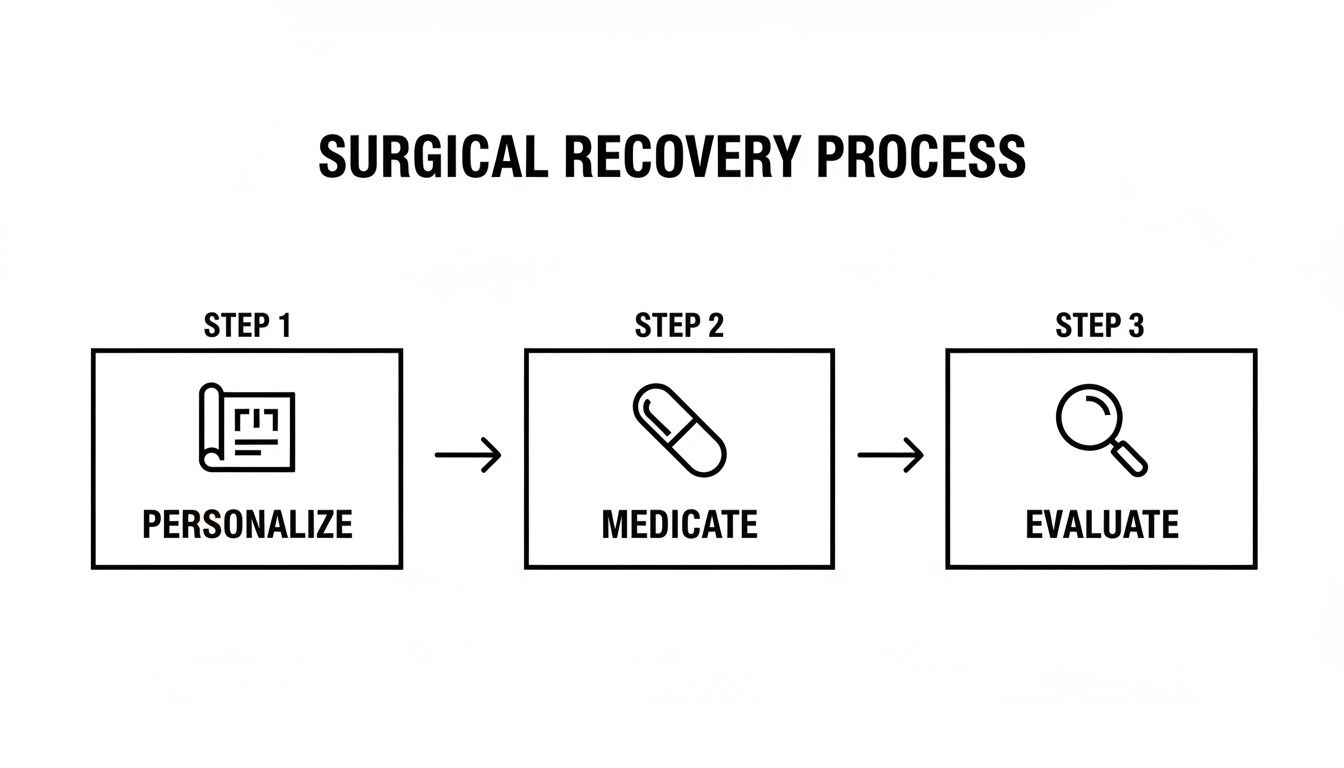
It all comes down to following your personalized plan, taking your medication on schedule, and paying attention to how you feel.
Key Takeaway: Your dosing log isn't just a checklist—it's a critical safety tool. It prevents accidental double-dosing and gives our team precise information if we need to adjust your pain management plan.
Here’s an example of what a simple log might look like. You can easily adapt this for yourself.
| Time | Medication | Dose | Pain Level (1-10) |
|---|---|---|---|
| 8:00 AM | Narcotic (e.g., Norco) | 1 tablet | 6 |
| 12:00 PM | NSAID (e.g., Ibuprofen) | 600 mg | 4 |
| 4:00 PM | Narcotic (e.g., Norco) | 1 tablet | 5 |
This simple chart helps you see how your pain levels are responding to the medication, putting you in the driver's seat of your own recovery.
The Tapering-Off Process
Our goal is to help you transition off the stronger pain medications as your body heals. This "tapering" process is a gradual step-down, not a sudden stop. We never want you to be in unnecessary pain, but we also want to minimize the amount of time you need to be on narcotics.
Here’s a real-world example of what a tapering plan might look like after a breast augmentation recovery:
- Days 1-3: Take your prescribed narcotic every 4-6 hours, around the clock. Continue taking your scheduled NSAID as directed.
- Days 4-5: Try stretching the time between narcotic doses to every 6-8 hours. You’ll start relying more on the NSAID and Tylenol at this point.
- Days 6+: Use the narcotic only "as needed" for breakthrough pain. Your primary pain relief should now come from over-the-counter options.
For many of our patients, this transition happens quite naturally. By following a structured schedule at the start and then thoughtfully tapering off, you maintain control over your comfort. This allows you to focus on what truly matters: resting, healing, and enjoying your results.
Beyond The Pill: Effective Non-Drug Pain Relief
While your prescribed medication is the foundation for your initial comfort, it’s only one piece of the puzzle. There are some incredibly powerful, non-drug strategies that can dramatically cut down on your discomfort, keep swelling in check, and even help you heal faster.
Think of these methods as working hand-in-hand with your medication. They often help patients feel comfortable enough to switch to over-the-counter options sooner than they expected. These aren't just optional extras; they're essential tools for a smoother recovery.

Harnessing The Power Of Cold And Elevation
One of the simplest yet most effective ways to manage post-op pain and swelling is with cold therapy and elevation. This classic combination works by constricting blood vessels to reduce inflammation and using gravity to drain excess fluid away from the surgical site. The result? Less throbbing and discomfort.
Here’s how to put these techniques to work for your specific procedure:
- For Facial Procedures (Rhinoplasty, Facelift): You’ll need to keep your head elevated above your heart at all times, even when you sleep. Using several pillows or a recliner is perfect for this. Apply a soft gel pack wrapped in a thin towel to the swollen areas for 15-20 minutes at a time, then take a break for at least 45-60 minutes before reapplying.
- For Breast and Body Procedures (Breast Lift, Tummy Tuck): When you're resting, use pillows to prop up your upper body. For a tummy tuck, placing pillows under your knees creates a slight bend at the hips, which is crucial for taking tension off your incision line. You can find more specific advice in our guide on tummy tuck recovery tips.
A quick word of caution: never put ice or a cold pack directly on your skin, as it can cause serious tissue damage. The key to success with cold therapy is consistency, especially during the first 48-72 hours after your surgery.
The Importance Of Compression And Gentle Movement
After your procedure, Dr. Bain will place you in a specialized compression garment. This garment isn't just for appearances—it plays a vital role in both your comfort and your results. The constant, gentle pressure helps support your healing tissues, minimizes swelling by preventing fluid from accumulating, and often provides a welcome sense of security.
At the same time, while you absolutely must avoid strenuous activity, gentle movement is vital. Getting up and walking slowly around your house for a few minutes every hour or two is one of the best things you can do. This light activity promotes healthy circulation, which significantly reduces the risk of dangerous blood clots and also helps with stiffness and muscle soreness.
Think of gentle movement as a signal to your body that it's time to start the healing process. It boosts blood flow, delivering oxygen and nutrients right where they're needed most—the surgical site.
This doesn't have to be a major undertaking. A short, slow walk to the kitchen for a glass of water or to the restroom is more than enough to make a real difference in your safety and overall comfort.
Prioritizing Restorative Sleep
Quality sleep is when your body performs its most critical repair work. But getting comfortable enough for deep, restorative sleep can be a real challenge after surgery. Pain, anxiety, and just the awkwardness of sleeping in a new position can all get in the way.
Setting up your space for success ahead of time is a game-changer. Try these tips:
- Build Your Recovery Nest: Before you even leave for your surgery, arrange your bed or recliner with plenty of pillows. You’ll want them to support your back, prop up your legs, and tuck under your arms until you find that perfect, comfortable, elevated position.
- Stick to a Routine: As much as possible, try to go to bed and wake up around the same time each day. This helps regulate your body’s internal clock, making it easier to fall asleep when you need to.
- Time Your Medication: Plan to take your scheduled pain medication about 30-45 minutes before you want to sleep. This ensures it's working at its peak effectiveness right when you’re trying to drift off.
Later in your recovery, if you find muscle soreness is lingering, some hands-on therapies can provide relief. After getting full clearance from Dr. Bain, exploring an option like deep tissue massage therapy can be very helpful for managing aches without medication. By making these non-drug strategies a core part of your routine, you take an active role in your own healing, paving the way for a more comfortable and efficient recovery.
Handling Common Recovery Side Effects
A smooth recovery is about more than just managing pain at the incision site. It’s also about knowing how to handle the common, temporary side effects that come up from both the surgery itself and the medications we prescribe. Knowing what to expect and how to manage these issues can make a world of difference in your comfort.
There’s a good reason we focus so much on this. The entire field of post-operative care is shifting toward using multiple methods to control pain specifically to reduce side effects. The goal is to minimize issues like opioid-induced constipation and nausea, which helps patients have faster, safer recoveries. For those interested in the industry trends, you can explore the market research on post-operative pain management.
Dealing With Constipation and Nausea
Two of the most frequent complaints I hear from patients are constipation from pain medication and some lingering nausea from anesthesia. Thankfully, we can get ahead of both with a few simple, proactive steps.
Constipation is an almost universal side effect of opioid pain medication because these drugs slow down your entire digestive system. My advice is simple: don't wait for it to become a problem.
- Hydrate, Hydrate, Hydrate: Make sure you are drinking plenty of water all day long.
- Add Fiber Gently: As your appetite comes back, try to work in some high-fiber foods that are easy on your stomach, like pears, berries, and oatmeal.
- Start a Stool Softener: We strongly recommend starting an over-the-counter stool softener (like Colace) the very same day you start taking your prescription pain medication. Think of it as a preventative measure.
Nausea typically gets better within the first 24 hours, but it can be very unpleasant while it lasts. The best way to combat it is to always take your pain medication with a little food, even just a few crackers or a piece of toast. Never take these pills on an empty stomach.
Normal Healing vs. A Cause for Concern
It's absolutely essential to understand the difference between the normal signs of your body healing and the warning signs of a potential complication. Bruising, swelling, and even some mild numbness are all expected parts of the process as your body works to repair itself.
Key Insight: Don't let fear of the unknown cause you anxiety. Normal healing follows a predictable path: swelling and bruising are at their worst in the first few days, then they start to get better. Complications, on the other hand, tend to worsen over time, not improve.
Here is a straightforward guide to help you know when things are normal and when you should call our office.
| Symptom | What's Normal | What's a Red Flag |
|---|---|---|
| Swelling | Peaks at 48-72 hours, then slowly goes down. It’s usually symmetrical. | Swelling that suddenly gets much worse, especially if it's only on one side. |
| Bruising | May spread out and change color over time (from purple to yellow or green) as it fades. | A rapidly growing, firm, and very painful area of bruising (which could be a hematoma). |
| Incision | Pinkish edges, with minimal clear or light-yellow fluid drainage in the beginning. | Spreading redness, warmth, a foul-smelling discharge, or the wound edges pulling apart. |
| Pain | Gradually improves each day. Your prescribed medication should keep it under control. | Pain that suddenly gets much worse or is not being controlled by your medication schedule. |
Taking proper care of your incisions is one of the most important things you can do to prevent infection. For a detailed guide, please check out our guide on how to care for an incision after surgery.
Knowing these differences empowers you to rest easier when your body is on the right track and to act quickly if something seems off. Your safety is my absolute priority, and I want you to feel confident and supported through every stage of your recovery.
Knowing When to Call for Help
A successful recovery is about more than just following the plan we lay out. It's also about recognizing when something feels off and knowing you can reach out for support. My goal is for you to feel completely confident in your healing process, and that includes calling our office without a second thought if a concern arises.
You know your body better than anyone. If your intuition tells you something isn't right, I want you to trust it. You are never, ever bothering us by calling. In fact, that open line of communication is exactly what ensures a safe and smooth recovery.

Clear Red Flags That Require a Phone Call
The normal healing process follows a predictable arc—you should feel gradually better with each passing day. Any symptom that signals a step backward is a reason to get in touch with our team immediately.
Here are the specific red flags that mean it's time to call us:
- A Persistent Fever: A temperature of 101°F (38.3°C) or higher that doesn’t respond to Tylenol is often a primary sign of infection.
- Signs of Infection at the Incision: This can include redness spreading away from the incision, the area feeling hot to the touch, any foul-smelling or discolored (yellow or green) drainage, or the wound edges starting to pull apart.
- Worsening Pain: Your pain should be on a downward trend. If it suddenly gets significantly worse or stops responding to your medication schedule, this is a major red flag that needs our attention.
- Signs of a Blood Clot: Be aware of any new pain, swelling, tenderness, or redness in your calf or leg, especially if it only affects one side. This requires immediate medical advice.
Your safety is our absolute priority. Never "wait and see" with these symptoms. A quick phone call allows us to assess the situation and provide guidance, which could be as simple as adjusting your care or as critical as having you come in for an evaluation.
How to Prepare for Your Call
When you call our office with a concern, coming prepared with a few key details helps us give you the best advice, fast. A clear picture of what you're experiencing is essential for us to guide you properly.
Before you dial, try to have this information ready:
- Your Most Recent Temperature Reading: If fever is a concern, please use a thermometer to get an accurate number before calling.
- Your Medication Log: Be ready to tell us exactly which pain medications you’ve taken and, just as importantly, when you took your last dose. This is critical for figuring out what’s going on with your pain control.
- Specific Symptom Details: Being specific is incredibly helpful. Instead of just saying, "I don't feel well," try something like, "The redness around my incision has spread about an inch since this morning," or "My pain jumped from a 4 to a 7 in the last two hours, even after I took my medication."
This kind of detail gives us the context we need to determine the right next steps for you. Taking a moment to gather these facts makes a real difference and keeps you as an active partner in your own safe recovery.
Frequently Asked Questions About Post-Surgery Pain
After your procedure, it’s completely normal to have questions about what to expect during your recovery, especially when it comes to managing pain. Feeling prepared helps you focus on what's most important: healing well.
We find that patients are often most curious about their pain management plan and when they can expect to feel more like themselves again. Here are answers to some of the questions we hear most often in our practice.
How Long Will I Need Prescription Pain Medication?
This is a very common question, and the answer really depends on both the individual patient and the specific surgery performed. There isn't a one-size-fits-all timeline.
For instance, a patient recovering from a less invasive procedure like a rhinoplasty or an eyelid lift might only need prescription-strength pain medicine for about 2 to 4 days. After that, most find that any remaining discomfort is easily handled with over-the-counter options.
In contrast, someone who has had more extensive surgery, such as a tummy tuck or a body lift after weight loss, will naturally need a bit more time. For these procedures, it's common to use prescription medication for closer to 7 to 10 days. This is simply because larger areas were involved in the surgery.
The goal is always the same: use the medication to keep you comfortable during that initial, more intense healing phase. Then, as your body begins to heal, you’ll gradually taper off.
We will give you a specific, personalized plan for tapering your medication. The idea is to reduce your reliance on the stronger medicine as your pain naturally lessens, rather than stopping abruptly while you're still in significant discomfort. This approach ensures you stay comfortable while minimizing how much medication you need.
Should I Use Ice Or Heat For Post-Surgical Pain?
This question comes up a lot. For any pain you experience right after surgery, the answer is always cold therapy. Ice or a cold pack will be your best friend in the early days of recovery.
Heat actually increases blood flow. While that can feel good for a sore muscle much later on, it’s the exact opposite of what you want after an operation. More blood flow can lead to worse swelling, inflammation, and a throbbing sensation.
Cold therapy does the opposite by constricting blood vessels. This simple action helps in several important ways:
- Reduces Swelling: By limiting blood flow to the surgical site, cold packs help minimize the fluid buildup that creates puffiness and pressure.
- Decreases Inflammation: Cold helps to calm the body's natural inflammatory response right where you need it most.
- Provides Numbing: The cold sensation acts as a natural pain reliever, helping to numb sore and tender tissues.
For the best results, apply a cold pack wrapped in a thin cloth for 15-20 minutes at a time. It’s crucial to give the skin a break for at least 45-60 minutes before applying it again. This on-and-off cycle is most effective during the first 48-72 hours post-surgery. A critical point: never apply ice or a cold pack directly to your skin, as this can cause frostbite and damage the delicate, healing tissue.
What Can I Do About Medication Side Effects?
This is a very important and practical concern, and it’s something we plan for from the start. Dr. Bain’s pain management approach is specifically designed to minimize side effects. By using a combination of different medications and non-drug strategies, we can control pain effectively without having to rely on high doses of any one drug, especially opioids.
Even so, some side effects can still pop up. Here’s what you can do about the most common ones:
- For Constipation: The key is to be proactive. We recommend starting an over-the-counter stool softener on the same day you begin taking your prescription pain medication. It's also very helpful to drink plenty of water and, as your appetite returns, try to incorporate fiber-rich foods like berries or oatmeal.
- For Nausea: The simplest and most effective solution is to take your pain medication with a small amount of food. A few crackers, a piece of toast, or a small yogurt can make all the difference. Never take pain pills on a completely empty stomach.
If you find that side effects are making you miserable or preventing you from resting, please call our office. We can almost always adjust your plan to make you more comfortable.
Can I Take Extra Doses If The Pain Is Really Bad?
The answer here is an emphatic no. It is critical that you never take more medication than what has been prescribed or take doses more frequently than instructed by Dr. Bain. This is an absolute safety rule.
Your dosing schedule is carefully calculated for you based on the procedure you had, your medical history, and your specific needs. Taking extra medication—even if you feel you need it—dramatically increases the risk of serious, and even dangerous, side effects. These can range from severe drowsiness and nausea to life-threatening issues like respiratory depression, which is a slowing of your breathing.
If you feel your prescribed medication isn't controlling your pain, that’s an important sign. It tells us that something may have changed or that your needs are different from what we anticipated. Uncontrolled pain is not something you should just "tough out." Instead of reaching for an extra pill, you should see this as a clear signal to contact our office. This allows us to re-evaluate your situation and find a safe way to get your pain under control.
At Michael A. Bain, MD, our commitment to your care extends far beyond the operating room. We are dedicated to ensuring your entire journey is supported, comfortable, and leads to the beautiful, natural-looking results you deserve. To learn more about our approach or to schedule your personal consultation, please visit us at https://www.drbain.com.