

Choosing implant removal and breast lift is a powerful decision many women are making to bring their bodies into alignment with their current lives and aesthetic goals. This procedure, which we call an explant with mastopexy, involves removing breast implants and then immediately reshaping and lifting the natural breast tissue for a restored, more youthful contour.
Why More Women Are Choosing Implant Removal and Breast Lift
A major cultural shift is happening, and we see it right here in Orange County. More and more women are moving away from implants and embracing a more natural look. This isn't just about undoing a past decision; for many, it's a proactive choice for their health, comfort, and a new chapter of self-acceptance. The reasons for pursuing an implant removal and breast lift are always deeply personal and different for every patient.

Key Motivations for Explantation
The path to explantation is usually driven by a mix of physical realities and personal feelings. For a lot of women, it boils down to reclaiming a sense of control over their own bodies and well-being.
Here are some of the most common reasons I hear in my practice:
- Aesthetic Evolution: Lifestyles change, and so does our personal taste. It’s very common for women to find that their implants simply don't fit the person they are today, and they’d much prefer a natural shape.
- Implant Complications: Issues like implant rupture, shifting out of place (malposition), or capsular contracture—which is the hardening of scar tissue around the implant—can cause real pain and distort the breast's appearance.
- Lifestyle Comfort: Over time, large implants can get in the way of exercise, lead to chronic back or neck pain, or just feel heavy and cumbersome.
- Health Concerns: There's a growing awareness of Breast Implant Illness (BII), a term used to describe a collection of systemic symptoms some women experience with implants. This has become a major reason for removal.
A Growing National Trend
This isn’t just something we’re noticing locally; it's a well-documented national trend. The number of women choosing to have their implants removed has skyrocketed. Recent data shows that from 2008 to 2021, breast implant removal surgeries saw a massive 653% increase, growing much faster than other breast procedures. By 2022, over 320,000 women were choosing removal annually. This is a powerful statistic that points to a worldwide shift toward prioritizing health and a natural aesthetic.
For many women, the decision is one of liberation—freeing themselves from the maintenance, worry, and physical burden of implants. A breast lift completes this process by beautifully restoring the breast's natural shape.
Here in Newport Beach, I've dedicated a significant part of my practice to this specific procedure. As a board-certified plastic surgeon, I understand the technical skill needed to not only remove the implant safely but to artfully perform the breast lift afterward, ensuring your results feel and look authentically you. While implants have a limited lifespan, the choice to remove them is often a permanent step toward long-term peace of mind. To get a better sense of this, you can learn more about how long breast implants typically last.
How the Explant and Breast Lift Procedure Works
When a woman decides to remove her breast implants, combining the procedure with a breast lift is an incredibly effective way to restore a natural, youthful shape. I often explain it like this: think of a balloon that's been inflated for a long time. Once you let the air out, the balloon's rubber is stretched and saggy. A breast lift is the surgical step that reshapes and tightens that skin after the volume from the implant is gone.
This procedure, technically known as an explantation with mastopexy, is about much more than just taking the implants out. The real art is in reconstructing the breast using your own tissue. I carefully remove the implant and the surrounding scar tissue, then lift and reshape your natural breast tissue to create a perkier, more aesthetically pleasing contour. This dual approach is often essential for achieving a beautiful result after an implant removal and breast lift.
Two Core Surgical Goals
When you come in for this combined procedure, my focus is on two distinct but connected goals to ensure both your health and your happiness with the final look.
- Complete Implant and Capsule Removal: The first step is the explantation, which involves more than just removing the implant itself. Your body naturally creates a layer of scar tissue around any foreign object, and with implants, this is called the capsule. Removing this capsule—a procedure called a capsulectomy—is a critical part of the process, especially if you have health concerns or issues like a rupture.
- Aesthetic Breast Reshaping: The second step is the mastopexy, or breast lift. Once the implant volume is removed, the breast skin and tissue can sag. The lift repositions the nipple to a more youthful height, gets rid of excess skin, and tightens the remaining skin. From there, I internally reshape your own breast tissue to recreate fullness in the upper part of the breast and achieve a natural-looking shape.
The art of this surgery lies in envisioning the final shape. It's not about subtraction; it's about reconstruction. The breast lift component is what transforms a potentially deflated appearance into a lifted, beautiful, and completely natural breast shape.
Simultaneous vs Staged Procedures: Which Is Right for You?
One of the most important decisions you and I will make together is whether to perform your implant removal and breast lift at the same time (simultaneously) or in two separate operations (staged). The best path forward really depends on your unique anatomy, how large your implants are, and your personal goals.
A simultaneous or one-stage procedure is the most common approach. We combine both surgeries into a single operation, which means you only have to go through one recovery period. This is often a great choice for patients with good skin quality and moderate-sized implants, as we can better predict the final outcome. It’s both convenient and cost-effective.
On the other hand, a staged or two-stage procedure breaks the process into two separate surgeries. First, I remove the implants. We then give your body time to heal—usually a few months—allowing the skin and tissues to settle into their new, implant-free state. The breast lift is then performed as a second operation. This approach might be better for women with very large implants, significant skin stretching, or compromised tissue quality. Staging the surgery allows for a more predictable and controlled breast lift once the tissues have fully recovered from the implant removal.
Here is a quick comparison to help you understand the differences at a glance.
Simultaneous vs Staged Procedure: A Quick Comparison
| Factor | Simultaneous (One-Stage) Surgery | Staged (Two-Stage) Surgery |
|---|---|---|
| Timing | Implant removal and breast lift are done in one operation. | Two separate surgeries, typically 3-6 months apart. |
| Recovery | One recovery period. | Two separate recovery periods. |
| Best For | Moderate implants, good skin elasticity, predictable cases. | Very large implants, poor skin quality, significant sagging. |
| Cost | More cost-effective (one anesthesia and facility fee). | More expensive (two separate surgical fees). |
| Results | Final result is visible sooner after one healing period. | Final result takes longer but can be more precise in complex cases. |
| Convenience | Highly convenient; one time off from work and life. | Requires more time commitment and planning. |
Ultimately, the goal is to choose the path that offers the safest and most beautiful result for you. During your consultation here in my Newport Beach office, I will carefully evaluate your situation and talk through all the pros and cons of each approach for your implant removal and breast lift.
Are You an Ideal Candidate for This Combined Surgery
Making the choice to have your implants removed and get a breast lift is a very personal decision. Every woman’s story is different, but there are several common reasons that tell us this combined surgery could be the right move to meet your health and cosmetic goals. Knowing what these are can help you walk into a consultation feeling more prepared and confident.
The reasons for wanting an explant and lift vary widely, from physical pain to simply wanting a change. It's often a mix of factors that leads a woman to start looking into her options.
Physical and Health-Related Indicators
Many women I see are looking for a solution to real, physical problems. If your implants are causing you pain or you’re dealing with other health concerns, you might be a great candidate.
Ask yourself if you’re experiencing any of these issues:
- Implant Complications: Problems like implant rupture, leakage, shifting (malposition), or the painful tightening of scar tissue called capsular contracture are top reasons for removal.
- Systemic Symptoms (BII): A lot of women with implants report a cluster of symptoms—chronic fatigue, joint pain, brain fog, and rashes—that are often grouped together as Breast Implant Illness (BII). Choosing to remove implants is a very common step for those wanting to improve their overall well-being.
- Physical Discomfort: Over time, the sheer weight of implants can cause chronic back, neck, and shoulder pain. It can also get in the way of activities you love, like running or working out.
Aesthetic and Lifestyle Motivations
Your cosmetic goals and lifestyle are just as important as any physical symptoms. What felt right for you ten years ago might not match the person you are today. This change is a completely normal and valid reason to consider a new path.
The decision to undergo an implant removal and breast lift is often an act of self-reclamation. It’s about aligning your physical self with your current identity, health priorities, and vision for the future.
From a cosmetic perspective, you are likely a good candidate if:
- Your Goals Have Changed: You may simply feel that large implants no longer reflect your personal style, or you might be looking for a more natural, subtle look.
- You Have Breast Sagging (Ptosis): The weight of implants over many years, plus life events like pregnancy, breastfeeding, or weight changes, will eventually stretch the skin. A breast lift is designed specifically to fix this sagging by getting rid of the extra skin and lifting the breast tissue back into a more youthful position.
The checklist below breaks down the main reasons women decide to move forward with this surgery.
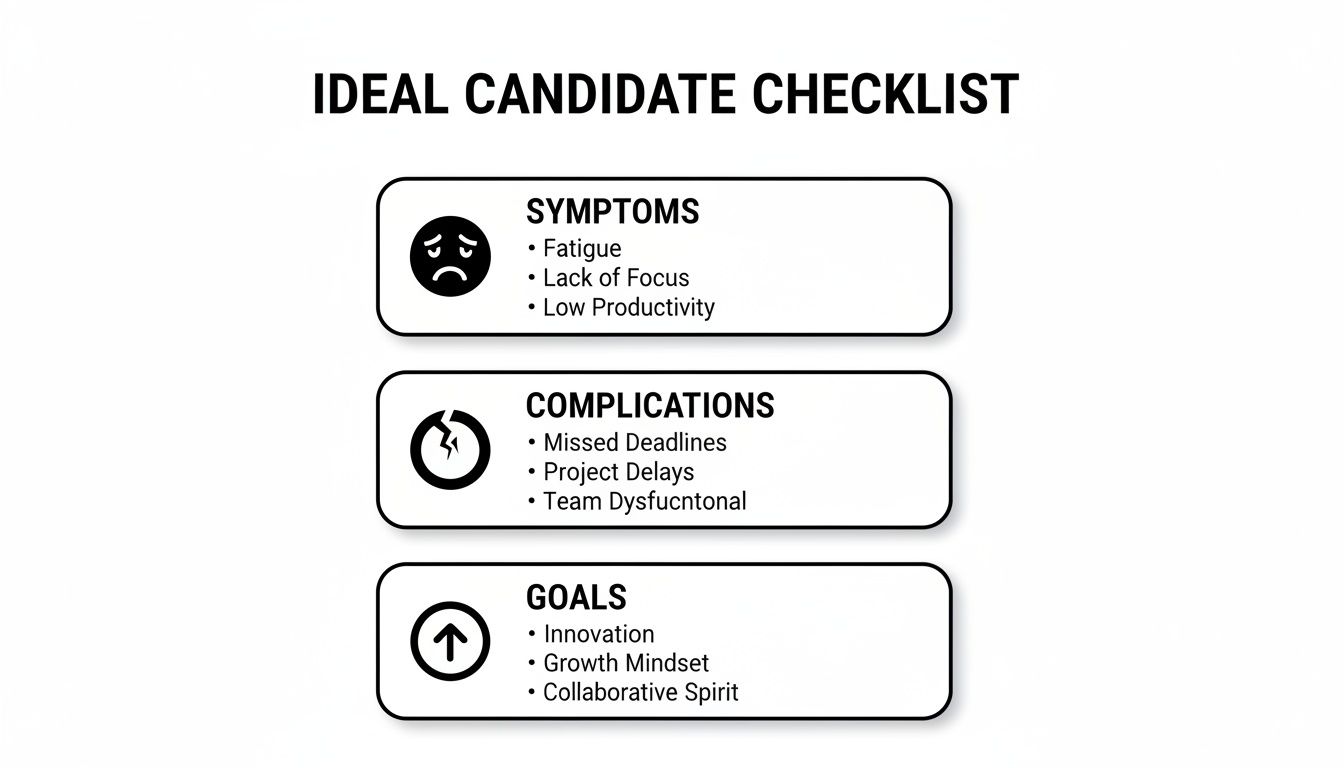
It really comes down to three things: your health symptoms, any implant-specific problems, and your desire to realign your look with your current life. These are the key topics we will discuss in depth during your consultation.
The Importance of Overall Health and Expectations
Finally, the best candidates are women who are in good overall health, have a stable weight, and do not smoke. Smoking is a major issue because it seriously gets in the way of healing.
Just as important, the best candidates have realistic expectations. The aim isn’t to perfectly recreate the volume you had with implants. Instead, the goal is to create the best possible version of your natural breasts—lifted, well-shaped, and authentically you.
Your Surgical Journey from Consultation to Final Results
Choosing to have your implant removal and breast lift is a big step, and knowing what the whole process looks like can make it feel a lot less overwhelming. Think of it as a partnership between you and your surgeon, a clear roadmap designed to take you from your first questions to your final results with confidence. Here in our Newport Beach practice, we've mapped out every step of that experience for you.

It all starts with a detailed, unhurried consultation. This first meeting is just as much about connection as it is about education. Dr. Bain will take the time to really listen to your story, understand why you’re considering this change, and hear what your ideal outcome looks like.
He’ll then do a careful physical exam to evaluate your breast tissue, skin quality, and implant position. This is your time to ask absolutely anything that's on your mind. Our goal is to make sure you leave feeling heard, understood, and fully informed.
The Day of Your Surgery
Your procedure will be performed at a top-tier, fully accredited facility like Newport Beach Surgery Center, guaranteeing the absolute highest standards of safety, privacy, and care. On the morning of your surgery, you’ll meet with Dr. Bain one more time to go over the final plan. You will also meet the board-certified anesthesiologist who will be dedicated to keeping you safe and comfortable throughout the entire operation.
The surgery itself is essentially a two-act play. First, the implants and the scar tissue that forms around them (the capsule) are meticulously removed. Then, Dr. Bain begins the breast lift, artfully reshaping your natural breast tissue and tightening the skin to give you a lifted, more youthful shape. Once he’s finished, you’ll be taken to a quiet recovery area where our specialized nursing team will monitor you as you gently wake up.
The surgical day is the culmination of careful planning. Our entire team, from the front office to the operating room staff, is coordinated to ensure your experience is smooth, safe, and centered on your well-being.
Your Recovery Timeline: A Practical Guide
Recovering from an implant removal and breast lift is a gradual process. Knowing what to expect week by week is the best way to reduce anxiety and plan your life accordingly. It's helpful to see it as a series of small, manageable milestones leading to your final outcome.
First 48 Hours
This is your dedicated rest period. You’ll feel tightness, swelling, and soreness—this is all normal and is managed with the medication we prescribe. You will be wearing a special surgical bra to provide support and keep swelling to a minimum. Your only job is to rest.
Weeks 1-2: The Return to Light Activity
During this time, swelling and bruising will peak and then start to go down. You'll notice you feel a little better each day. Most patients with desk jobs feel ready to return to work within 1-2 weeks. You can start going for light walks, but it’s crucial to avoid any heavy lifting or strenuous activity. To make your healing phase as smooth as possible, it helps to prepare your space ahead of time; you can find great tips on recovering from surgery at home.
Weeks 4-6: Resuming Your Normal Life
By now, you will feel much more like yourself. Dr. Bain will likely give you the green light to get back to most of your regular exercise routine. Your incisions will be healing nicely, and the new shape of your breasts will really start to emerge. For an even more detailed look at this phase, you can check out our guide on breast lift recovery week by week.
Settling into Your Final Results
Patience is a virtue in this final phase of healing. While you'll see a huge improvement right after surgery, it takes time for your breasts to fully "settle" and soften into their new, permanent shape. Your final, beautiful results will continue to refine themselves in the months after your procedure.
It’s a journey that typically unfolds like this:
- 3 Months: The vast majority of the swelling is gone, and your new breast shape is clear. Scars will still be pinkish but are already starting to fade.
- 6 Months: Your breasts will feel softer and will have settled into their final position on your chest. Scars will have faded quite a bit.
- 1 Year: Your results are now considered fully mature. Your breasts will look and feel completely natural, and your scars will have lightened to thin, faint lines.
Navigating Potential Risks and Ensuring Your Safety
Your safety is the most important part of any surgical decision, and an implant removal and breast lift is certainly no exception. Feeling confident in your choice means having a real, open conversation about the potential risks involved. Like any surgery, there are general risks that we work hard to avoid.
These include things like bleeding, a reaction to the anesthesia, or getting an infection at an incision site. While these are not common, particularly when operating in a fully accredited surgical center, it’s important to know about them. Our team follows extremely strict protocols to minimize these risks at every step.
Understanding Procedure-Specific Risks
Beyond the general risks of surgery, there are a few things specific to the explant and breast lift procedure to be aware of. Knowing what they are helps set realistic expectations for your healing journey.
- Scarring: Because a breast lift requires incisions, scars are simply part of the process. Dr. Bain is meticulous about placing incisions where a bra or bikini can easily hide them. He also uses advanced closure techniques to help them heal into fine, flat lines that fade quite a bit over time.
- Asymmetry: To be fair, no one's breasts are perfectly symmetrical to begin with. The goal of surgery is to create the best possible balance. It's possible to have minor differences in shape, size, or nipple position as you heal, but significant asymmetry is very uncommon with a skilled surgeon.
- Changes in Sensation: It's very normal to have some temporary numbness in the nipples and breast skin right after surgery. For most women, sensation comes back gradually over several months. In some cases, however, these changes can be permanent.
The key to minimizing risks really comes down to three things: choosing a board-certified plastic surgeon with deep experience in explant surgery, having your procedure in a top-tier accredited facility, and your own commitment to following all the post-op care instructions to the letter.
The FDA, BIA-ALCL, and Your Health
For many women, health concerns are a major reason for choosing an implant removal and breast lift. It's important to understand the FDA's guidance on implant-related health issues, as it gives crucial context for your decision. One of these issues is Breast Implant-Associated Anaplastic Large Cell Lymphoma (BIA-ALCL), which is a rare cancer of the immune system.
BIA-ALCL is not breast cancer, but it has been linked primarily to textured implants. The FDA's ongoing research and advisories have raised awareness and given many women solid, health-focused reasons for explantation, even with modern implants that have great safety records. In fact, after the FDA released advisories on BII and BIA-ALCL (which has been associated with 33 deaths worldwide), there was a 47% jump in women choosing to have their implants removed without replacement in 2021. You can find more details on these implant removal trends and safety statistics.
Part of our commitment to your safety also involves how we handle your personal information. Knowing that your clinic follows strict HIPAA-compliant communication practices is a key part of feeling secure and cared for. Your privacy is a top priority, and we take every measure to protect it.
Understanding Costs and Financing in Orange County
Let's talk about the financial side of your implant removal and breast lift. This is a really important conversation to have as you plan your journey. Here in Orange County, we break down the total investment into three clear parts. It’s all about transparency—no hidden fees, just a straightforward quote so you can plan with confidence.
First is the surgeon’s fee. This covers Dr. Bain's expertise, all the time he spends meticulously planning and performing your surgery, and every one of your follow-up appointments after the procedure. Then there’s the anesthesia fee, which pays for the board-certified anesthesiologist who will be dedicated to your safety and comfort from start to finish.
The final piece is the surgical facility fee. This covers the use of the fully accredited operating room, all the state-of-the-art equipment, and the amazing, highly-trained nursing staff who care for you before, during, and after your surgery.
Insurance Coverage and Cosmetic Costs
One of the most common questions we get is whether insurance will help with the cost. The short answer is: it depends entirely on the reason for your implant removal.
- When Insurance May Cover Removal: Insurance providers might cover the implant removal portion of your surgery if it's proven to be medically necessary. This usually requires very specific documentation, like an MRI confirming a silicone implant rupture.
- Why the Lift Is Typically Cosmetic: The breast lift (mastopexy) part of the procedure, on the other hand, is almost always considered purely cosmetic. Its purpose is to restore a beautiful shape, not to fix a medical issue, so it isn't something insurance will cover.
Think of it this way: insurance might help pay to fix a functional problem (a ruptured implant), but it won't cover the aesthetic enhancements (the lift). We'll help you navigate this process to make sure you can maximize any benefits that are available to you.
Straightforward Financing Options
We strongly believe that financial concerns shouldn't stand in the way of your health and confidence. That’s why we offer simple, straightforward financing options to help patients fit this empowering procedure comfortably into their budget. Our team is here to walk you through easy applications with trusted medical financing companies.
These plans allow you to break down the total cost into manageable monthly payments. It removes a common source of stress and lets you focus on what really matters: your recovery and your beautiful results.
Many different factors can influence the final price. We encourage you to read our detailed guide on what influences breast uplift cost for more information. When you come in for your consultation, we will provide you with a detailed, all-inclusive quote so you know exactly what to expect.
Common Questions About Explant and Breast Lift Surgery
Thinking about implant removal and breast lift surgery always brings up a lot of questions. That’s perfectly natural. To help give you some clarity and confidence as you consider your options, I’ve put together answers to the most common questions I hear from patients right here in my Newport Beach practice.
Will My Breasts Be Flat After Implant Removal and a Lift?
This is one of the biggest fears I hear, and it’s an understandable one. But the short answer is no, and the breast lift is the reason why. The entire point of the mastopexy is to prevent that exact "deflated" or "flat" look.
While we are removing the volume the implant provided, the lift procedure is all about artfully reshaping and tightening your own breast tissue. I reposition what you already have to create a new, perky, and beautifully proportional breast mound. The final size comes down to how much natural tissue you start with, but my goal is always to give you a natural shape that looks fantastic and is in harmony with your frame—not a chest that looks empty.
What Is a Capsulectomy and Is It Always Necessary?
Whenever your body encounters a foreign object, like a breast implant, it builds a wall of scar tissue around it. We call this the "capsule." A capsulectomy is the surgery to remove that scar tissue capsule. Whether it’s necessary really comes down to your individual situation and your reasons for surgery.
For any patient experiencing symptoms of Breast Implant Illness (BII) or who has a ruptured silicone implant, a total capsulectomy is absolutely the gold standard. This means I remove the entire capsule, often with the implant still inside it in one piece (a technique we call "en bloc").
An en bloc capsulectomy is my preferred technique for health-focused removals. It’s the most thorough way to ensure all foreign material and any potentially inflammatory tissue tied to the implant is meticulously taken out of your body. This is a critical step for patients whose main motivation is their well-being.
In other cases, where the goal is purely aesthetic and there are no health concerns, removing just part of the capsule might be enough. During your consultation, I’ll carefully evaluate your implants, your tissue, and your goals to recommend the specific type of capsulectomy that will give you the safest and best possible result.
How Visible Will My Breast Lift Scars Be?
Scarring is an unavoidable part of any surgery, but the surgeon's technique makes all the difference in how those scars heal and look over time. To perform an effective breast lift after implant removal, I need to make a few well-placed incisions to remove the stretched-out skin and reposition everything.
The most common incision patterns are:
- The "Lollipop" Scar: This involves an incision around the areola and another that runs vertically down to the crease under the breast.
- The "Anchor" Scar: This pattern includes the lollipop incisions but adds a horizontal incision hidden within the natural breast crease itself.
I take great pride in meticulously planning these incisions so they are placed where they'll be least noticeable. More importantly, I use advanced, multi-layered closure techniques to bring the skin together without tension. This is the key to helping scars heal into the finest, flattest lines possible. You'll also go home with a detailed scar care plan to help them fade significantly over the next year.
Are you ready to explore how an implant removal and breast lift can help you feel like yourself again? The next step is a personal consultation. Schedule a time to meet with me, Michael A. Bain, MD, in my Newport Beach office so I can answer all your questions and we can start your journey toward renewed confidence. Contact us today to get started.
Composed with Outrank