

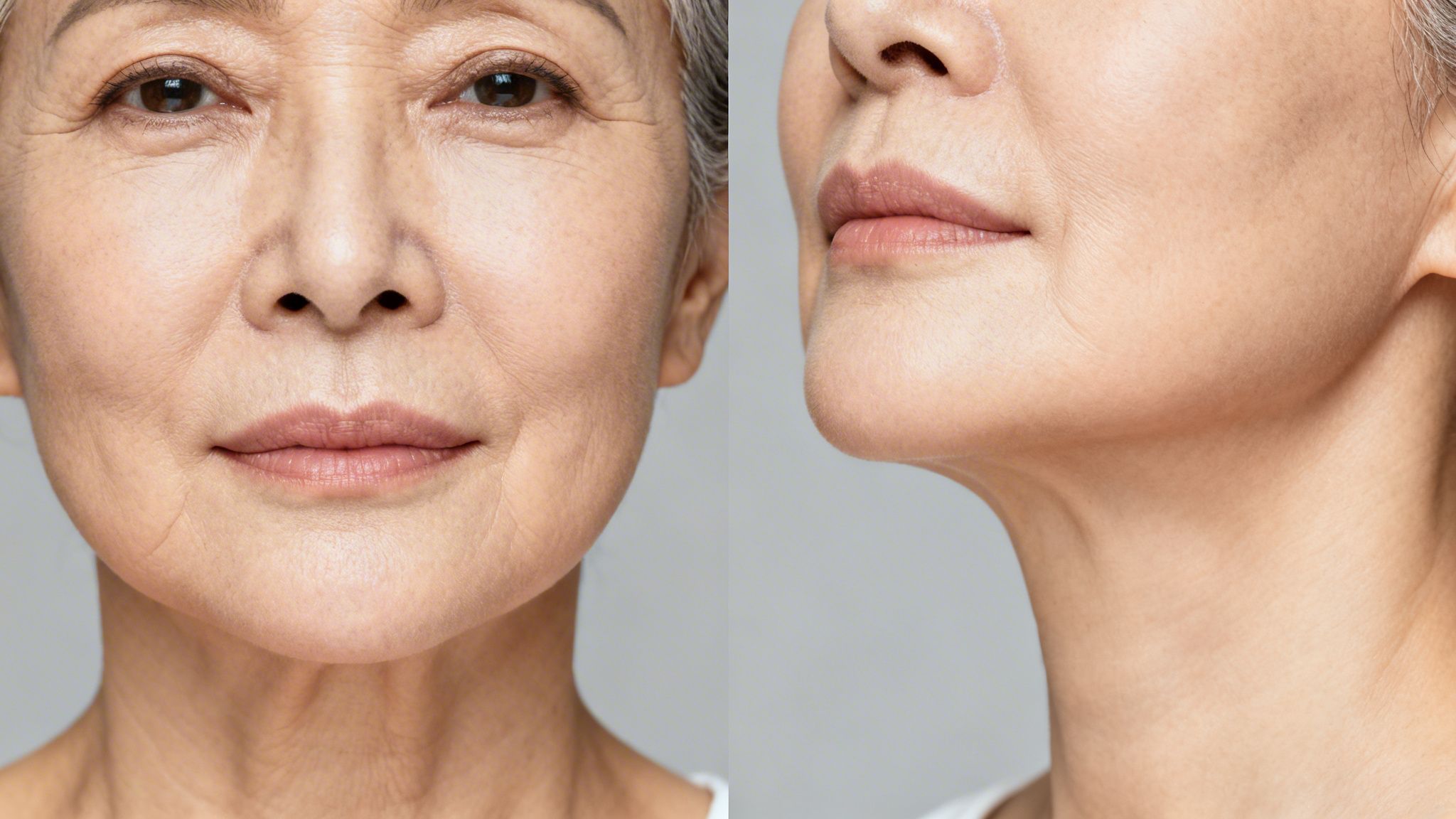
The fundamental difference is this: a facelift is designed to address sagging in the mid-to-lower face, like jowls and hollowed cheeks. A neck lift, on the other hand, specifically targets the area below the chin to correct a "turkey neck" and visible muscle bands.
Your final choice really depends on whether your primary concerns are on your face or concentrated entirely on your neck.
Understanding the Main Goals of Each Procedure
To choose between a neck lift and a facelift, you first have to understand what each surgery is designed to fix. While both offer powerful rejuvenation, they target different anatomical zones to get very distinct results.
A facelift is fundamentally about restoring the underlying structure of the lower two-thirds of the face. In contrast, a neck lift is all about sculpting the profile and sharpening the jawline. This clear separation of goals is the first step in figuring out which procedure matches your personal needs.
What a Facelift Corrects
A facelift is the gold standard for correcting age-related sagging and descent in the face itself. Its main job is to lift and reposition the underlying facial tissues and muscle (the SMAS layer) that have started to droop with time.
Key concerns that a facelift addresses include:
- Jowls that create a heavy, squared-off appearance along the jawline.
- Deep nasolabial folds (the lines from your nose to the corners of your mouth) and marionette lines.
- Hollow or sunken cheeks caused by fat pads that have descended.
- A general loss of the youthful "V-shape" of the lower face.
What a Neck Lift Corrects
A neck lift, known in medical terms as a lower rhytidectomy, is a more focused procedure. It’s designed to address signs of aging that are mainly visible below the chin and along the neck.
This surgery is often perfect for patients who are still quite happy with their facial appearance but are bothered by their neck’s contour. If you are primarily concerned with issues like sagging skin under your chin, a neck lift can be an excellent approach.
Common issues a neck lift resolves are:
- "Turkey neck," which is characterized by loose, hanging skin.
- Platysmal bands, the prominent vertical muscle bands that run down the neck.
- Excess fat that creates a double chin or hides the definition of the jawline.
The simplest way to think about it is that a facelift restores the frame and structure of your face, while a neck lift sharpens the silhouette of your profile. One deals with facial volume and sag; the other sculpts the neck and jawline.
This initial distinction is crucial for guiding your decision. The table below offers a quick summary of the primary differences to help you see which procedure might be a better fit for your goals.
At a Glance: Neck Lift vs. Facelift
This table offers a quick summary of the primary differences between a facelift and a neck lift to help you identify the best fit for your goals.
| Focus Area | Facelift | Neck Lift |
|---|---|---|
| Primary Target Area | Mid-to-lower face (cheeks and jowls) | Neck and area under the chin |
| Main Aesthetic Goal | Lifts sagging cheeks and eliminates jowls | Defines the jawline and removes a "turkey neck" |
| Addresses | Deep facial folds and volume loss | Excess skin, muscle bands, and submental fat |
Ultimately, understanding these core differences is the first step. The next is a personal consultation where we can discuss your specific anatomy and aesthetic goals in detail.
Comparing Surgical Techniques and Anatomical Goals
To understand the real difference between a facelift and a neck lift, we have to look deeper than just the skin’s surface. Each surgery uses distinct techniques because they are designed to correct entirely different anatomical structures. It’s not simply about tightening skin; it’s about rebuilding the foundational support that’s been affected by aging.
A modern facelift, especially with the advanced techniques Dr. Bain uses, is far more complex than the simple "skin pulls" of the past. The goal is to reposition the deeper tissues of the face to create a lift that is both natural and long-lasting.
Facelift Surgical Techniques
The secret to an authentic facelift result is addressing the Superficial Musculoaponeurotic System (SMAS). This is a fibrous layer deep beneath your skin that acts like scaffolding for your facial muscles and fat pads. By lifting this foundational structure, a surgeon can restore the face’s youthful contours from the inside out.
Dr. Bain specializes in advanced methods that have replaced outdated approaches:
- Deep Plane Facelift: This is a sophisticated technique where the SMAS and skin are released and repositioned together as a single, cohesive unit. By working beneath the muscle layer, Dr. Bain can achieve a powerful lift for the mid-face and jowls without any tension, resulting in an exceptionally natural and durable rejuvenation.
- SMAS Imbrication/Plication: With this approach, the SMAS layer itself is tightened with sutures, creating an internal support system for the facial tissues. The skin is then redraped smoothly over this newly reinforced foundation.
The most significant advancement in modern facelifts is the focus on the deep plane. By releasing ligaments under the SMAS, the entire cheek and jowl can be elevated as one cohesive unit, avoiding a "pulled" look and producing a far more organic rejuvenation.
Neck Lift Surgical Techniques
A neck lift, technically called a lower rhytidectomy, uses several techniques to comprehensively sculpt the neck and jawline. The surgery is precisely designed to correct sagging skin, repair separated muscles, and remove excess fat—each issue requiring its own specific solution.
The procedure usually involves a combination of the following:
- Platysmaplasty: This is the cornerstone of a powerful neck lift. It specifically targets the vertical bands (platysmal bands) that appear when neck muscles separate. Through a small, hidden incision under the chin, Dr. Bain surgically repairs and tightens these muscles, creating an internal "corset" that restores a smooth, defined neck.
- Cervicoplasty: This technique is all about removing the excess, sagging skin. Incisions are discreetly placed behind the ears, which allows the surgeon to trim away the redundant skin and create a much sleeker profile.
- Neck Liposuction: For patients who have a "double chin" caused by stubborn fat, targeted liposuction is used. This permanently removes those fat cells and helps to further sharpen the angle between the chin and neck.
Modern facelifts, like the deep plane technique, involve releasing ligaments below the SMAS to elevate the mid-face and jowls together. A 2024 review found a striking 94.4% patient satisfaction rate with deep plane facelifts, which is significantly higher than the 87.8% rate for older SMAS methods. When comparing surgical techniques, it's helpful to understand the clinics that offer various facial lift procedures to see the range of options available. In contrast, the neck lift focuses squarely on correcting the "turkey neck" by tightening the platysma muscles and smoothing vertical bands, leaving the cheeks and mid-face untouched.
Who Is the Ideal Candidate for Each Procedure
Choosing between a neck lift and a facelift has less to do with your age and everything to do with your anatomy. The right procedure is simply the one that addresses your specific concerns. While a personal consultation is the only way to know for sure, learning about the classic candidate for each can help you clarify your own goals.
The first step is always a thorough evaluation. I'll look at your skin quality, jawline definition, cheek volume, and the condition of your neck muscles. This assessment helps me determine if your concerns are isolated to one area or if they are interconnected, which would point toward a more integrated surgical plan.
The Ideal Neck Lift Candidate
The best candidate for a standalone neck lift is often someone whose face has kept its structure and volume, but their neck seems to have aged more quickly. Their main issues are almost entirely below the chin.
You might be a perfect neck lift candidate if you have:
- Isolated Neck Laxity: You’re primarily bothered by loose, hanging skin on the neck, often called a "turkey neck."
- Visible Platysmal Bands: These are prominent vertical muscle bands that run down the front of your neck, creating a cord-like look you want to smooth out.
- A "Double Chin": Stubborn fat under the chin that hides your jawline, even if you are at a healthy weight.
- Minimal Facial Sagging: This is the key difference. Your cheeks are still full, and you have little to no jowling along your jawline.
This decision tree gives you a simple starting point by focusing on what bothers you most—your jowls or your neck.
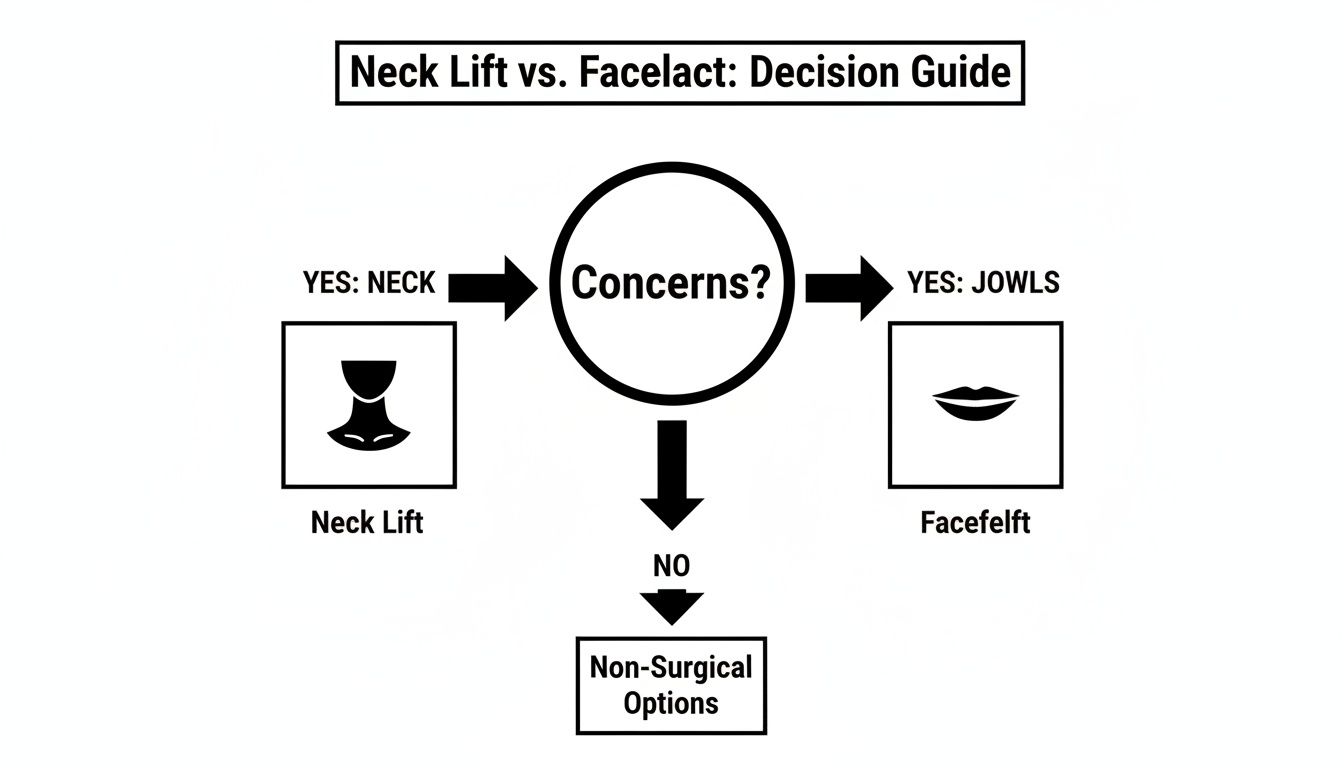
As the guide shows, if your main issue is sagging skin on the neck itself, then a neck lift is the logical place to begin the conversation with your surgeon.
The Ideal Facelift Candidate
On the other hand, a great candidate for a facelift is someone whose signs of aging are more spread out across the lower two-thirds of their face. They are usually concerned with an overall loss of definition and a heavy or tired look.
You are likely a strong facelift candidate if you're experiencing:
- Significant Jowling: This is a giveaway. The smooth line of your jaw has been broken up by sagging skin and fat, creating a heavy, squared-off appearance.
- Deep Facial Folds: Pronounced nasolabial folds (smile lines) and marionette lines are making you look sad or perpetually tired.
- Mid-Face Volume Loss: Your cheeks have started to look flat or hollowed out because the underlying fat pads have shifted downward over time.
A Critical Insight: Trying to fix significant jowls with only a neck lift is a mistake. It often leads to an unnatural, "pulled" look because it doesn't address the root cause. A facelift is the proper way to lift and reposition the facial skin and underlying tissue that create jowls in the first place.
For patients with only mild skin laxity who feel they aren't ready for surgery, it's worth looking into non-surgical skin tightening options to see if they can meet your current needs. However, for structural changes like jowls and deep folds, a surgical approach will give you the most dramatic and long-lasting correction.
When to Combine a Facelift and Neck Lift
When patients come in to discuss a neck lift vs. a facelift, the conversation often arrives at a natural conclusion: for many, the best result comes from doing both. The face and neck don’t age separately; they are a single, connected aesthetic unit. Addressing only one area can sometimes create an unbalanced look.
For a truly seamless and natural-looking outcome, combining a facelift and neck lift is often the gold standard. This approach allows for a comprehensive rejuvenation, addressing signs of aging from the cheeks all the way down to the collarbone in one procedure.
Achieving a Seamless Transition
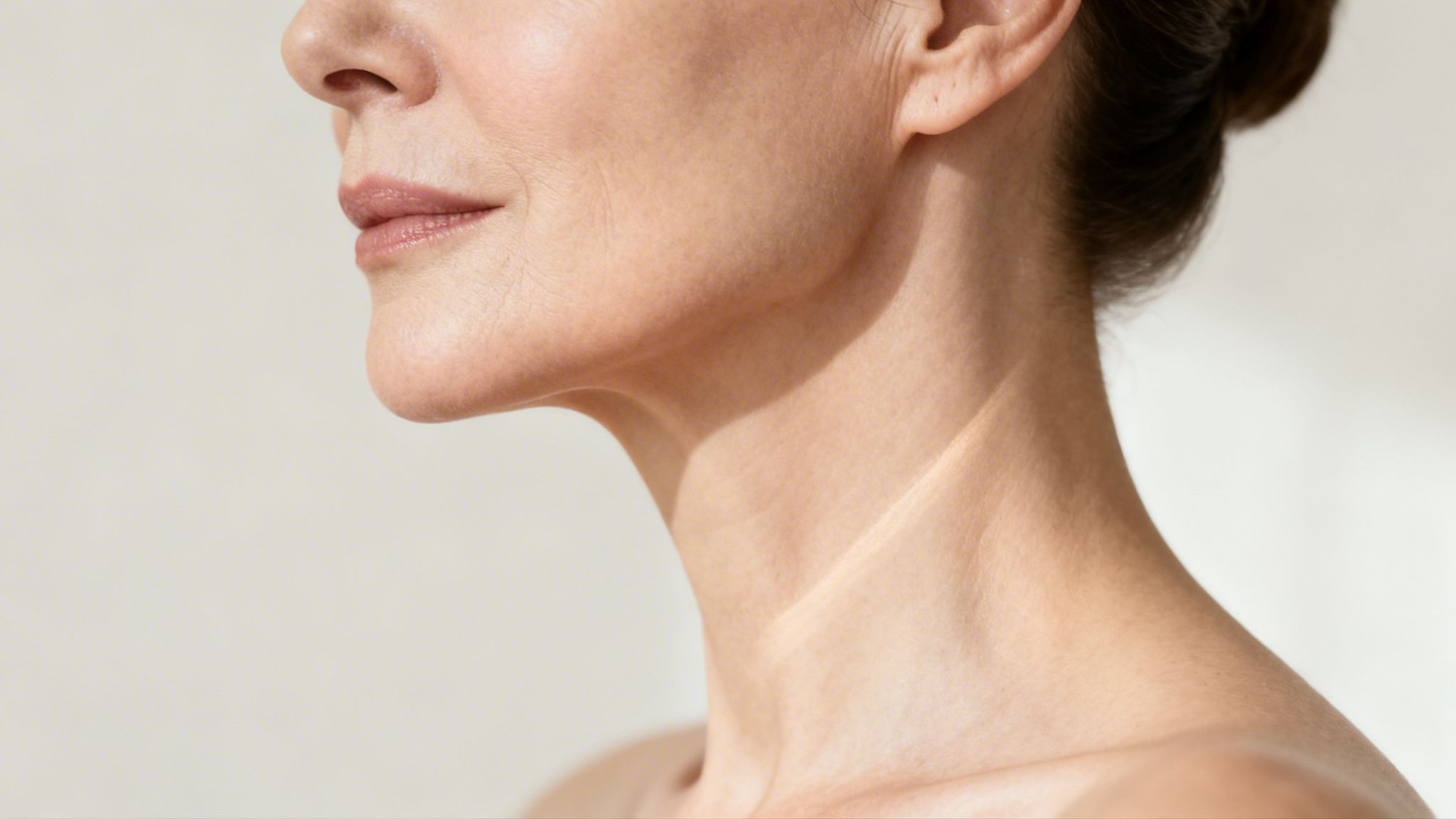
The main reason to combine these procedures is to create a smooth, continuous line from the jaw to the clavicle. A facelift that expertly corrects jowls and restores cheek volume can look unfinished if it stops at a neck with significant skin laxity or prominent muscle bands. That contrast can be jarring and is often a giveaway that a procedure was done.
On the other hand, a beautifully rejuvenated neck can actually make sagging jowls and deep facial folds more noticeable if the face isn't treated. When both areas show significant signs of aging, treating them together is the only way to restore a truly balanced and youthful profile. This strategy ensures your results look completely natural, not like a collection of separate fixes.
The Strategic Advantages of a Combined Approach
Opting for a combined facelift and neck lift has several key benefits that go beyond the final look. From a purely practical standpoint, it’s a much more efficient path to total facial rejuvenation.
Key advantages include:
- A Single Recovery Period: You only have to plan for one period of downtime. This means taking time off work and social activities once, rather than going through the healing process on two separate occasions.
- Cost-Effectiveness: Combining surgeries is almost always more affordable than staging them separately. You only pay for major expenses like anesthesia and facility fees one time.
- Comprehensive Correction: This method allows Dr. Bain to address all interconnected signs of aging—from sagging cheeks and jowls to a "turkey neck" and vertical bands—in a single, cohesive surgical plan.
Why settle for half-measures when the face and neck age as a single unit? Combining these procedures delivers unmatched harmony, addressing everything from the cheeks to the collarbone for a seamless, comprehensive result.
This unified approach is backed by high patient satisfaction and strong demand. In peak years, over 131,000 facelifts and 160,000 neck lifts were performed, but combining them is the key for many. A deep plane facelift can achieve a 94.4% satisfaction rate and last 12-15 years, while the neck lift adds firmness that can last up to a decade. Together, they can rewind the clock by 10-15 years. You can read more about how these procedures provide superior results when combined.
Who Is the Ideal Candidate for a Combined Procedure
The ideal candidate for a combined facelift and neck lift is anyone experiencing moderate to significant signs of aging in both the lower face and the neck. If you look in the mirror and are bothered by both jowling along the jawline and laxity in your neck, you are very likely a perfect candidate for this synergistic approach.
Consider this real-world scenario: a 60-year-old patient has lost definition along her jawline due to jowls, and this flows directly into loose skin and banding on her neck. Treating one without the other would only solve half the problem. For her, a combined facelift and neck lift is the clear path to a cohesive and satisfying transformation.
Recovery Timelines, Results, and Longevity
Thinking about the postoperative journey is a crucial step in planning for your facial rejuvenation. While everyone’s healing process is a bit different, comparing the typical timelines for a neck lift versus a facelift helps you set realistic expectations for downtime and the long-term value of your procedure.
One of the main differences comes down to the scale of the surgery. Because a facelift is a more extensive operation, it naturally requires a slightly longer initial recovery period than a neck lift performed on its own.
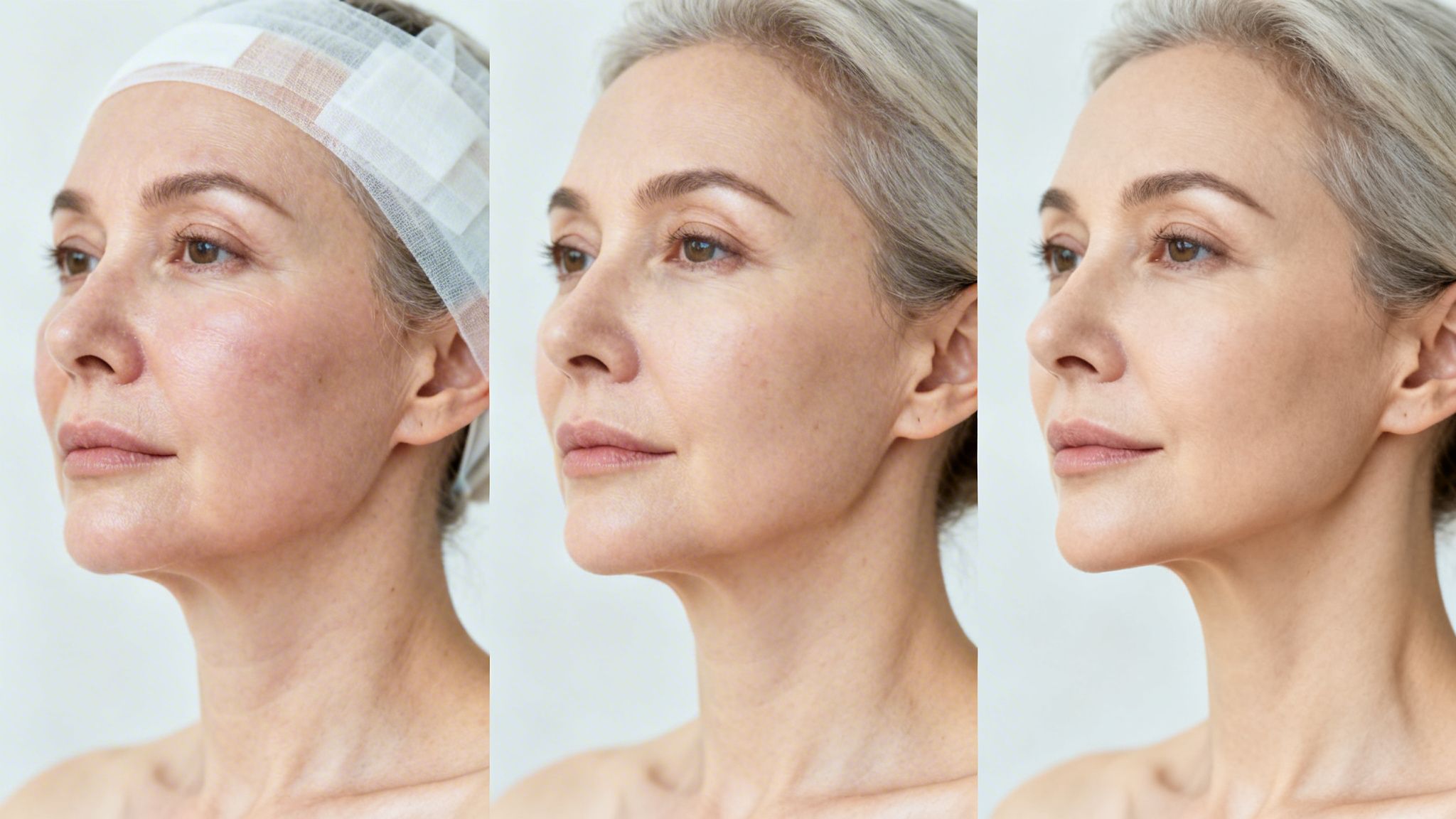
The First Two Weeks of Recovery
The initial 7-14 days are the most intensive part of healing for either surgery. During this time, you can expect some swelling, bruising, and a feeling of tightness in the treated areas. Facelift patients might see more swelling across the cheeks and mid-face, whereas recovery from a neck lift is more focused below the jawline.
You'll wear a special compression garment to help minimize swelling and support the tissues as they heal. Most patients feel comfortable enough to go back to a desk job and light daily routines within:
- 1-2 weeks after a neck lift.
- 2-3 weeks after a facelift or a combined procedure.
Comparing Long-Term Results and How Long They Last
Once the initial healing phase is over, the focus shifts to your final aesthetic results and how long you can expect them to last. A well-performed facelift brings back the youthful "V-shape" to the lower face by lifting the deep tissues, which gets rid of jowls and adds volume back to the cheeks. It’s not uncommon for patients to feel they look 10 to 15 years younger.
A neck lift, on the other hand, is all about creating contour and definition. It produces a sharp, elegant profile by tightening the underlying muscles, removing loose skin, and sculpting the jawline. The main goal here is to eliminate a "turkey neck" and restore that defined angle between the chin and neck.
A question I get all the time is, "How long will my results last?" The longevity of your procedure is one of the most important factors when comparing a neck lift vs. facelift.
Modern deep plane facelifts produce remarkably durable outcomes, often lasting 12 to 15 years. A neck lift is also a long-lasting fix, with most patients enjoying their refreshed neck contour for around 10 years. You can explore more about what affects the duration of these results in our guide on how long neck lift surgery lasts.
This table gives you a quick side-by-side comparison of what to expect for recovery and longevity.
| Milestone | Facelift | Neck Lift |
|---|---|---|
| Return to Desk Work | 2-3 Weeks | 1-2 Weeks |
| Resume Strenuous Exercise | 4-6 Weeks | 4-6 Weeks |
| Major Swelling Subsides | 3-4 Weeks | 2-3 Weeks |
| Expected Longevity | 12-15 Years | ~10 Years |
Ultimately, how you care for yourself after surgery—things like sun protection, a good skincare regimen, and maintaining a stable weight—will have a big impact on how gracefully you age. Neither procedure can stop the clock, but both offer a substantial and lasting reset.
Scheduling Your Personalized Consultation
Reading a guide is an excellent starting point, but it can’t replace a one-on-one conversation. The only way to know for sure whether a neck lift, a facelift, or a combination of procedures will deliver the results you want is to come in for a personal consultation.
This is where we move from theory to a practical plan designed just for you. It's your chance to have your facial structure properly evaluated by an expert and to map out a clear path forward.
What to Expect During Your Visit with Dr. Bain
When you meet with Dr. Michael A. Bain, he will perform a thorough physical examination, looking at your skin quality, facial volume, and the underlying muscle and bone. This isn't just a quick look—it's a detailed analysis that is critical for figuring out the best surgical approach for your specific anatomy.
Dr. Bain will listen to you describe what you're hoping to change. This conversation is key to making sure the surgical plan matches your goals.
Your consultation is the start of a partnership. Dr. Bain is committed to fully understanding your goals to ensure the final recommendation is one you feel confident and excited about.
As a board-certified plastic surgeon, Dr. Bain’s top priority is delivering safe, beautiful, and natural results that last. He’ll explain everything in clear, straightforward terms so you can make a decision you feel good about. When looking into a neck lift or facelift, it's always best to get opinions from trusted practitioners, who are often part of specialized Med Spas and Aesthetic Clinics.
Ready to take the next step in your rejuvenation journey? Contact our Newport Beach office today to schedule a private consultation with Dr. Bain and find out what’s possible for you.
Of course. Here is the rewritten section, crafted to sound like an experienced human expert and match the provided examples.
Frequently Asked Questions About Facial Rejuvenation
When you're exploring options like a neck lift or a facelift, it's natural to have a lot of questions. Patients often ask me about the same key concerns during their consultations, so let's walk through some of the most common ones right here.
How Much Does a Neck Lift vs a Facelift Cost?
Cost is always a practical consideration, and it varies based on the extent of the surgery, anesthesia, and the facility where it's performed. Because a facelift is a more involved procedure that addresses more anatomy, it will naturally have a higher price point than a neck lift performed on its own.
Interestingly, many patients find that combining the two procedures is more economical over the long term than staging them as separate surgeries years apart. The only way to get a firm, accurate number is to come in for a consultation where I can assess your specific needs and goals to provide a detailed quote.
Can Non-Surgical Treatments Achieve Similar Results?
Non-surgical options, such as Ultherapy or various injectables, definitely have their place. They are excellent for managing very early signs of aging or for helping maintain your surgical results down the road.
But it’s crucial to have realistic expectations. No non-surgical device or injectable can deliver the same outcome as a surgical lift. Only surgery allows me to physically remove excess, sagging skin and, most importantly, lift and reposition the deeper SMAS muscle layer to create a truly significant and lasting result.
What Is the Best Age for a Facelift or Neck Lift?
There is no "best" age for this type of surgery. The right time is a personal decision, driven by your genetics and how you feel about your appearance—not the number of candles on your birthday cake.
Most of my patients are between their late 40s and 70s, but the perfect time is simply when you look in the mirror and feel that your reflection doesn’t match the vitality you feel inside. The key is to address these changes when they start to bother you, whether you’re 48 or 68.
What Are the Risks of These Procedures?
As with any operation, both procedures have potential risks, such as swelling, bruising, infection, or a reaction to the anesthesia. While these complications are uncommon, it’s my responsibility to make sure you are fully aware of them.
Choosing a board-certified plastic surgeon who operates in a fully accredited surgical facility is the single most important decision you can make for your safety. This ensures you receive the highest standard of care from start to finish and that every possible measure is taken to minimize risk and deliver a safe, beautiful outcome.
Ready to get answers that are specific to you? The team at Michael A. Bain, MD is here to listen to your concerns and provide a personalized evaluation. We can help you understand which procedure will best achieve your unique goals.
Schedule your private consultation by visiting https://www.drbain.com today.