

In the world of aesthetics, non-surgical skin tightening refers to a whole class of treatments that use focused energy to address mild to moderate skin laxity—all without a single incision. Instead of relying on scalpels, these advanced procedures get your own body to do the heavy lifting by stimulating new collagen and elastin, essentially hitting the reset button on your skin from the inside.
The Shift Towards Non Invasive Rejuvenation
There’s been a major shift in how people approach cosmetic rejuvenation. Not too long ago, a surgical facelift or body lift was the only real answer for sagging skin. While these surgeries are certainly effective, they also come with significant downtime, expense, and risks that many people simply aren't willing to take on.
Today, the priority for most patients is achieving natural-looking results with minimal interruption to their lives. This demand has sparked incredible innovation in non-invasive solutions. The numbers tell the story: the global market for non-surgical skin tightening was valued at USD 1 billion in 2023 and is on track to hit over USD 1.6 billion by 2029. This growth is driven by technologies like radiofrequency (RF) and ultrasound that deliver impressive results with little to no recovery.
Why Are People Choosing This Path?
At its heart, non-surgical tightening is about working with your body, not fighting against it. I like to use the analogy of a trampoline: when you're young, the springs (your collagen and elastin fibers) are tight and bouncy. Over the years, things like sun damage, aging, and weight changes cause those springs to get stretched out and lose their snap, which we see as sagging skin.
These treatments send a targeted "wake-up call" to the fibroblasts—the tiny factories in your skin that produce new collagen. By delivering controlled heat energy deep below the surface, we’re signaling the body to start a repair process, rebuilding and strengthening that underlying support structure.
This approach gives patients a powerful middle ground that just didn't exist before: real, visible improvement without the commitment and recovery of a major operation. It’s a fantastic option for people who are just starting to see signs of aging or want to target specific problem areas that bother them.
Common Goals for Non Surgical Rejuvenation
Many of our patients are looking for the best anti-aging treatments for sagging skin that can fit into their demanding schedules. These non-surgical techniques are incredibly versatile and can be used to address a wide variety of concerns.
Some of the most popular goals we help patients achieve include:
- Facial Rejuvenation: Firming up early jowling, lifting a heavy brow, or tightening a "turkey neck" without going under the knife.
- Post-Pregnancy Contouring: Addressing lax skin on the stomach after childbirth to help a woman feel more like herself again.
- After Weight Loss: Tightening loose skin on the arms, thighs, or abdomen that remains even after hitting a goal weight.
- Preventative Care: Younger patients are increasingly using these treatments proactively to keep their collagen strong and delay the onset of more significant laxity down the road.
This guide is meant to give you clear, expert information to help you understand how non surgical skin tightening works and decide if it’s the right path for your own aesthetic goals.
How These Treatments Rebuild Your Skin From Within
To really get a handle on non-surgical skin tightening, it helps to picture your skin as a structure. The surface is just the paint job, but the real strength comes from the foundation deep underneath. These treatments aren't just spackling over cracks; they're designed to renovate that deep, internal framework, getting your body to rebuild itself from the inside out.
The one thing almost all these technologies have in common is how they trigger collagenesis—the body's process for creating new collagen. They work by sending controlled heat down into the deeper layers of your skin. This heat creates what we call a "controlled thermal injury," which sounds much worse than it is. It’s really just a signal. Your body’s natural repair crew immediately gets the message and kicks into gear, telling cells called fibroblasts to start weaving fresh, strong collagen and elastin fibers.
Over the next few weeks and months, this new collagen foundation remodels and contracts. The result is skin that looks firmer, feels smoother, and sits a little higher. This isn't an overnight miracle; it’s your own body doing the work on its own schedule. That's why the results look so natural—because they are.
Radiofrequency: The Smart Thermostat for Your Skin
Radiofrequency (RF) is one of the most trusted and popular ways we tighten skin without surgery. You can think of it like a smart thermostat for the deeper layers of your skin. A handpiece delivers a gentle electrical current that warms the dermis to a very specific temperature, usually right around 40-43°C (104-109°F).
This targeted warmth is just the wake-up call your fibroblasts need to get back on the job of producing new collagen.
- How It Feels: Patients often tell me it feels like a warm, deep heating sensation, almost like a hot stone massage. The surface of your skin stays comfortable and cool the whole time.
- The Mechanism: The trick is bulk heating. The RF energy passes right through the top layer of skin without damaging it and concentrates its warmth in the collagen-rich dermis below. You get a little bit of immediate collagen contraction for a subtle tightening effect right away, but the real magic happens over the next few months as new collagen is built.
- Best For: RF is a fantastic tool for tackling general skin looseness, softening fine lines, and improving the overall texture and health of the skin on the face, neck, and even the body.
Because it warms up a broad area, RF is a go-to foundational treatment for anyone just starting to notice that loss of firmness or "snap" in their skin.
High-Intensity Focused Ultrasound: The Magnifying Glass Effect
If RF is about bulk heating, then High-Intensity Focused Ultrasound (HIFU) is more like a sniper. Imagine using a magnifying glass to focus a beam of sunlight onto one tiny, powerful spot. HIFU does something very similar, but it uses sound waves to create that focus point deep under your skin.
HIFU is unique because it completely bypasses the surface of the skin. It delivers focused ultrasound energy to create tiny, precise points of heat at very specific depths. In fact, it can target the SMAS layer—the very same foundational tissue that plastic surgeons lift during a surgical facelift.
This incredible precision allows for a powerful lifting and tightening effect from below. Your body’s healing response rushes to these specific thermal points, kicking off a major collagen-building project that contracts and lifts the tissue over time.
This makes HIFU an incredible option for creating a visible lift in places like the brow, jowls, and neck. It’s one of the truest non-surgical methods we have for targeting the deep structural supports of the face.
RF Microneedling: Combining Two Powerhouses
So, what happens if you combine the deep, collagen-stimulating heat of radiofrequency with the proven power of microneedling? You get RF Microneedling, and it’s a game-changer. This procedure uses a specialized device with ultra-fine, insulated needles that penetrate the skin to a perfectly controlled depth.
Once those needles are exactly where they need to be, they deliver a quick burst of radiofrequency energy directly into the dermis. This creates a potent one-two punch:
- Microneedling: The tiny micro-channels created by the needles trigger your body's natural wound-healing response all on their own.
- Radiofrequency: Adding that burst of focused heat deep within the dermis dramatically amplifies the production of both collagen and elastin.
This combination is a workhorse, proving incredibly effective not just for tightening skin but also for smoothing out texture, improving acne scars, and shrinking pore size. Because the heat is delivered deep below, it doesn't affect the skin's surface, making it a safe and effective option for all skin types with less downtime than many aggressive lasers.
Thread Lifts: A Scaffold for Your Skin
Thread lifts offer a completely different and more direct approach to lifting sagging skin. This is a minimally invasive procedure where we place dissolvable, medical-grade sutures (or "threads") just beneath the skin with a fine needle. These aren't just simple threads; many are designed with tiny, invisible barbs or cones that gently grip the underside of the skin.
As soon as they are in place, the threads can be used to physically lift the sagging tissue into a higher, more youthful position. The result is an immediate, visible lift you can see right away.
But that’s only half the story. The threads themselves are made from materials like Polydioxanone (PDO), the same safe material used in absorbable surgical stitches for decades. As your body naturally dissolves these threads over several months, it builds a "scaffold" of brand-new collagen in their place. This creates a secondary, long-lasting tightening effect that helps support the lift long after the threads are gone. It's a brilliant combination of an instant mechanical lift followed by your body’s own biological rejuvenation.
Choosing The Right Skin Tightening Technology For You
Now that we've covered how these technologies work, the next step is applying that knowledge to your specific goals. The best non surgical skin tightening plan is never a generic package. It’s about a careful diagnosis, matching the right tool to the right problem—whether that’s firming up sagging jowls, tightening a "turkey neck," or improving loose skin on the stomach after weight loss.
Each method has its strengths, making it better for certain areas of the body and certain types of skin laxity. Knowing the difference helps you have a more productive conversation with your provider, ensuring the treatment plan is perfectly aligned with the results you want to see.
Matching Concerns To Treatments
Let's break this down into practical terms. If you're looking in the mirror and are bothered by mild, crepey texture on your face or neck, a broad-heating technology like standard Radiofrequency (RF) is an excellent place to start. It works beautifully to improve overall skin quality with a gentle, uniform firming effect. Think of it as reinforcing your skin’s existing structure from within.
However, if your main concern is more structural, like a noticeable droop along the jawline or a heavy brow, you need a technology that can go deeper. This is where High-Intensity Focused Ultrasound (HIFU) really proves its worth. By targeting the deep, foundational SMAS layer of tissue, HIFU provides more of a lift from below, helping to reposition tissue without surgery.
For issues that involve both skin laxity and surface texture—like fine lines and acne scars combined with some sagging—RF Microneedling is an exceptional choice. When looking into these combined technologies, Morpheus8 is a popular and effective option that leverages this dual-action approach. It rebuilds the skin’s surface and deep structure at the same time.
Finally, for someone who wants an immediate and visible lift, a thread lift delivers that instant result. It’s the most direct, non-surgical way to physically elevate sagging facial tissue, but it also gives you the long-term benefit of stimulating collagen. This makes it a great option for patients who want to see a change right away while still investing in their skin's future health.
This concept map helps visualize how these different methods all aim to rejuvenate the skin's structure.
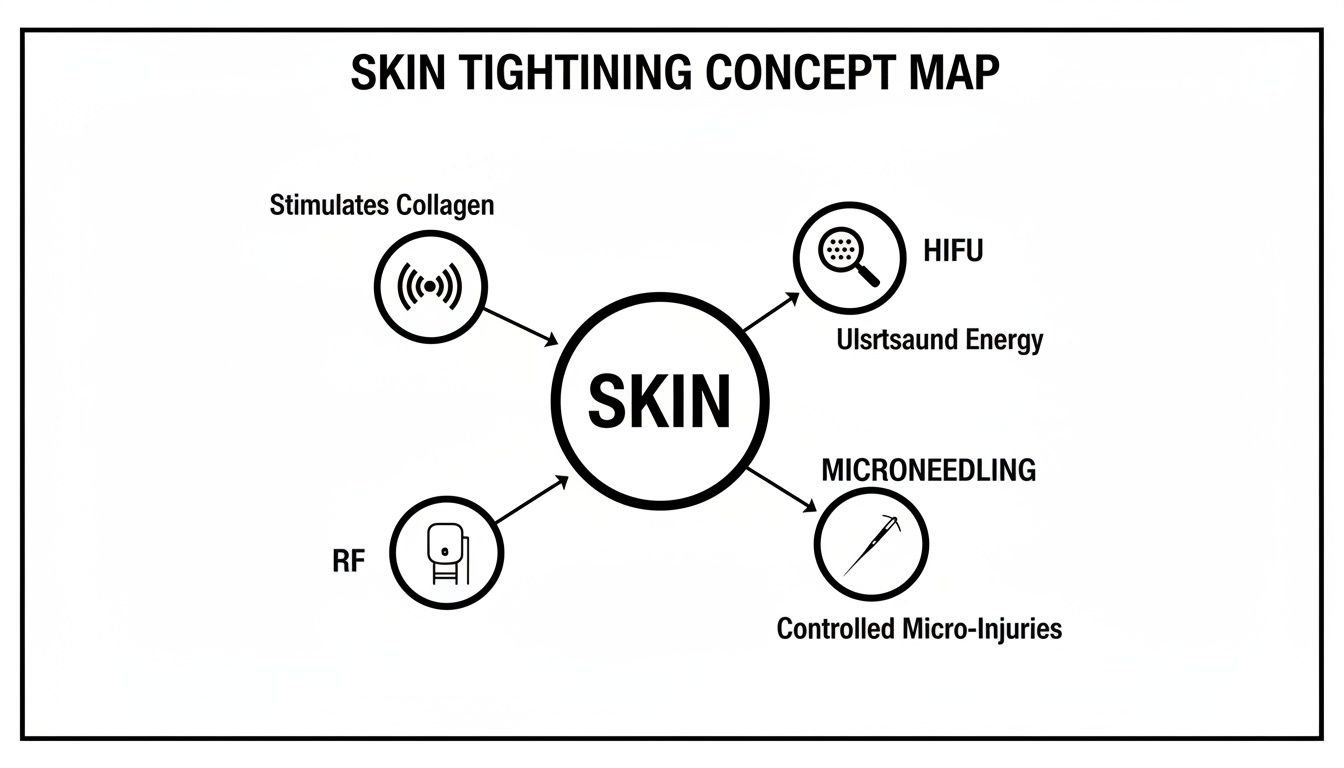
The key takeaway is that these popular treatments all work by triggering your body’s own natural healing and regenerative processes to restore firmness and structure to the skin.
A Clear Comparison Of Your Options
To make this even clearer, let's look at the key differences side-by-side. You can use this table as a quick guide to understand what each technology truly offers. We'll compare how they work, the areas they treat best, and what to expect for sessions and downtime.
Comparing Non Surgical Skin Tightening Technologies
This table breaks down the most common technologies to help you understand their unique applications and what to expect from a treatment course.
| Technology | How It Works | Best For | Typical Sessions | Downtime |
|---|---|---|---|---|
| Radiofrequency (RF) | Uses gentle, bulk heating to warm the dermis and stimulate widespread collagen production. | Mild laxity, fine lines, and improving overall skin texture on the face, neck, and body. | 3-6 sessions | Minimal to none |
| HIFU | Delivers focused ultrasound energy to precise, deep points, including the foundational SMAS layer. | Lifting and tightening the brows, jowls, and neck; ideal for moderate structural sagging. | 1-2 sessions | Minimal to none |
| RF Microneedling | Combines microneedling with RF energy delivered deep into the dermis via fine needles. | Moderate laxity, textural issues, acne scars, and enlarged pores on the face and body. | 3-4 sessions | 1-3 days of redness |
| Thread Lifts | Places dissolvable sutures under the skin to provide an immediate mechanical lift and stimulate collagen. | Instantly lifting sagging cheeks, jowls, and neck tissue for a more defined facial contour. | 1 session | 3-7 days of mild swelling/bruising |
This gradual improvement is often preferred by patients who are looking for subtle, natural-looking changes over time. A series of RF treatments, for example, can slowly but surely tighten loose skin on the abdomen—a common concern after pregnancy or weight loss. These techniques are quite versatile; you can learn more about how they are applied by reading our guide on the non-surgical breast lift.
Ultimately, each approach has its place. The best one for you depends entirely on your anatomy, your goals, and your lifestyle.
So, Are These Procedures Right for You?
Figuring out if non surgical skin tightening is the right path for you really comes down to an honest look at your skin and your goals. These treatments aren't magic, but for the right person, the improvements can be genuinely remarkable, all without the long recovery and risks that come with surgery.
The best candidates are usually those with mild to moderate skin laxity. What does that mean? It’s skin that's lost some of that firm, youthful "snap-back" quality but isn't significantly sagging yet. Maybe you're starting to see the beginnings of jowls, a bit of softness under the chin, or that crepey texture on your arms or stomach. You're looking for a real improvement—firmer, tighter, smoother skin—but you just aren't ready to commit to a surgical procedure.
What Determines Your Results?
Your body is what does the real work of creating new collagen, so your overall health and a few personal factors play a big role in the final outcome.
We have to consider a few things:
- Age and Skin Health: Younger skin that still has good elasticity naturally responds better to this kind of stimulation. There isn't a hard age limit, but patients who begin treatments as soon as they notice these early changes often get the best results, both for correction and prevention.
- Your Lifestyle: Nothing destroys collagen faster than smoking and chronic sun exposure. These habits actively work against what we're trying to achieve, and they can really limit how effective any skin tightening procedure will be. Living a healthy lifestyle is one of the best ways to support better, longer-lasting results.
- Realistic Expectations: It’s important to understand that non-surgical treatments create gradual, natural-looking changes. They won't give you the dramatic, overnight transformation of a facelift, but they will absolutely help to visibly firm and rejuvenate your skin over the course of several months.
When Do These Treatments Really Work Best?
Certain situations and life stages make someone a perfect fit for non-surgical tightening. We see these treatments are especially popular with the 35-55 age group, who are often looking for alternatives to a neck lift or want to feel more confident as part of a "mommy makeover." The data backs this up; Baby Boomers and Gen X make up roughly 60% of clients in North America. Here in Orange County, it’s common for clinics to see bookings for RF and ultrasound treatments jump by 25-30% each year. You can explore more data on market trends to see just how much this field is growing.
These procedures are particularly effective for:
- Post-Pregnancy Recovery: For new mothers dealing with loose skin on their abdomen after having children, these options can help restore firmness without needing a full tummy tuck.
- After Major Weight Loss: Once you've hit your goal weight and it’s stable, these treatments are great for tightening up the mild skin laxity that can remain on the stomach, arms, or thighs.
- Facial Upkeep and "Prejuvenation": If you're just starting to notice a less-defined jawline or early jowls, these treatments are ideal for getting ahead of the aging process and putting off the need for more invasive procedures down the line.
Who Might Be a Better Fit for Surgery?
It's just as important to be upfront about when a non-surgical approach won't be enough. If you have significant skin sagging—the kind often seen after massive weight loss or with more advanced aging, where there's a lot of excess, hanging skin—a surgical procedure like a facelift or a body lift is almost always going to be the better choice to get the results you want.
Knowing your starting point is the first step toward a great outcome. When you can match your skin's current condition and your aesthetic goals with the right procedure, you can move forward on your journey with confidence.
Weighing Your Options: Surgical Versus Non-Surgical
Deciding between a surgical lift and a non-surgical skin tightening treatment is one of the most important conversations we have. It’s an honest discussion about trade-offs, where we weigh the desire for dramatic results against factors like recovery time, cost, and how long you can expect those results to last. There's no single "best" path—only the one that truly fits your goals, your lifestyle, and your budget.
A surgical procedure, like a facelift or a tummy tuck, delivers the most powerful and immediate transformation. We are physically removing excess, sagging skin and often tightening the muscle layer underneath. The change is profound. But, this level of change comes with the realities of surgery: general anesthesia is required, incisions are made, and there will be a recovery period that can take weeks.
Non-surgical options, on the other hand, offer a completely different approach. They're designed for visible, yet very natural-looking improvements with almost no interruption to your daily life. The goal here is to prompt your own body to build new collagen. This means the results emerge gradually over a few months, ensuring you still look like yourself—just a firmer, more refreshed version.
The Big Picture Comparison
When my patients are weighing their options, I find it helps to break the comparison down into the four factors that matter most. Understanding these key differences is essential for setting the right expectations and making a decision you feel confident about.
- The Results: Surgery gives you an immediate, dramatic change by physically removing loose skin. Non-surgical methods deliver a more subtle, natural-looking firmness that builds up over time.
- The Downtime: Surgical procedures require significant downtime—often 2-6 weeks away from your normal routine. Most non-surgical treatments have zero downtime, with maybe some minor redness that’s gone in a day.
- The Longevity: A surgical lift is considered very long-lasting, though of course, the natural aging process continues. Non-surgical results typically last 1-2 years and benefit from periodic maintenance sessions to keep things looking sharp.
- The Risk Profile: Any major operation carries inherent risks related to anesthesia, infection, and scarring. Non-surgical options have a much lower risk profile, with side effects usually limited to temporary, mild swelling or redness.
Seeing these differences laid out side-by-side really helps clarify the trade-offs.
| Factor | Surgical Skin Tightening (e.g., Facelift) | Non-Surgical Skin Tightening |
|---|---|---|
| Result | Dramatic, immediate, transformative | Natural, gradual, noticeable improvement |
| Downtime | Significant (weeks of recovery) | Minimal (hours to a few days) |
| Process | Invasive, involves incisions and anesthesia | Non-invasive, uses energy to stimulate collagen |
| Longevity | Very long-lasting (many years) | 1-2 years with maintenance |
| Ideal For | Severe skin laxity, significant sagging | Mild to moderate laxity, preventative care |
The Critical Role Of Cost
For many people, the cost is a major deciding factor. Surgical procedures are a significant upfront financial commitment. In contrast, non-surgical skin tightening treatments provide a much more accessible starting point, making them a practical choice for a wider range of patients.
Patient satisfaction with these non-surgical options is quite high, often around 85-90%, because the results can be fantastic for the right person. A full course of treatments, which is typically 3-6 sessions, might cost between $2,000 and $4,000. When you compare that to a surgical procedure that can easily run over $15,000, the financial difference is clear. You can read more about the market dynamics that make these treatments so appealing.
The decision ultimately comes down to your personal priorities. Are you seeking a dramatic, one-time transformation and are prepared for the associated cost and recovery? Or do you prefer a less invasive path with gradual, natural-looking results that fit more easily into your life and budget?
It’s also important to know that these two paths aren’t always mutually exclusive. Sometimes, a procedure like liposuction is performed to remove stubborn fat, but the skin doesn't bounce back as much as we’d like. In these situations, non-surgical tightening can be a fantastic follow-up to refine and perfect the final result. If this sounds like your situation, you might be interested in our article on whether liposuction tightens loose skin. It provides more detail on how these different procedures can work together.
Why Your Choice of Provider Is the Most Critical Step
The advanced technology behind non surgical skin tightening is only half of the story. The person operating the device—their experience, artistic eye, and deep understanding of anatomy—is what truly determines the quality and safety of your results. An incredible tool in the wrong hands can easily deliver disappointing outcomes or worse.
Think of it this way: you can give two artists the exact same high-quality marble and chisel, but only the master sculptor will create something beautiful. The other might just make a mess. In cosmetic medicine, the provider is the artist. Your safety and your satisfaction depend entirely on their skill.
What Defines an Expert Provider
When you're looking for a provider, there are several non-negotiable standards you should expect. These things ensure you're in the hands of a professional who prioritizes both safety and natural, refined results.
- Board Certification: This is the most important credential to look for. A board-certified plastic surgeon, like Dr. Michael A. Bain, has gone through years of intense training in both surgical and non-surgical procedures.
- Device-Specific Experience: You should ask how many treatments they've actually performed with the specific machine being recommended. Real experience means they understand the subtleties of adjusting energy levels for different skin types and body areas.
- A Strong Portfolio: An expert provider will always have a large gallery of before-and-after photos showing their work. You want to see results that look refreshed and natural, not overdone or "worked on."
The best results always come from a provider who can accurately figure out the real cause of skin laxity—whether it's collagen loss, fat shifting, or both—and then pick the right technology to fix it. This requires a profound grasp of facial and body anatomy.
Why Dr. Bain Is a Trusted Choice in Orange County
For patients in Newport Beach and the rest of Orange County, Dr. Michael A. Bain has built his practice on these principles. As a board-certified plastic surgeon, his approach is grounded in medical excellence and a keen artistic vision. He understands that effective non surgical skin tightening is a mix of science and art.
Dr. Bain’s philosophy is to create a truly personalized treatment plan for every patient. He knows that each person's body and goals are unique, and that calls for a custom strategy, not a one-size-fits-all treatment. His commitment to patient safety and delivering consistently excellent outcomes makes him a trusted authority for those seeking real, lasting improvement.
Because he has deep knowledge of both surgical and non-surgical options, you can be sure you're getting an honest recommendation for what will actually work best for you. This is also a key difference you'll find when exploring the benefits of a true medical spa environment that operates under a plastic surgeon's direct supervision.
Frequently Asked Questions
Even after learning about non-surgical skin tightening, it's natural to have more specific questions. Here, we address the inquiries we hear most often from our patients, providing straightforward answers to help you move forward with confidence.
How Long Do Non-Surgical Skin Tightening Results Last?
This is one of the first things most patients want to know. While the results can be fantastic, they aren't permanent. Because these treatments stimulate your own body to build new collagen, you can typically expect the improvements to last anywhere from one to two years.
Your body's aging process will continue, of course. The best way to maintain your results is with occasional follow-up treatments. Many of our patients find that scheduling a single maintenance session once a year is a great strategy to keep their skin looking firm and refreshed.
Are Skin Tightening Treatments Painful?
The thought of pain is a common worry, but patients are almost always surprised by how comfortable these procedures really are. Most people describe the sensation as a deep, gentle warmth in the treatment area, much like a hot stone massage.
To make sure the experience is as pleasant as possible, we almost always apply a topical numbing cream before we begin. On top of that, modern devices have built-in cooling systems that protect the surface of your skin, making the treatment very easy to tolerate. Any feeling of warmth is gone the moment the session ends.
Can I Combine These Treatments With Other Procedures?
Absolutely. In fact, combining treatments is often the best way to achieve a full-scale rejuvenation. Non-surgical skin tightening works very well with other aesthetic procedures, and together, they can produce a result that is far better than what any single treatment could do alone.
A few popular combinations include:
- Injectables: Using products like Botox to relax expression lines or dermal fillers to bring back lost volume is a perfect partner to skin tightening.
- Skin Resurfacing: Following a tightening procedure with a laser treatment or chemical peel can tackle laxity, uneven texture, and pigmentation all at once.
A skilled provider will look at your unique facial structure and concerns to design a layered treatment plan that addresses everything you want to improve for the best possible outcome.
How Much Downtime Should I Expect?
This is one of the single biggest benefits of choosing a non-surgical option. For the majority of these treatments, there is practically no downtime. Most patients leave with just some mild redness or a little swelling, similar to a minor sunburn, that usually fades within a few hours. You can go right back to your normal routine, including work or social events, immediately after your appointment.
If you're in Orange County and ready to explore how a personalized plan can help you achieve your aesthetic goals, we invite you to consult with a true expert. The team at Michael A. Bain, MD combines board-certified expertise with an artistic approach to deliver results that are both beautiful and natural.