

Choosing between saline and silicone breast implants is one of the first, and most important, conversations we'll have on your breast augmentation journey. This isn't just about picking a material; it's about defining how your new breasts will look, feel, and integrate into your life for years to come.
The choice really boils down to your personal priorities. While silicone implants are overwhelmingly popular for their remarkably natural feel, chosen in over 87% of all augmentations, saline implants offer a different kind of reassurance with their straightforward rupture detection.
The Core Decision: Saline or Silicone Implants
Understanding the fundamental difference between these two implant types is the key to making a decision you'll feel confident about. The distinction lies entirely in their filler material, and that one difference influences everything from the surgical approach to your long-term results and care.
This visual guide breaks down the main trade-offs. You can see how saline's sterile saltwater filling results in a firmer feel and a very obvious deflation if it ruptures. On the other hand, silicone's cohesive gel provides that soft, natural texture but requires imaging to confirm its integrity.
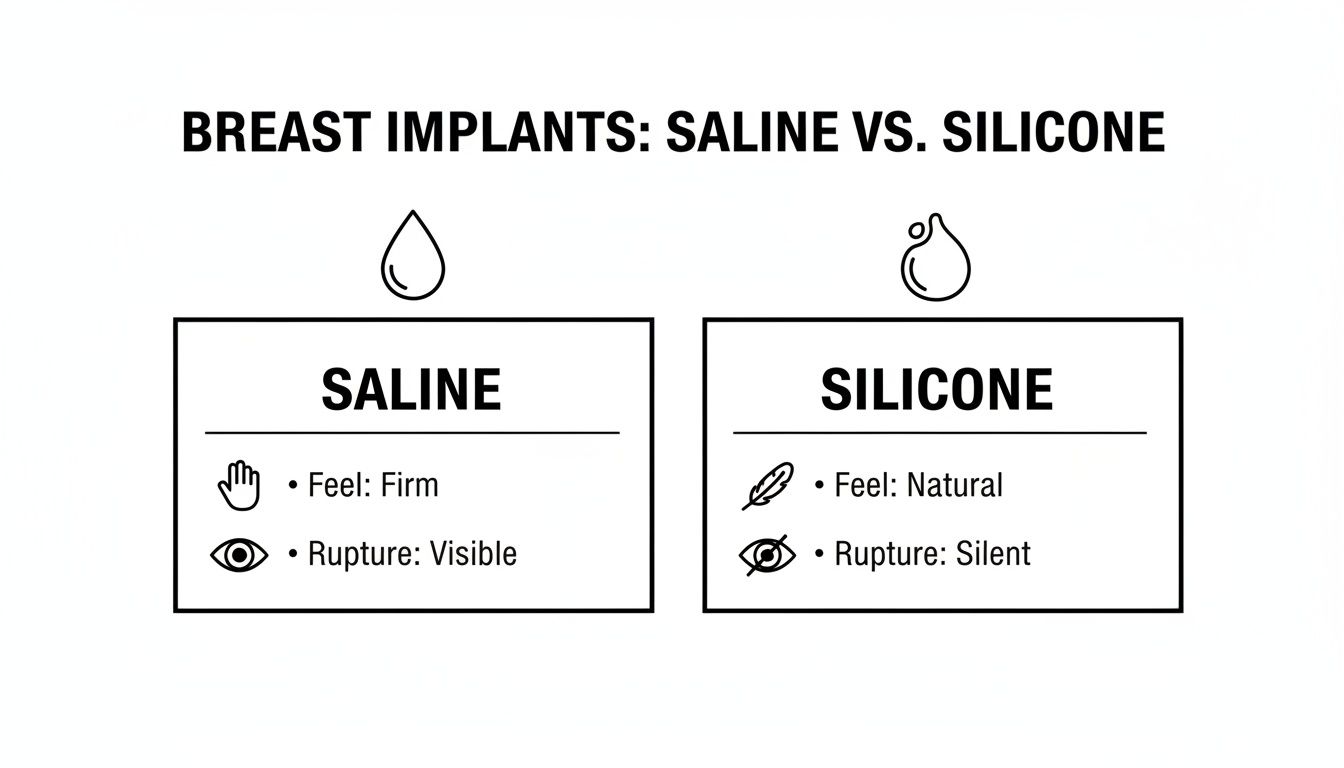
Ultimately, the right choice for you is a balance between the assurance of visible safety and the desire for the most natural aesthetic possible.
Understanding The Materials
Both implant types have a durable outer silicone shell. The real difference is what's on the inside.
- Saline Implants: We place these shells into the breast pocket while they are empty. Once they're perfectly positioned, they are filled with sterile saltwater to achieve your desired size. This technique allows for a smaller incision.
- Silicone Implants: These implants arrive pre-filled with a cohesive silicone gel that has a consistency very similar to natural breast tissue. Because they are already filled, they require a slightly larger incision for placement.
The most significant takeaway is that the filler material—sterile saltwater versus cohesive gel—dictates nearly every other characteristic of the implant, including its feel, rupture behavior, and incision requirements.
This single factor is why one feels firmer and the other feels softer. It's also why one type of rupture is immediately obvious, while the other is "silent" and needs regular monitoring. For patients who are also interested in using their own body tissue for augmentation, you can explore a different path in our guide on fat transfer breast augmentation.
Quick Comparison: Saline vs. Silicone Implants
To help you see the differences side-by-side, this table gives a quick summary of the key characteristics of each implant. It's a great starting point for our more in-depth conversation during your consultation.
| Feature | Saline Implants | Silicone Implants |
|---|---|---|
| Composition | Silicone shell filled with sterile saltwater | Silicone shell filled with cohesive silicone gel |
| Feel | Can feel firmer and more uniform | Softer, closely mimics natural breast tissue |
| Incision Size | Smaller, as implant is filled after placement | Larger, as implant is pre-filled |
| Rupture | Deflates, providing immediate visual detection | "Silent" rupture, requires MRI/ultrasound to detect |
While tables are helpful for a high-level view, the best choice always comes down to your unique anatomy, lifestyle, and aesthetic goals. We'll discuss all these factors to find the perfect fit for you.
When we talk about choosing between saline and silicone breast implants, one of the most important conversations I have with patients revolves around how they will actually look and feel. This isn't just about picking from a list of features; it’s a personal decision that shapes how your new breasts will move, feel to the touch, and look as a part of your body.
The difference in feel comes down to what’s inside the implant shell. This is the single biggest reason one type feels different from another.
The Feel: The Softness of Silicone vs. The Firmness of Saline
Silicone implants are filled with a cohesive gel that is specifically made to mimic the feel and weight of natural breast tissue. When you hold or touch a silicone implant, it has a soft, responsive quality that gives way under pressure, very much like a natural breast. This is why so many of my patients say it gives them a result that feels completely seamless and natural.
Saline implants are quite different. They are filled with sterile saltwater, which gives them a more uniform and firm feel. While some patients don't mind this firmness, those who are looking for the softest, most natural-feeling result often find silicone to be the better option.
A patient’s satisfaction often comes down to the final look and feel. The ability of silicone to mimic natural tissue is a major reason for its popularity. In fact, surveys have shown that 87% of silicone patients are happy with the firmness of their breasts, a testament to its more natural quality compared to saline.
The Look: Rippling and Implant Visibility
One aesthetic concern we always discuss is the potential for "rippling," which is when the implant shell creates visible wrinkles or folds that can be seen through the skin.
Because saline is a liquid, the implant shell isn't as consistently filled, making it more prone to folding or wrinkling. This can be especially noticeable in patients who have very little natural breast tissue or thinner skin, as there isn't enough of a natural layer to hide these small imperfections.
Silicone implants tend to have a much lower risk of visible rippling. The cohesive gel fills the implant shell completely, providing internal support that helps it keep a smooth, consistent shape. This is a significant advantage, particularly for leaner patients who want a natural contour without any tell-tale signs of an implant. While some visible rippling can still occur—reported by around 35% of silicone patients—it's a far more common issue with saline.
How Implant Placement Mitigates Rippling
The surgical technique I use is just as important as the implant choice when it comes to preventing rippling. One of the most effective methods is submuscular placement, which means positioning the implant either partially or completely behind the pectoral muscle. This adds an extra layer of tissue over the implant, acting as a natural cushion.
This additional coverage is crucial because it helps to:
- Soften and hide the edges of the implant.
- Greatly reduce the visibility of any potential ripples.
- Create a smoother, more gradual slope from the chest wall out to the breast.
For any patient with thin skin or not much existing breast tissue, placing the implant under the muscle is almost always the best approach for achieving a result that looks and feels completely natural. While your implant choice matters, the surgical plan I create for your specific anatomy is what truly brings it all together. To learn more about how all these factors work together, our breast implant size guide offers an in-depth look at how size and placement influence your final outcome.
Of all the things my patients and I discuss, long-term safety is always at the top of the list. When you're choosing between saline and silicone implants, it’s crucial to understand what happens in the rare event of a rupture and what that means for your health and peace of mind down the road.
The way each implant behaves if its outer shell is compromised is completely different. This is a major factor, as it directly shapes the follow-up care and monitoring you’ll need for the life of your implants.
How You Know If a Saline Implant Has Ruptured
With a saline implant, a rupture is an unmistakable event. The implant is filled with sterile saltwater, so if a leak occurs, the implant simply deflates—much like a balloon losing air. The change is usually quite obvious within 24 to 48 hours.
You’ll know a saline implant has ruptured if you notice:
- A clear and often sudden decrease in the size of one breast.
- The breast shape looks flattened or distorted.
- A feeling of lopsidedness or asymmetry as one breast becomes smaller.
The good news is that the fluid is just sterile saltwater, which your body absorbs without any harm or health risks. This built-in, obvious detection system means you don't need any special scans or tests to know there's a problem. The deflation itself is the signal to schedule a revision surgery.
For many patients, the greatest benefit of saline is this simple fact: there is no guesswork. A rupture is immediately apparent, which eliminates the anxiety of a "silent" or hidden problem.
This straightforward feedback is a key reason why some women, when comparing saline vs silicone breast implants, feel more comfortable with the clear-cut nature of saline. It takes all the ambiguity out of the equation.
Understanding a "Silent Rupture" with Silicone Implants
A silicone implant rupture, on the other hand, is almost always a "silent" event. The cohesive silicone gel inside modern implants is thick and stable, designed to stay put even if the outer shell is compromised. The gel will typically remain inside the implant shell or within the scar tissue capsule your body naturally forms around it.
Because of this, the implant usually won't deflate or change shape in any noticeable way. You might not see or feel any difference at all. While this cohesiveness is a fantastic safety feature that prevents gel from moving, it also means a rupture can go undetected for years without specific medical imaging.
The FDA’s ten-year studies show that while both implants are incredibly safe, their long-term performance differs. Saline ruptures are obvious, but with silicone, the gel's containment means you need to be proactive. After the 10-year mark, silicone implants have 1-2% annual rupture rates, which is why the FDA recommends regular screening. Interestingly, that same FDA data also showed that some structured saline implants had a lower risk for complications like capsular contracture compared to certain silicone gel implants. You can explore more about these long-term study outcomes to see how different implants perform over a decade.
Long-Term Monitoring: The FDA's Recommendations
Because silicone ruptures are silent, the FDA has clear screening guidelines to check on their integrity over the years. If you choose silicone implants, this long-term monitoring is a crucial part of your commitment to your health.
The current FDA recommendations for silicone implant screening are:
- First Screening: Your first check-up should happen 5-6 years after your initial augmentation.
- Ongoing Screenings: After that, you should continue with screenings every 2-3 years.
These screenings are done with either a breast MRI or a high-resolution ultrasound. An MRI is generally considered the gold standard for its accuracy, but a specialized ultrasound is also a very effective and often more accessible option. This ongoing monitoring is the single biggest difference in long-term care when deciding between saline vs silicone breast implants. It’s a lifelong commitment that ensures you always know your implants are in good shape, allowing us to act quickly if a rupture is ever found.
How Implant Choice Affects Your Surgical Plan
Choosing between saline and silicone breast implants is more than just a preference for what's inside; it's a decision that fundamentally shapes the surgical approach we'll take. Your choice has a direct impact on the size of the incision, where it can be placed, and how we position the implant to achieve the beautiful, natural look you're after.
The most straightforward difference comes down to the size of the incision. We place saline implants into the breast pocket while they are still empty, and then I fill them with a sterile saltwater solution. This technique allows for a much smaller incision, since we only need to pass the collapsed outer shell through.
Silicone implants, on the other hand, are pre-filled with their cohesive gel. Because they are already at their final volume when I place them, they naturally require a slightly longer incision. I am always meticulous about making scars as discreet as possible, but this is a practical reality determined by the implant’s design.
Common Incision Options and Implant Suitability
Your specific anatomy, combined with your implant selection, will help us determine the best location for the incision. We have several options, and each one has its own set of advantages.
- Inframammary Fold (IMF): This is my most frequently used approach. The incision is tucked away in the natural crease beneath the breast, giving me excellent control for placing both saline and silicone implants. The scar is typically very well hidden.
- Periareolar: Here, the incision is made along the lower curve of the areola. The darker skin in this area provides natural camouflage for the resulting scar. It’s a great option for both implant types, but the smaller incision requirement of saline can make it an especially good fit.
- Transaxillary: For patients who want no scarring on the breast itself, an incision in the armpit is an excellent alternative. It’s a fantastic technique for saline implants, which are easy to maneuver into the pocket and fill. While it can be used for silicone, it’s a more specialized approach.
Submuscular vs Subglandular Placement
Beyond the incision, the next critical choice is whether to place the implant over or under your pectoral muscle. This decision is absolutely vital for ensuring a natural appearance, providing long-term support, and minimizing issues like visible rippling.
The placement of your implant—either over or under the muscle—is one of the most important decisions we'll make. It’s tailored to your body to ensure the best support, a smooth contour, and a durable, beautiful result.
Subglandular (Over the Muscle): With this technique, the implant sits directly behind your breast tissue but on top of the pectoral muscle. This placement can create a more prominent upper-pole fullness and often leads to a slightly faster recovery.
Submuscular (Under the Muscle): Here, the implant is positioned partially or completely behind the pectoral muscle. This provides an extra layer of soft tissue over the implant, which is especially important for women who have thin skin or less natural breast tissue. That added coverage is key to camouflaging the implant's edges and drastically reducing the risk of visible rippling—a major point of discussion in the saline vs. silicone implant debate.
Ultimately, I will evaluate your body, including your skin quality and the amount of breast tissue you have, to recommend the placement that will give you the most stable, predictable, and natural-looking outcome.
Longevity, Lifetime Costs, and Implant History
When comparing saline and silicone implants, it's natural to look at the initial price tag first. But to make a truly informed decision, we need to consider the total lifetime cost, which tells a much more complete story.
The upfront cost of breast augmentation covers the surgeon’s fee, anesthesia, facility fees, and the implants themselves. Saline implants are less expensive to produce, which often results in a lower initial cost for the surgery. However, that's just the beginning of the financial picture.
Total Lifetime Cost: Saline vs. Silicone
The biggest long-term financial difference comes down to monitoring. Because a silicone rupture is "silent"—meaning it often has no obvious symptoms—the FDA advises regular imaging to confirm the implant is intact.
This ongoing monitoring plan is a recurring expense that saline implants simply don't have.
- Silicone Monitoring: The FDA recommends an MRI or high-resolution ultrasound 5-6 years after your initial surgery, and then every 2-3 years after that. These scans are an ongoing cost you'll need to factor into your budget.
- Saline Monitoring: No routine imaging is needed. If a saline implant ruptures, it deflates immediately. The leak is harmless saltwater that your body absorbs, and the only follow-up cost is for a revision surgery.
It's crucial to look beyond the initial surgery fee. With silicone, you're paying for decades of recommended imaging. With saline, your primary future cost is the potential for a single revision surgery if a rupture happens down the road.
This shifts the conversation from "which is cheaper?" to which financial model you're more comfortable with. Are you okay with a higher initial cost followed by smaller, recurring monitoring fees (silicone), or a lower upfront cost with the potential for a single, more expensive revision later (saline)?
The History Behind Implant Popularity
To understand why silicone implants dominate the market today, even with the required MRIs, it helps to look back at their history in the United States. For a long time, most patients didn't even have a choice.
From 1992 until November 2006, saline implants were the only FDA-approved option for cosmetic breast augmentation. They completely commanded the U.S. market. That all changed when the FDA re-approved cohesive silicone gel implants after years of extensive clinical trials proved their safety and durability. The market shifted almost overnight as patients and surgeons embraced silicone's more natural feel.
By 2016, saline usage had plummeted from nearly 100% to just 13% of all U.S. breast augmentations. For patients today, this history helps clarify the modern trade-offs we've been discussing. You can find more details on breast implant history and safety data to see just how far the industry has come.
Setting Realistic Expectations for Implant Lifespan
One of the most common myths I hear is that breast implants are lifetime devices. They aren't. Both saline and silicone implants are incredibly durable, but like any medical device, they will likely need to be replaced at some point.
On average, you can expect both types of implants to last anywhere from 10 to 20 years. Many patients keep theirs for much longer, but it's wise to plan for at least one revision surgery in your lifetime. Reasons for replacement can vary, from rupture and capsular contracture to simply wanting a different size.
To get a better handle on this timeline, I recommend reading our article on how long breast implants typically last. Going into your surgery with this knowledge helps ensure you're truly prepared for the journey ahead.
Making a Confident Decision with Your Surgeon
When it comes to choosing between saline and silicone, there isn't a single "best" implant. The real question isn't which implant is superior overall, but which one is superior for you. It all comes down to your personal goals, your anatomy, and what you're most comfortable with.
This decision is about weighing what matters most to you. Are you looking for the most natural feel possible, which silicone often provides? Or does the peace of mind that comes with saline's straightforward rupture detection appeal more? Answering these kinds of questions honestly is the first step toward a result you will love for years to come.
Your Surgeon Is Your Most Important Partner
While the implant you choose is a big decision, the most critical factor for a beautiful, refined outcome is the expertise of your board-certified plastic surgeon. An implant is just a tool; a surgeon's skill, meticulous technique, and artistic eye are what transform it into a natural-looking part of your body.
An experienced surgeon knows how to work with your unique anatomy. They can guide you on the best implant placement and incision to create a result that is both stunning and durable. Their guidance is invaluable as you consider saline versus silicone, because they can assess your tissue thickness to predict the risk of rippling and help you visualize the final outcome. This collaborative process ensures your decision is based on professional insight tailored specifically to you.
The success of your breast augmentation hinges less on the implant material and more on the surgeon's ability to create a personalized surgical plan that respects your anatomy and achieves your aesthetic vision. This partnership is the foundation of a confident decision and a beautiful result.
Questions to Ask During Your Consultation
To get the most out of your consultation, it's a great idea to come prepared with some questions. A good consultation should feel like a conversation where all your concerns are heard and you get the details you need to make an informed choice.
Here are a few questions I always encourage patients to ask:
- Based on my body and skin thickness, am I a better candidate for saline or silicone implants, and why? This pushes for a recommendation based specifically on your anatomy, not just generalities.
- What are your thoughts on submuscular versus subglandular placement for me, and how will that affect my final look? This opens a discussion about the surgical technique that will deliver the best aesthetic and minimize potential complications.
- Could you explain the risk of rippling with each implant type, considering my amount of natural breast tissue? This directly addresses a key aesthetic concern and helps set realistic expectations.
- If I choose silicone, what is your recommended long-term monitoring plan for me? This clarifies the lifelong commitment and ensures you understand the follow-up care involved.
- Can you show me before-and-after photos of patients with a similar body type who chose each type of implant? Seeing is believing. Visual examples are powerful tools for understanding what's possible.
By working closely with your surgeon, you're not just picking an implant—you're co-creating a surgical plan. This partnership empowers you to move forward with clarity and confidence, knowing you're on the path to an outcome that truly reflects your desires.
Here are some of the most common questions I hear from patients as they sort through the details of saline versus silicone implants. Getting clear answers is a crucial part of making a final decision you feel confident about.
Which Implant Is Better for a Combined Breast Lift and Augmentation?
For a mastopexy-augmentation—what we call a breast lift with implants—silicone implants are very often the preferred choice. The cohesive gel gives us a predictable shape and reliable fullness in the upper part of the breast, which is absolutely essential for creating that lifted, youthful contour that will hold up over time. Because silicone implants are pre-filled, I can precisely shape and position the implant to best complement the work of the lift.
That said, saline implants can also be a fantastic option. Their main advantage is the ability to make small, final adjustments to the volume during the surgery. This can be a huge help in achieving perfect symmetry after the breast tissue has been lifted and reshaped. The right choice depends on your specific anatomy, and I’ll evaluate your skin elasticity and the degree of sagging to recommend the implant that will best support your new breast shape for a stable, long-term result.
Are Lifelong MRIs Required for Silicone Implants?
The FDA has strong recommendations for imaging to detect "silent ruptures" in silicone implants, but it's important to know this is not a legal requirement. The official guidance suggests an initial MRI or a high-resolution ultrasound about 5 to 6 years after your surgery. After that, they recommend follow-up screenings every 2 to 3 years.
While it’s not legally mandatory, the FDA's screening recommendation is a critical safety measure. Deciding to opt out of regular imaging means you accept the risk that a rupture could go undetected, so it's a significant decision we need to discuss thoroughly.
Ultimately, this is your choice to make. During your consultation, we'll talk through the pros and cons to create a long-term health monitoring plan that you're comfortable with.
Which Implant Is Safer if I Plan on Having Children?
Both saline and silicone implants are considered safe for pregnancy and breastfeeding by the FDA. Extensive research shows no evidence of risk to infants from either type of implant. In my experience, the ability to breastfeed is influenced more by where the surgical incision is placed, not the implant material itself.
This decision often comes down to what gives you the most peace of mind. Some women feel more secure with saline implants because if one were to rupture, it only releases harmless saltwater that the body simply absorbs. However, it's worth remembering that silicone ruptures are rare, and today's cohesive gel is designed to stay contained within the scar tissue capsule. This is a very personal choice, and we can discuss it in the context of your family planning goals.
At Michael A. Bain, MD, we believe an informed patient is an empowered one. Dr. Bain is dedicated to providing clear, honest guidance to help you navigate your options and achieve a result you'll love with confidence. If you're ready to take the next step, schedule your personal consultation.