Your Ultimate Guide to Rhinoplasty Recovery Week by Week: 8 Key Stages

Embarking on a rhinoplasty journey is exciting, but the key to a beautiful, lasting result lies in a well-managed recovery. Many patients feel a mix of anticipation and anxiety about the healing process, wondering what each day will bring. This detailed guide breaks down the entire rhinoplasty recovery week by week, offering a realistic and practical roadmap from the moment you leave the surgery center to your return to daily life.

We will demystify the healing process by providing clear, actionable information for each specific stage. You will learn exactly what to expect regarding swelling and bruising, how to manage discomfort, and the precise steps for wound care. This article provides a clear timeline for returning to work, exercise, and social engagements, helping you plan your life around your healing.

Understanding the progression is essential for both your physical comfort and your peace of mind. By following a structured plan, you can minimize complications and feel confident at every step. Drawing on the specific protocols and patient resources of Newport Beach plastic surgeon Dr. Michael A. Bain, this week-by-week guide is designed to empower you. Our goal is to provide you with the knowledge needed for a smooth, confident, and successful experience, ensuring the outcome you've envisioned becomes your reality. This isn’t just about waiting to heal; it's about actively participating in your recovery to achieve the best possible result.

1. Week 1: Immediate Post-Operative Care and Swelling Management

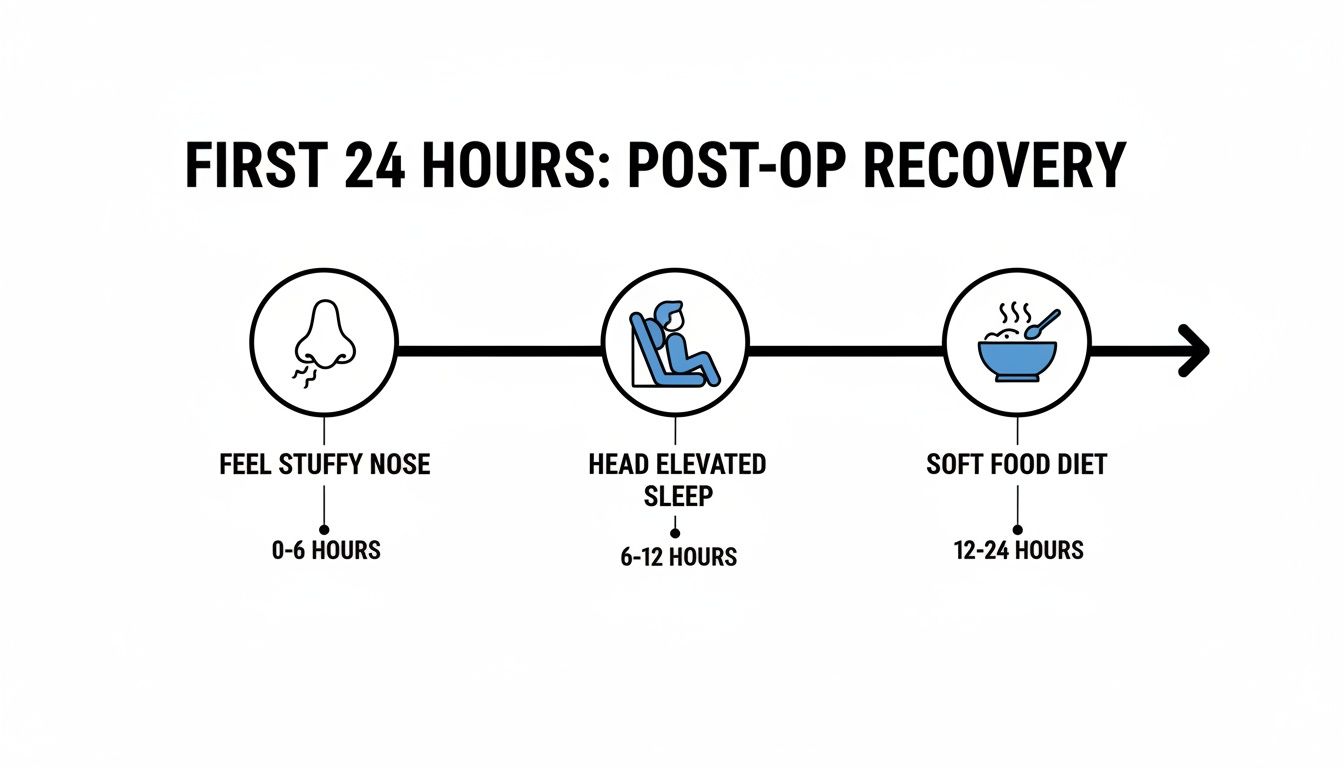
The first seven days of your rhinoplasty recovery week by week journey are foundational for a successful outcome. Immediately after your procedure with Dr. Bain, you will wake up with a protective external splint on your nose and, in some cases, internal packing or splints. Your primary focus during this time is not on seeing the final result, but on creating the optimal environment for your body to begin the healing process. Expect to feel significant nasal congestion, similar to a bad head cold, which will cause you to breathe through your mouth.

Bedside setup for recovery with nasal dilator, cold pack, nasal spray, water, and humidifier.

Swelling, Bruising, and Pain

Swelling and bruising are most pronounced during this initial week, typically peaking around day two or three. Bruising often appears under the eyes, giving the appearance of "black eyes," but this is a normal part of the process and will begin to fade toward the end of the week.

Pain is generally most noticeable in the first 48-72 hours and is often described as pressure or a dull ache rather than sharp pain. It's crucial to stay ahead of the discomfort. Taking your prescribed pain medication on a consistent schedule, rather than waiting for pain to become severe, will make your recovery much more comfortable. For a deeper dive into effective strategies, our guide on how to manage pain after surgery offers specific advice from Dr. Bain.

Key Actions for Week 1

Your actions this week directly impact the level of swelling you experience. Follow these instructions carefully:

  • Elevate Your Head: Sleep with your head propped up on two to three pillows or in a recliner. Keeping your head elevated above your heart at a 30-45 degree angle uses gravity to help drain fluid from your face and reduce swelling.
  • Apply Cold Compresses: For the first 48 hours, apply a cold compress or a small bag of frozen peas to your cheeks and around your eyes for 20 minutes at a time, followed by a 20-minute break. Never apply the compress directly to your nasal splint, as this can affect its position and put undue pressure on the healing tissues. To aid in immediate swelling reduction and comfort during this critical period, understanding the benefits of icing your face and how to apply it safely is key.
  • Diet and Hydration: Stick to soft, cool foods like smoothies, yogurt, applesauce, and lukewarm soup. Avoid hot or spicy foods that can increase swelling, and avoid foods that require a lot of chewing. Stay hydrated with water, which helps flush your system and can ease the discomfort of mouth-breathing.
  • Activity Restrictions: This is a week of rest. All strenuous activities, including bending over, lifting anything heavier than a gallon of milk, and exercise, are strictly prohibited. These actions can raise your blood pressure and increase the risk of bleeding and swelling.

2. Week 2: Splint Removal and Initial Swelling Reduction

The second week of your rhinoplasty recovery week by week journey brings a significant and exciting milestone: the removal of your external splint. This appointment, typically scheduled with Dr. Bain around day five to seven, offers the first glimpse of your new nasal profile. While the initial reveal can be thrilling, it's important to remember that significant swelling is still present, often accounting for 50-60% of the total swelling you'll experience. Your nose will appear wider and the tip more upturned than its final result.
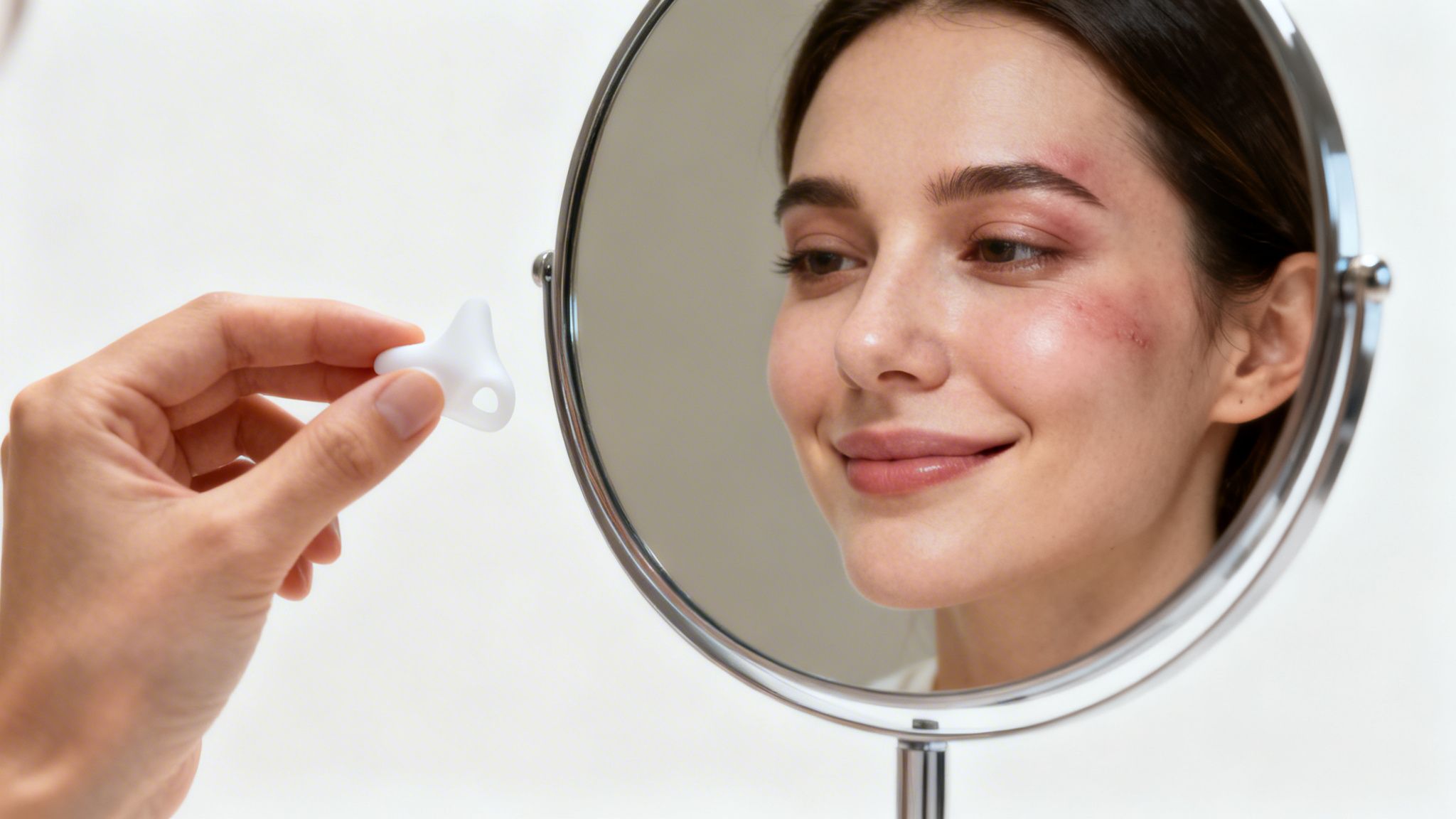
Close-up of a patient's nose one week after rhinoplasty, showing residual swelling but a new shape.

Swelling, Bruising, and Sensation

During week two, the dark bruising under your eyes will have peaked and should now be transitioning to a yellowish-green hue as it begins to fade significantly. Swelling remains the dominant feature, but you'll notice gradual daily improvements. The focus now shifts from acute swelling management with cold compresses to promoting circulation and resolving residual fluid. Your nose might feel stiff and numb, particularly at the tip, which is a normal part of the nerve regeneration process.

Pain has typically subsided to a point where prescription pain medication is no longer needed. Any discomfort can usually be managed with over-the-counter options like Tylenol, but always confirm with Dr. Bain's office before taking any new medication. Your primary sensation will likely be one of stuffiness and pressure.

Key Actions for Week 2

With the splint off, your nose is now exposed and vulnerable. Gentle care is paramount to protect the delicate, healing structures underneath.

  • Gentle Cleansing: You can now begin to gently clean the area. Use a soft, damp cloth to carefully wipe the skin around your nose, but avoid scrubbing or applying pressure directly to the nose itself. Dr. Bain will provide instructions for nasal hygiene, which usually involves using a saline nasal spray to keep the internal passages moist and clear of crusting.
  • Warm Compresses: You may be instructed to switch from cold to warm compresses. Applying a warm (not hot) cloth to the cheeks and around the nose for 15-minute intervals, a few times a day, can help improve blood flow and accelerate the resolution of bruising and swelling.
  • Continued Elevation: Continue sleeping with your head elevated on at least two pillows or in a recliner. This simple habit remains one of the most effective ways to minimize morning swelling.
  • Activity and Socializing: While you might feel ready to re-engage, you must continue to avoid all strenuous activities, including exercise, heavy lifting, and bending over. Most patients feel comfortable returning to a desk job or school during this week. If you choose to use makeup to conceal any lingering bruising, be sure to use non-irritating products and apply them gently.

3. Week 3-4: Progressive Swelling Resolution and Return to Light Activities

Weeks three and four mark a significant turning point in your rhinoplasty recovery week by week journey. The most intensive phase of healing is over, and you'll begin to see a more recognizable version of your new nose. While internal healing is still very much in progress, the external signs of surgery are rapidly diminishing. Expect approximately 70-80% of the initial, most obvious swelling to subside by the end of this period, allowing the refined contours of your nose to become more apparent.

Profile of a beautiful woman with natural makeup, looking away in a bright outdoor setting.

Swelling, Bruising, and Sensation

By week three, most significant bruising should be gone, though some faint yellowish discoloration may linger. Swelling continues to decrease, but it won't be a linear process. You'll notice fluctuations, with your nose often appearing more swollen in the morning and less so by the evening. The nasal tip is typically the last area to "de-swell," so be patient with this area as it can remain firm and slightly bulbous for a while longer.

You might also experience strange sensations like numbness, tingling, or itching, especially at the tip of the nose. This is normal and indicates that the nerves are regenerating. Pain should be minimal to non-existent at this stage; most patients have long since stopped taking prescription pain medication.

Key Actions for Weeks 3-4

This period is about carefully re-integrating into your daily life while continuing to protect your healing nose. Follow Dr. Bain's guidance to support the final stages of early recovery:

  • Return to Work and Social Life: Most patients feel comfortable returning to work and social activities. With any residual bruising easily covered by makeup and the most significant swelling down, you will look and feel more like yourself.
  • Introduce Light Exercise: You may resume light cardiovascular activities like walking on a treadmill or using a stationary bike. The goal is to elevate your heart rate gently. Avoid high-impact exercises, heavy lifting, and any activity that could risk contact with your nose.
  • Maintain Nasal Hygiene: Continue using saline sprays or rinses as directed. This keeps the internal nasal passages clean, moisturized, and free of crusting, which is crucial for comfortable breathing and proper healing.
  • Protect Your Skin: The skin on your nose is very sensitive. Once cleared by Dr. Bain, you can begin applying a broad-spectrum sunscreen (SPF 30+) daily. This is critical to prevent sun damage and discoloration of your healing scar tissue.
  • Be Mindful of Pressure: Continue to avoid sleeping on your stomach or side, which can put pressure on your nose and affect swelling. Be cautious in crowds and when playing with children or pets to prevent accidental bumps. Also, avoid swimming pools and saunas, as these environments can introduce bacteria and affect swelling.

4. Week 5-6: Enhanced Definition and Functional Improvements

By the time you enter the second month of your rhinoplasty recovery week by week, the most challenging phase is behind you. Weeks five and six mark a significant turning point where your new nasal contours become much more apparent. The majority of the swelling, roughly 80-90%, has now subsided, revealing the refined structural changes Dr. Bain made during your procedure. This is often the period when patients truly begin to see and appreciate their emerging results.

Functionally, if you had any pre-existing breathing issues addressed, you should notice substantial improvement. The internal swelling that caused congestion has greatly diminished, allowing for easier, clearer nasal breathing. Your nose will also feel less delicate and more like a part of your face again, though the tip may still feel firm and numb to the touch, which is perfectly normal.

Swelling, Bruising, and Sensation

At this stage, any significant bruising should be completely gone. You are now dealing with the final, more stubborn residual swelling, primarily concentrated at the nasal tip. This remaining swelling is what softens and refines over the coming months, but its reduction now allows the bridge and overall shape to look much more defined.

The sensation in your nose will slowly continue to return. While the skin over the bridge and middle of your nose likely feels normal, the tip often remains the last area to regain full sensation. Tenderness should be minimal, and you will feel more confident in your day-to-day activities, no longer constantly worried about accidental bumps.

Key Actions for Week 5-6

Your focus now shifts from intensive recovery to a safe and gradual return to your normal lifestyle. Continuing to protect your nose is crucial as the bones are still finalizing their healing process.

  • Resume Moderate Exercise: With Dr. Bain's approval, you can typically reintroduce more strenuous cardiovascular activities. This includes running, using an elliptical machine, and attending aerobics classes. Listen to your body and start slowly.
  • Protect Your Nose: Continue to be mindful in situations where your nose could be bumped or hit. Avoid contact sports (basketball, soccer) and activities with a high risk of facial impact. If you swim, you can return to the pool, but avoid diving.
  • Wear Glasses Carefully: If you wear glasses, you can usually start wearing them again. To prevent indentations on the healing nasal bones, you might consider taping them to your forehead or using a support device like a "NoseComfort" to lift them off the bridge.
  • Protect Your Skin: The skin on your nose is still sensitive and susceptible to sun damage, which can cause permanent discoloration. Apply a broad-spectrum sunscreen with at least SPF 30+ daily, even on cloudy days. You can also resume your regular skincare routines, being gentle around the nasal area.
  • Stay Active and Engaged: Returning to your social life and daily routines is important for your psychological well-being. Feeling "back to normal" helps you feel more confident and positive about your recovery journey.

5. Week 7-8: Near-Complete Recovery and Full Activity Return

By the time you reach the two-month mark in your rhinoplasty recovery week by week timeline, you have entered the final phase of initial healing. This period represents a significant milestone where you can truly begin to enjoy the results of your procedure. At this stage, your nose has settled significantly, the structural integrity is secure, and you are clear to re-engage with nearly all aspects of your pre-surgery life. While subtle refinements will continue over the coming months, the overwhelming majority of your active recovery is complete.

Swelling, Bruising, and Pain

At this point, pain should be a distant memory, and any bruising will have long since vanished. The primary focus is now on the last vestiges of swelling. Approximately 95% of the swelling will have resolved, revealing a much clearer picture of your final nasal shape and definition. The remaining 5% is mostly residual swelling, particularly at the nasal tip, which is the last area to fully settle. This final bit of swelling is often so subtle that it is only noticeable to you and Dr. Bain, and it will continue to slowly dissipate over the next year.

Key Actions for Week 7-8

Your focus now shifts from intensive care to the full resumption of your life and long-term maintenance. With the nose now fully healed from a structural standpoint, your restrictions are almost entirely lifted.

  • Resume All Exercise: You can return to your complete fitness routine. This includes high-impact cardio, strenuous weightlifting, and any other activities you enjoy. The risk of affecting your results through increased blood pressure has passed.
  • Return to Contact Sports: With Dr. Bain's clearance, you may resume contact sports like soccer, basketball, or martial arts. However, it is crucial to use appropriate protective gear, such as a face mask designed for sports, to shield your nose from direct impact.
  • Normalize Your Routines: You can sleep in any position you find comfortable, including on your stomach. Your full skincare regimen, including exfoliants and other treatments on and around the nose, can be resumed.
  • Protect Your Investment: Your nasal skin will be sensitive to UV radiation. To prevent permanent pigmentation changes or discoloration on your incision lines, diligent sun protection is key. Apply a broad-spectrum sunscreen with an SPF of 30 or higher to your nose daily, even on cloudy days.

6. Swelling Management Throughout Recovery: Advanced Techniques and Strategies

While swelling naturally subsides over time, proactive and strategic management is a cornerstone of the rhinoplasty recovery week by week journey. Effectively controlling inflammation not only improves your comfort but can also influence the final aesthetic definition of your nose. This phase isn't just about waiting for swelling to go down; it's about actively participating in your healing by creating an environment that supports rapid fluid reduction and tissue settling.

Temperature Therapy, Diet, and Hydration

The methods for managing swelling evolve as you heal. In the first 48-72 hours, cold compresses applied to the cheeks (never directly on the nose) are essential for constricting blood vessels and minimizing initial fluid buildup. After this period, Dr. Bain often recommends switching to warm compresses. The gentle heat can help improve circulation to the area, which aids in clearing away bruising and residual swelling more efficiently.

Your diet plays a a significant role in fluid retention. Throughout your recovery, it is crucial to avoid salty foods, which can cause your body to hold onto water and worsen facial puffiness. Instead, focus on staying well-hydrated by drinking plenty of water. Beyond immediate post-operative care, sustained swelling management often benefits from understanding techniques for reducing inflammation naturally, as detailed in this physician-led guide to reducing inflammation naturally.

Key Actions for Sustained Swelling Management

Adopting a consistent routine is key to seeing a noticeable decrease in puffiness and beginning to appreciate the new contours of your nose.

  • Maintain Elevation: Continue sleeping with your head elevated on a wedge pillow or several pillows for several weeks. This simple habit uses gravity to prevent fluid from pooling in your face overnight.
  • Lifestyle Modifications: Avoid hot showers, saunas, and steam rooms, as the heat can cause blood vessels to dilate and increase swelling. Also, steer clear of any strenuous activity or exercise that elevates your blood pressure until cleared by Dr. Bain.
  • Nasal Care: Use a humidifier in your bedroom, especially at night, to keep the nasal passages moist and comfortable. Consistent use of nasal saline rinses as directed helps clear internal crusting and reduces inflammation within the nasal lining.
  • Follow Medication Schedules: If prescribed, take anti-inflammatory medications exactly on schedule to maintain a consistent level of control over your body's inflammatory response. For a more detailed timeline of what to expect, explore our guide on how long swelling lasts after a nose job.

7. Activity Restrictions and Progressive Return to Exercise

One of the most challenging parts of the rhinoplasty recovery week by week process is knowing when and how to safely resume physical activity. Returning to your normal routine too quickly can increase your risk of bleeding, worsen swelling, and potentially compromise the delicate work Dr. Bain performed. Adhering to a structured, gradual return to exercise is essential for protecting your investment and ensuring an optimal final result. These guidelines are designed to prevent complications while allowing you to get back to your life safely.

Understanding the Risks and Rationale

During the initial weeks, the blood vessels in and around your nose are fragile. Any activity that significantly raises your blood pressure or heart rate can cause these vessels to bleed. This includes strenuous exercise, heavy lifting, and even bending over with your head below your heart. Furthermore, increased blood flow to the face can lead to a dramatic spike in swelling, which prolongs recovery and obscures the healing nasal contours. Following Dr. Bain’s activity restrictions is not just about comfort; it's a critical component of achieving the aesthetic outcome you desire.

Key Actions for A Progressive Return to Activity

Your journey back to full activity will be a step-by-step process. Listening to your body is crucial; if an activity causes throbbing, pain, or increased swelling in your nose, it’s a sign to stop and scale back.

  • Initial Rest Period (Weeks 1-2): Your only focus is rest. Light walking around your house is encouraged to promote circulation, but all other exercise is off-limits. Avoid bending, lifting anything over 10 pounds, and any exertion that makes you strain.
  • Light Cardio (Weeks 3-4): With Dr. Bain's approval, you can typically begin to reintroduce light cardiovascular exercise. This might include walking on a treadmill or using an elliptical at a low intensity. Keep your heart rate down and avoid any high-impact movements. If you work a desk job, you can usually return to work during this period.
  • Moderate Exercise (Weeks 4-6): You can gradually increase the intensity and duration of your workouts. Start at about 50% of your usual effort and slowly build back up. You can introduce light weightlifting, but avoid strenuous sets that cause you to strain or hold your breath.
  • Full Return to Activity (6+ Weeks): By this point, most patients are cleared to return to their regular workout routines. However, activities with a high risk of facial impact, such as basketball, soccer, or boxing, should be avoided for several more months, or until Dr. Bain gives you specific clearance. Patients with physically demanding jobs may need an extended recovery of 4-6 weeks before returning to full duties.

8. Managing Expectations: Understanding Visible vs. Final Results During 8-Week Recovery

A critical, yet often overlooked, part of your rhinoplasty recovery week by week is managing your own expectations. It is absolutely essential to understand that the nose you see in the mirror at week one, week four, and even week eight is not your final result. Healing is a progressive journey, and the tissues of your nose will continue to remodel, settle, and refine for up to 18-24 months after your procedure with Dr. Bain. Many patients feel discouraged in the early weeks when swelling can temporarily obscure the improvements or even make the nose appear wider than before surgery.

The psychological aspect of recovery is just as important as the physical one. The initial post-operative phase can be challenging, but understanding the natural timeline of healing is key to maintaining a positive outlook. The majority of noticeable swelling subsides in the first 2-3 months, but subtle, residual swelling, especially at the nasal tip, can persist for a year or longer. This is the difference between a "socially acceptable" result (where you feel comfortable going out) and the final, refined outcome. For a more detailed timeline of what to anticipate, our guide on what to expect after rhinoplasty can provide additional reassurance and clarity.

Keeping Perspective During Early Recovery

Patience is your most valuable asset during this period. Your nose is undergoing a significant transformation, and seeing the day-to-day progress can be difficult.

  • Document Your Journey: Take weekly progress photos from the same angles and in the same lighting. When you feel discouraged, compare your current photo to your week one photo, not to your ideal goal. This will highlight the real progress you've made.
  • Focus on Milestones: Instead of fixating on the final look, focus on functional improvements, like better breathing, and short-term milestones, such as the day your splint comes off or the bruising completely fades.
  • Avoid Unhelpful Comparisons: Steer clear of comparing your healing nose to celebrity photos or pictures on social media forums. Every patient's anatomy and healing process are unique. Trust the plan Dr. Bain created specifically for you.
  • Communicate with Your Surgeon: If you have concerns about your progress, always bring them to Dr. Bain during your follow-up appointments. Self-diagnosing based on online information can lead to unnecessary anxiety. We are your partners in this journey.
  • Trust the Process: Remind yourself daily that swelling is temporary. Your nose is actively healing and changing for the better, even when the shifts are too subtle for the naked eye to see from one day to the next.

8-Week Rhinoplasty Recovery Comparison

Item 🔄 Implementation Complexity ⚡ Resource Requirements 📊 Expected Outcomes 💡 Ideal Use Cases ⭐ Key Advantages
Week 1: Immediate Post-Operative Care and Swelling Management High — strict protocols, close monitoring and splint/packing care Moderate — nasal splint/packing, prescribed meds, cold packs, humidifier, 24/7 contact available Peak swelling/bruising; hemostasis and initial tissue protection; pain controlled Immediate post-op period to protect structure and prevent complications ⭐ Protects nasal framework and controls bleeding; reduces early complications
Week 2: Splint Removal and Initial Swelling Reduction Medium — controlled splint removal and gentle tissue care Low–Moderate — clinic visit for splint removal, saline rinses, warm compresses Emerging nasal shape; breathing improves; swelling begins downward trend Early follow-up to assess healing and reassure patient ⭐ Boosts morale by revealing early results; improves comfort and breathing
Week 3–4: Progressive Swelling Resolution and Return to Light Activities Medium — staged activity increases and ongoing wound care Low — follow-up visits, saline care, light hygiene supplies ~70–80% visible swelling resolved; return to work; better nasal function Return to work/social life; begin light exercise and public activities ⭐ Visible aesthetic improvement; increased confidence and functionality
Week 5–6: Enhanced Definition and Functional Improvements Low — broader activity clearance with surgeon approval Low — progress photos, exercise guidance, sunscreen and minor supports ~80–90% swelling resolved; clear definition; significant breathing improvement Resuming most normal activities and moderate exercise ⭐ Near-final aesthetics and major functional gains; high patient satisfaction
Week 7–8: Near-Complete Recovery and Full Activity Return Low — final short-term assessments and maintenance advice Low — follow-up visit, protective gear recommendation for sports ≈95% swelling resolved; stable results; full activity clearance for most Full return to normal and high-impact activities (with protection) ⭐ Stable, nearly final results and restored nasal function
Swelling Management Throughout Recovery: Advanced Techniques Medium–High — consistent multi-modal regimen requiring compliance Moderate — cold/heat packs, tape/compression, meds, hydration, humidifier Accelerated swelling resolution; improved comfort and aesthetic outcome Applies across all recovery weeks to optimize healing and outcomes ⭐ Cost-effective, evidence-based approaches that improve final results
Activity Restrictions and Progressive Return to Exercise Medium — staged, individualized plan and monitoring Low–Moderate — written guidelines, alternative activities, clinician oversight Reduced complication risk; safe, progressive fitness return Active patients and athletes needing structured return-to-exercise plan ⭐ Prevents premature activity-related complications and supports rehab
Managing Expectations: Understanding Visible vs. Final Results Low–Medium — education and repeated reinforcement Low — counseling, educational materials, progress photos Improved patient satisfaction; fewer revision requests; better compliance Pre-op and early post-op education to reduce anxiety and unrealistic expectations ⭐ Aligns expectations with timeline; improves psychological recovery and satisfaction

Embracing Your Final Result with Confidence and Care

The journey through your rhinoplasty recovery, week by week, is a structured process of healing, patience, and gradual revelation. As we've detailed, the initial two months mark the most significant period of change, from the immediate post-operative phase of swelling and splinting to the exciting moment you begin to see refined definition. Understanding this timeline is the first step toward a smooth and successful recovery, allowing you to manage expectations and actively participate in your healing.

The most critical takeaways from this guide are not just about what to do, but how and why. Diligent adherence to post-operative instructions, particularly regarding activity restrictions and nasal care, is not just a suggestion; it is the foundation upon which your final result is built. Each step, from keeping your head elevated to reintroducing exercise at the right moment, directly influences swelling and protects the delicate structures of your newly shaped nose.

Key Pillars for a Successful Rhinoplasty Recovery

To distill the extensive information into actionable principles, focus on these core concepts as you move beyond the initial 8-week period:

  • Patience is Your Greatest Ally: The nose you see at your splint removal in Week 2 is not the nose you will have at Week 8, and the nose at Week 8 is not the one you will have in a year. Swelling, especially at the nasal tip, can persist for many months. Accepting this timeline prevents unnecessary anxiety and allows you to appreciate the subtle, positive changes as they unfold.
  • Active Swelling Management is Non-Negotiable: Your commitment to managing inflammation is paramount. This goes beyond the first week. Consistently following a low-sodium diet, avoiding strenuous activity, and protecting your nose from the sun are all crucial actions that continue to impact your results long after the initial bruising has faded.
  • Open Communication with Your Surgeon: Your recovery is a partnership between you and your surgical team. Never hesitate to report concerns or ask questions. A seemingly small issue could be a red flag, and early intervention is always best. For patients of Dr. Bain, this open line of communication is a cornerstone of the practice's patient care philosophy, ensuring you feel supported at every stage.

A Note on the Final Result: Remember that complete maturation of the nasal tissues can take 12 to 18 months. While you will be "socially presentable" and back to your normal life much sooner, the ultimate refinement, especially in the tip and skin thickness, is the last piece of the puzzle to fall into place. This final phase of your rhinoplasty recovery week by week evolution requires the most patience but often yields the most rewarding subtleties in your outcome.

Looking Ahead: Life After Rhinoplasty Recovery

As you move past the initial healing stages, your focus will shift from recovery to enjoyment. The functional and aesthetic improvements will become an integrated part of your daily life. The confidence that comes from feeling your appearance is in harmony with your self-image is a profound and lasting benefit of this procedure.

By diligently following the week-by-week guidance, managing your expectations, and staying connected with your surgeon, you are not just healing from a procedure; you are investing in a result that will bring you satisfaction for years to come. You have equipped yourself with the knowledge to navigate this period with confidence, turning a potentially anxious time into a predictable and empowering experience. The care you take now is the best guarantee of a beautiful, natural-looking nose that you can carry with pride for a lifetime.


Ready to take the next step in your rhinoplasty journey with a surgeon renowned for natural-looking results and exceptional patient care in Orange County? Schedule a consultation with Dr. Michael A. Bain. The team at Michael A. Bain, MD provides patients with detailed guidance and support throughout the entire rhinoplasty recovery process, ensuring you are prepared and confident from your first appointment to your final result.


Weighing Your Options: 10 Critical Breast Reduction Pros and Cons

Making the decision to undergo breast reduction surgery is a deeply personal journey, one that extends far beyond aesthetics. It's about weighing significant functional benefits against tangible surgical realities. Many individuals suffer for years from chronic pain, limited physical activity, and psychological distress caused by disproportionately large breasts, a condition known as macromastia. This procedure, medically termed reduction mammaplasty, is often misunderstood as purely cosmetic, yet it frequently provides life-altering relief from persistent physical symptoms.

This article serves as a direct, patient-centered guide to the most critical breast reduction pros and cons. We will move beyond surface-level discussions to provide a detailed, balanced roundup, empowering you to make a well-informed decision that aligns with your health, lifestyle, and personal goals. While surgery offers a definitive solution for many, it's also important to understand the full spectrum of care. Exploring conservative management can provide context, as highlighted in discussions comparing Physical Therapy Vs Surgery.

Our goal is to give you a clear, honest look at what to expect. We will cover the following 10 key considerations every prospective patient should understand:

  • Relief from Chronic Neck, Shoulder, and Back Pain
  • Improved Physical Activity and Exercise Capacity
  • Enhanced Clothing Fit and Fashion Options
  • Improved Skin Health and Hygiene Under the Breast
  • Psychological and Emotional Wellbeing Improvements
  • Aesthetic Considerations: Surgical Scarring, Asymmetry & Revision
  • Risk of Loss of Nipple Sensation or Numbness
  • Impact on Breastfeeding and Lactation Capacity
  • Recovery Timeline and Activity Restrictions During Healing
  • Cost Considerations and Insurance Coverage Variability

From dramatic pain relief to the realities of scarring and recovery, this guide will equip you with the knowledge needed to confidently determine if this is the right path for you.

1. Relief from Chronic Neck, Shoulder, and Back Pain

Among the most impactful breast reduction pros and cons, the potential for significant pain relief is often the primary motivator for patients. Large, heavy breasts (macromastia) exert a constant downward force, placing immense strain on the musculoskeletal system. This continuous tension can lead to chronic pain in the neck, shoulders, and upper back, as well as persistent headaches and poor posture. Breast reduction surgery directly addresses this by removing excess breast tissue, fat, and skin, reducing the overall weight and volume.

An Asian woman with good posture stands next to a faded figure showing poor, slumped posture.

The procedure works by creating a smaller, lighter, and more proportionate breast mound that better suits a patient's frame. By alleviating the physical load, the surgery allows the spine to return to a more natural alignment, easing the tension on overworked muscles and ligaments. This physical recalibration is why many patients report a dramatic improvement in their quality of life, often feeling relief almost immediately after surgery, even during the initial recovery period.

Key Insight: Many patients are surprised that the relief extends beyond just back pain. A significant number report an 80-90% reduction in chronic tension headaches and neck stiffness once the root cause of the strain is removed.

Practical Tips for Maximizing Pain Relief

To get the most out of your surgery, consider these actionable steps:

  • Document Everything: Before your consultation, keep a detailed pain journal. Note the location, frequency, and intensity of your pain. This data provides a clear baseline for Dr. Bain to plan the optimal amount of tissue removal and for you to measure your success post-operatively.
  • Commit to Physical Therapy: Both before and after surgery, engaging with a physical therapist can be highly beneficial. Pre-surgical exercises can strengthen core and back muscles, while post-surgical therapy helps your body adapt to its new center of gravity and reinforces good posture.
  • Be Patient with Your Body: While some pain relief is immediate, it can take 6-12 months for your body to fully adjust. Tissues need to settle, swelling must completely subside, and your posture will continue to improve over time.

This surgical solution is often considered when conservative treatments like physical therapy, specialized bras, and pain medication have failed to provide lasting relief. Discover more about how breast reduction surgery can improve back and neck pain to see if it’s the right path for you.

2. Improved Physical Activity and Exercise Capacity

A significant benefit that adds weight to the "pros" side of breast reduction pros and cons is the profound improvement in a patient's ability to exercise. For many women with macromastia, large, heavy breasts create substantial biomechanical challenges. The constant bouncing and movement can cause pain, skin irritation, and extreme discomfort, making high-impact activities like running, jumping, or group fitness classes feel impossible. This often forces individuals to limit their activities or rely on multiple, often constricting, sports bras just to get through a workout.

A smiling young woman runs on a sunny park path, wearing a grey sports bra and leggings.

Breast reduction surgery directly addresses these barriers by creating smaller, lighter breasts that are more stable and proportionate to the body. This alleviates the physical strain and discomfort associated with movement, unlocking a new world of physical possibilities. Patients frequently report being able to engage in activities they had long abandoned, from joining a CrossFit class to resuming lap swimming or competitive running. This functional improvement is not just about comfort; it often leads to better cardiovascular health, easier weight management, and a significant boost in mental well-being and confidence.

Key Insight: Many patients find that their newfound ability to exercise comfortably is one of the most empowering outcomes of their surgery. This freedom often inspires them to achieve fitness goals they previously thought were unattainable, creating a positive ripple effect on their overall health and lifestyle.

Practical Tips for Maximizing Your Return to Activity

To safely and effectively re-engage with fitness post-surgery, consider these actionable steps:

  • Define Your Goals: Discuss your specific athletic ambitions with Dr. Bain during your consultation. Whether you're a marathon runner or a yoga enthusiast, sharing these details helps inform the surgical plan to best support your future activities.
  • Invest in Quality Support: After your initial recovery, purchasing a high-quality, properly fitting sports bra is crucial. This will provide the necessary support for your new breast shape as you return to exercise and protect your surgical results.
  • Start Slow and Listen to Your Body: Begin with low-impact activities like walking, swimming (once cleared), or using an elliptical. Gradually reintroduce higher-impact sports, paying close attention to any discomfort. Following Dr. Bain’s specific timeline for returning to vigorous and competitive activities is essential for a safe recovery.

This procedure is a powerful solution for those whose quality of life and health are limited by the physical constraints of large breasts. By removing the barrier to an active lifestyle, breast reduction can be a pivotal step toward achieving long-term health and wellness goals.

3. Enhanced Clothing Fit and Fashion Options

Beyond the medical benefits, one of the most celebrated aspects of a breast reduction is the newfound freedom in clothing choices. For individuals with macromastia, shopping often becomes a frustrating and demoralizing experience. Disproportionately large breasts can make it nearly impossible to find off-the-rack clothing that fits correctly, forcing many to resort to costly alterations, specialty retailers, or a limited wardrobe of baggy, unflattering styles. Breast reduction surgery is a key factor in addressing this, expanding fashion options and simplifying the shopping process.

This procedure significantly improves a patient's ability to wear a wider range of styles, from structured blazers and button-down shirts to wrap dresses and spaghetti-strap tops. By creating breasts that are in proportion with the rest of the body, the surgery allows standard-sized clothing to fit as intended. This seemingly superficial advantage carries profound psychological weight, boosting self-confidence, improving self-image, and finally allowing individuals to express their personal style without physical limitations.

Key Insight: Many patients report that the ability to walk into any store and buy an outfit off the rack is one of the most emotionally rewarding outcomes. This simple act represents a return to normalcy and a significant boost in day-to-day confidence that they hadn't experienced in years.

Practical Tips for Maximizing Your New Wardrobe

To make the most of your new silhouette, consider these actionable steps:

  • Wait for Swelling to Subside: Resist the urge to buy a whole new wardrobe immediately. It can take 4-6 months for your breasts to fully settle into their final size and shape. Start with a few essential pieces and plan your major shopping spree after your final follow-up.
  • Invest in Quality Foundation Garments: A proper-fitting bra is crucial. Get professionally measured once your initial swelling has gone down and invest in 2-3 high-quality bras. The right support will make your new clothes fit even better and help maintain your surgical results.
  • Explore and Experiment: Create a mood board or browse fashion magazines for styles you've always wanted to try but couldn't. This is your chance to redefine your personal style. Document your journey by taking photos in new outfits to see how your confidence and self-expression grow.

This surgery is often the definitive solution for those who feel their clothing choices are dictated by their bust size rather than their personal taste. Regaining the freedom to dress in a way that reflects your personality is a significant part of the overall satisfaction many patients experience with their breast reduction pros and cons analysis.

4. Improved Skin Health and Hygiene Under the Breast

A less-discussed but significant medical benefit in the breast reduction pros and cons debate is the resolution of chronic skin issues. Large, heavy breasts create a warm, moist environment in the inframammary fold (the crease underneath the breast). This area suffers from poor air circulation and constant skin-on-skin friction, creating a perfect breeding ground for persistent dermatological problems like rashes, fungal infections (intertrigo), and painful skin breakdown. Breast reduction directly resolves this by eliminating the conditions that cause irritation.

The surgery removes excess tissue and lifts the breast, which separates the skin of the breast from the skin of the upper abdomen. This simple change allows air to circulate freely, keeping the area dry and preventing the friction that leads to chafing and inflammation. For many patients, this means an end to the frustrating cycle of applying antifungal powders, medicated creams, and special barrier ointments just to manage daily discomfort.

Key Insight: Many patients find they can finally stop using specialized moisture-wicking bras or inserts designed solely for skin protection. The resolution of these persistent rashes, which often fail to respond to dermatological treatments, underscores that the root cause was anatomical, not just dermatological.

Practical Tips for Maximizing Skin Health

Follow these steps to ensure the best possible dermatological outcome from your surgery:

  • Inform Your Surgeon: If you have a history of chronic rashes, infections, or skin irritation, be sure to discuss this with Dr. Bain during your consultation. This information can influence surgical planning and post-operative care instructions.
  • Prioritize Hygiene: During recovery, keep the incision sites and the inframammary fold clean and dry. After bathing, gently pat the area completely dry with a clean towel; avoid rubbing.
  • Choose Breathable Fabrics: After you've healed, opt for bras and clothing made from breathable, natural fabrics like cotton. This helps maintain good air circulation and wicks away any moisture from perspiration.

This procedure provides a permanent solution for a medical issue that can significantly impact daily comfort and hygiene. When topical treatments and lifestyle adjustments have proven insufficient, surgically correcting the underlying anatomical cause is often the most effective and lasting remedy.

5. Psychological and Emotional Wellbeing Improvements

While physical benefits are significant, one of the most profound breast reduction pros and cons is the powerful impact on a patient's psychological and emotional health. Large breasts often lead to unwanted attention, deep-seated body image issues, and social anxiety that can affect personal and professional life. The constant self-consciousness can diminish confidence and create a barrier to engaging in activities like swimming or even wearing certain clothing. Breast reduction directly addresses this source of psychological distress.

A smiling Asian woman with hands on her chest talks to another woman by a window.

By creating breasts that feel more harmonious with their body, patients often report feeling a sense of freedom and relief from a long-standing emotional weight. Research consistently shows that well-selected breast reduction patients experience significant improvements in depression and anxiety scores, with patient satisfaction rates among the highest of any cosmetic procedure. This mental uplift comes from finally feeling comfortable and confident in one's own skin, which can positively affect relationships, career ambitions, and overall quality of life.

Key Insight: Many women report a dramatic increase in confidence in professional settings, feeling they are finally seen for their skills and ideas rather than their chest size. This newfound self-assurance can be a major catalyst for career advancement.

Practical Tips for Maximizing Emotional Benefits

To ensure a positive emotional and psychological journey, consider these actionable steps:

  • Discuss Emotional Goals: During your pre-operative consultation, be open with Dr. Bain about your emotional goals and expectations. Understanding the psychological motivations helps tailor the surgical plan to best meet your needs.
  • Journal Your Feelings: Document your feelings before and after surgery. This practice can help you process your transformation and provides a powerful record of your emotional progress from self-consciousness to self-confidence.
  • Connect with a Community: Join a support group or connect with other post-operative patients. Sharing experiences with others who have gone through the same process can provide invaluable validation, encouragement, and practical advice during your recovery.
  • Allow Time for Adjustment: The full psychological benefits may not be immediate. It can take 3-6 months to mentally and emotionally adjust to your new body, so be patient with yourself as you navigate this positive change.

This surgery is often the definitive step for those whose mental wellbeing has been negatively impacted by macromastia for years. By addressing the root physical cause, it unlocks a new chapter of confidence and emotional freedom. You can learn more about the patient journey and see real results to understand the complete experience.

6. Aesthetic Considerations: Surgical Scarring, Asymmetry & Revision

While the functional benefits are significant, one of the most important cons to weigh in the breast reduction pros and cons discussion is the aesthetic trade-off. This surgery inherently involves incisions to remove tissue, which results in permanent scars. While modern techniques aim to place scars discreetly (often in an anchor or lollipop pattern), they are an unavoidable outcome. The goal is for them to fade significantly over 12-18 months, but they will never completely vanish. Furthermore, achieving perfect symmetry is a challenge in any form of breast surgery, and minor residual asymmetries in size, shape, or nipple position can occur.

These aesthetic concerns sometimes lead to the need for a revision procedure. Although the majority of patients are highly satisfied, a small percentage (around 5-15%) may seek a revision to address specific issues like size dissatisfaction, scar appearance, or persistent asymmetry. A revision surgery adds to the overall cost, recovery time, and potential for more scarring. Meticulous surgical planning and clear communication are key to minimizing these risks and aligning the outcome with the patient’s goals.

Key Insight: Most patients find that the functional benefits, such as pain relief and improved lifestyle, far outweigh their concerns about scarring once fully healed. The scars often become a small price to pay for a dramatic improvement in quality of life.

Practical Tips for Optimizing Aesthetic Outcomes

To manage expectations and achieve the best possible aesthetic result, focus on these steps:

  • Follow Scar Care Instructions Meticulously: Dr. Bain will provide a detailed post-operative plan. This includes using silicone scar sheets or gels, protecting the area from sun exposure for at least 6-12 months to prevent darkening, and gently massaging the scars once cleared to do so.
  • Communicate Your Goals Clearly: During your consultation, bring reference photos of your desired breast appearance. Be specific about your size, shape, and nipple placement goals. This helps Dr. Bain create a surgical plan that is closely aligned with your vision.
  • Allow Time for Healing: The final shape and appearance of your breasts can take 3-6 months to settle as swelling subsides and tissues relax. It’s important to be patient and wait until this point before evaluating the need for any potential revisions.
  • Discuss Revision Policies: Before surgery, ask about the surgeon's policy regarding revisions. Understand the potential costs and timeline should you decide a follow-up procedure is necessary to fine-tune your results.

These aesthetic factors are a critical part of the decision-making process. By partnering with an experienced surgeon and committing to post-operative care, patients can significantly influence their final look and satisfaction. Explore more about what to expect by learning about the breast reduction recovery timeline.

7. Risk of Loss of Nipple Sensation or Numbness

A significant consideration in the list of breast reduction pros and cons is the potential for altered sensation in the nipples and breast skin. The procedure involves repositioning the nipple-areola complex and restructuring breast tissue, which can stretch, bruise, or sever the delicate sensory nerves. This manipulation can lead to temporary or, in some cases, permanent changes, including numbness, hypersensitivity, or a complete loss of sensation. While this is a known surgical risk, it's a trade-off many patients willingly accept for relief from physical pain.

During recovery, it is very common for patients to experience temporary numbness or paresthesia (unusual sensations like tingling or "pins and needles"). In the majority of cases, around 60-70%, sensation gradually returns over 6 to 12 months as nerve pathways heal and regenerate. However, about 10-15% of patients may experience some degree of permanent change. For patients who prioritize sexual sensation, this is a particularly important factor to discuss during the surgical consultation.

Key Insight: Most patients find that even if they experience temporary or minor permanent sensation changes, the functional benefits, such as the elimination of chronic pain and improved mobility, far outweigh this drawback.

Practical Tips for Managing Sensation Changes

To prepare for and manage potential changes in sensation, consider these steps:

  • Have a Candid Conversation: Before surgery, openly discuss your concerns about sensation, particularly regarding sexual function, with your surgeon. This allows for a clear understanding of your personal risks and helps set realistic expectations.
  • Establish a Baseline: Take time before your procedure to be mindful of your current nipple and breast sensation. Having a clear pre-operative baseline will help you accurately track changes and recovery progress post-surgery.
  • Practice Patience During Healing: Nerve regeneration is a slow process. It's normal for numbness to persist for months. Be patient and understand that improvements can continue for a year or even longer.
  • Encourage Nerve Recovery: Once cleared by your surgeon, gentle massage of the breast skin can help stimulate nerve endings and may encourage re-innervation. Wearing soft, non-restrictive fabrics can also prevent irritation during this sensitive period.

Ultimately, informed consent is critical. Understanding that a change in sensation is a possible outcome allows you to make a decision that aligns with your health priorities. Find out more about the risks and rewards of breast reduction to weigh every factor carefully.

8. Impact on Breastfeeding and Lactation Capacity

For patients who plan to have children in the future, a significant consideration in the list of breast reduction pros and cons is the potential effect on breastfeeding. The surgery involves removing breast tissue, which includes milk-producing glands and the ducts that transport milk to the nipple. Relocating the nipple-areola complex, a standard part of most reductions, can also disrupt the nerves and ductal systems essential for lactation. This means that while some women can breastfeed successfully after the procedure, others may experience a reduced milk supply or be unable to breastfeed at all.

The degree of impact depends heavily on the surgical technique used, the amount of tissue removed, and how much the nipple is moved. Techniques that prioritize preserving the connection between the nipple and the underlying milk ducts offer a better chance of retaining breastfeeding function. It’s a trade-off that requires an honest conversation between the patient and surgeon about priorities, balancing the desire for significant size reduction with the goal of future lactation.

Key Insight: Breastfeeding ability post-reduction is not an all-or-nothing outcome. Many women successfully combination-feed, supplementing their breast milk with formula. This allows them to experience the bonding and health benefits of breastfeeding while ensuring their baby receives adequate nutrition.

Practical Tips for Managing Lactation Goals

If breastfeeding is a priority, consider these steps when planning your surgery:

  • Discuss Your Timeline: Be upfront with Dr. Bain about your family planning goals during your consultation. If you plan to have children soon, delaying surgery might be the best option. If you are further out, a duct-sparing surgical technique can be prioritized.
  • Set Realistic Expectations: Understand that no surgeon can guarantee you will be able to breastfeed. Discuss the likelihood of success based on your specific anatomy and the amount of reduction needed. This allows you to make a truly informed decision.
  • Seek Specialized Support: If you have difficulty breastfeeding after your surgery, connect with a lactation consultant early. They can offer specialized techniques and support to help you maximize your milk production. For those exploring ways to support lactation, a guide on how to increase milk supply can provide useful strategies.

This consideration is most critical for patients who have not yet completed their families. It requires a careful evaluation of personal priorities, weighing the immediate physical and emotional benefits of surgery against the potential impact on future life stages.

9. Recovery Timeline and Activity Restrictions During Healing

While the long-term benefits are substantial, a significant con in the breast reduction pros and cons discussion is the required recovery period. The procedure involves considerable downtime, with activity restrictions that can disrupt work, exercise, childcare, and daily routines. The initial 1-2 weeks post-surgery involve the most limited mobility, and moderate restrictions typically continue for 4-6 weeks. This necessary healing phase demands patience and planning.

For patients with physically demanding jobs, young children, or active lifestyles, this downtime represents a notable disadvantage. For example, mothers of young children may struggle with the "no lifting over 10 pounds" rule, while athletes can find the 6-8 week restriction from intense training frustrating. Office workers, however, may return to desk duties within 2-3 weeks with minimal difficulty. Unrealistic expectations about this timeline are a frequent source of patient dissatisfaction.

Key Insight: The most common mistake patients make is underestimating the need for household support. Arranging for help with childcare, meals, and chores for the first 2-3 weeks is not an indulgence; it's a critical part of ensuring a smooth and complication-free recovery.

Practical Tips for a Smooth Recovery

To navigate the healing process successfully, careful planning is essential:

  • Plan Strategically: Schedule your surgery during a time that allows for adequate rest. This could mean using vacation time or planning it during a less demanding period at work. Communicate your activity demands with Dr. Bain to choose the best possible timing.
  • Arrange for Support: Line up help from a partner, family, or friends for the first few weeks. This support is crucial for everything from childcare and household tasks to driving you to follow-up appointments.
  • Follow Instructions Precisely: Adhere strictly to Dr. Bain's activity restrictions to prevent complications like poor scar healing or incision site separation. Gradually increase your activity only as you are cleared to do so. Rushing the process can set your recovery back.
  • Prepare for Downtime: Have entertainment and comfort items ready for your initial recovery period. Books, movies, podcasts, and comfortable pillows can make the resting phase much more pleasant.

The recovery journey requires a commitment to rest and adherence to medical advice. Setting realistic expectations and preparing your life for this temporary pause is the best way to ensure your healing is successful and your final results are optimal. For a detailed guide, get more breast reduction recovery tips to help you prepare.

10. Cost Considerations and Insurance Coverage Variability

The financial aspect is a critical component when evaluating breast reduction pros and cons. The total cost of the surgery can be substantial, often ranging from $8,000 to $15,000 or more. This figure typically includes the surgeon's fee, facility charges, and anesthesia costs. However, the most significant variable is insurance coverage, which can create a great deal of uncertainty for patients.

Many insurance plans will cover breast reduction if there is a documented functional impairment, such as chronic pain, skin rashes, or postural problems. Conversely, some plans automatically classify the procedure as cosmetic, regardless of the patient's symptoms. This discrepancy means that even with clear medical necessity, securing coverage is not guaranteed and requires diligent preparation. For instance, some patients with thorough documentation of chronic back pain may receive 80-90% coverage, while others with similar symptoms are denied because of their specific plan's exclusions.

Key Insight: Securing insurance coverage often hinges on the quality and detail of your medical documentation. A denial is not always the final word; the appeals process can be successful if you provide strong, evidence-based support for the procedure's medical necessity.

Practical Tips for Managing Costs and Insurance

To navigate the financial side of your surgery, consider these actionable steps:

  • Review Your Plan: Before your consultation, thoroughly read your insurance policy documents, specifically looking for language related to "reduction mammaplasty." Contact your insurance provider directly to ask about pre-authorization requirements and coverage criteria.
  • Document Medical Necessity: Work with Dr. Bain to create a comprehensive record of your symptoms and any conservative treatments you've tried (e.g., physical therapy, specialized bras). This documentation is essential for the pre-authorization submission.
  • Explore Financing: If your insurance denies coverage or if you have a high deductible, look into financing options. Many patients use medical credit cards, personal loans, or payment plans offered through the surgeon's office to make the procedure affordable.
  • Request All-Inclusive Pricing: When comparing costs, ask for a "global fee" that bundles the surgeon's fee, facility charges, and anesthesia. This provides a clear, upfront cost and helps you avoid unexpected bills.

Understanding the financial commitment is crucial for a smooth and stress-free surgical journey. You can discover more about how to determine if insurance will cover breast reduction surgery to better prepare for your consultation.

Breast Reduction: 10-Point Pros & Cons Comparison

Item 🔄 Complexity ⚡ Resources & Time ⭐ Expected Outcomes 📊 Ideal Use Cases 💡 Key Advantages / Tips
Relief from Chronic Neck, Shoulder, and Back Pain Moderate — tissue removal & repositioning; standard reduction technique OR + anesthesia; physio as needed; recovery weeks–months (full benefit 6–12 mo) ⭐ High — many report 80–90% reduction in pain and improved posture Patients with large breasts causing chronic musculoskeletal pain and postural problems Document pre-op pain, continue PT, allow 6–12 months for full improvement
Improved Physical Activity and Exercise Capacity Moderate — attention to preserving mobility; temporary movement limits OR + anesthesia; recovery 4–8 weeks before high-impact exercise; quality sports bras recommended ⭐ High — marked improvement in comfort, endurance, and sports participation Active patients limited by bounce/fit (runners, dancers, athletes) Discuss athletic goals with surgeon, start low-impact, invest in supportive sportswear
Enhanced Clothing Fit and Fashion Options Moderate — standard cosmetic planning for proportion OR + anesthesia; short–moderate recovery; may require wardrobe updates ⭐ High — greatly expanded clothing options and improved self-image Patients frustrated by clothing fit, limited by large-breast proportions Wait 4–6 weeks before major shopping; invest in 2–3 new bras; update wardrobe gradually
Improved Skin Health and Hygiene Under the Breast Moderate — reduces inframammary fold depth and friction OR + anesthesia; expect improved hygiene after healing; breathable fabrics advised ⭐ High — frequent resolution of chronic rashes, intertrigo, and infections Patients with persistent inframammary dermatitis, fungal infections, or skin breakdown Maintain hygiene during recovery, dry folds thoroughly, wear moisture-wicking fabrics
Psychological and Emotional Wellbeing Improvements Moderate — requires pre-op expectation management OR + anesthesia; pre-op counseling useful; emotional benefits often seen by 3–6 months ⭐ High — substantial gains in body image, confidence, and reduced anxiety/depression Patients experiencing body image distress, unwanted attention, or social anxiety Discuss goals candidly, consider therapy/support groups, journal emotional changes
Aesthetic Considerations: Scarring, Asymmetry & Revision High — precise planning to minimize scars and asymmetry; revision risk exists OR + anesthesia; long-term scar care (12–18 mo); possible revision (5–15%) ⭐ Moderate — functional benefits strong but permanent scarring and minor asymmetry common Patients who accept trade-off of scars for functional/aesthetic improvement Discuss scar placement, follow scar-care, allow 12–18 months before considering revision
Risk of Loss of Nipple Sensation or Numbness High — nerve manipulation inherent to procedure; sensory outcomes variable OR + anesthesia; counsel and document baseline; sensation may improve over 6–12 months ⭐ Low–Moderate — majority recover sensation, but 10–15% may have persistent changes Patients who prioritize pain/function over preserved nipple sensation Document baseline sensation, discuss sexual function, be patient with sensory recovery
Impact on Breastfeeding and Lactation Capacity High — technique-dependent impact on ducts and milk production OR + anesthesia; pre-op family-planning discussion; lactation support may be needed post-op ⭐ Variable — many retain some capacity (50–80%); 5–10% may lose ability Patients not planning future breastfeeding or willing to accept reduced lactation Discuss family timeline, request duct-preserving technique if breastfeeding desired
Recovery Timeline and Activity Restrictions During Healing Moderate — predictable but requires strict activity limits (6–8 wks) Time off work (1–2 wks desk; up to 8–12 wks for full activity); childcare/support often needed ⭐ Predictable — most resume desk work by 2–3 wks; full activity by ~8–12 wks Patients who can plan recovery time and arrange support at home Plan timing, arrange help, follow restrictions strictly, expect gradual progress
Cost Considerations and Insurance Coverage Variability Moderate — administrative complexity for pre-authorization and documentation Significant cost ($8k–$15k+); insurance possible with medical necessity; financing options exist ⭐ Variable — coverage depends on documentation; out-of-pocket burden possible Patients with documented functional impairment or financial means to self-pay/finance Review insurance policy, obtain pre-authorization, use surgeon's billing support and consider financing options

Making Your Final Decision: The Consultation Is Key

We have journeyed through the intricate landscape of breast reduction pros and cons, moving from the profound relief of chronic pain to the realities of surgical scars and recovery. You now have a detailed map of the benefits and drawbacks, from the functional freedom of improved exercise capacity to the emotional impact and cost considerations. This information is your foundation for making an informed choice, but the ultimate decision is deeply personal, resting entirely on your individual circumstances, health, and aspirations.

The core takeaway is that a breast reduction is not merely a cosmetic procedure; it is a medical intervention that can dramatically improve quality of life. For countless patients in Orange County and beyond, the ability to live without constant back pain, find clothes that fit comfortably, and engage in physical activities without hindrance represents a significant positive shift. These functional gains often far outweigh the potential downsides, such as scarring or the possibility of altered nipple sensation.

Synthesizing the Pros and Cons

Your personal "pros and cons" list will look different from anyone else's. The key is to weigh these factors based on what matters most to you.

  • For the Pain-Sufferer: If your primary motivation is relief from chronic neck, shoulder, and back pain, the benefits often present a clear and compelling case. The potential for a life free from constant discomfort is a powerful driver.
  • For the Active Individual: If your large breasts are a barrier to the active lifestyle you desire, the prospect of easier, more comfortable exercise can be the most important factor, making the recovery period a worthwhile investment.
  • For the Aesthetically Minded: If your goals are primarily aesthetic, it becomes critical to have realistic expectations about scarring, potential asymmetry, and final breast shape. Viewing extensive before-and-after portfolios and discussing scarring patterns with your surgeon is essential.

A crucial part of this process is an honest self-assessment. Ask yourself: What is my primary motivation? Which "con" would be most difficult for me to accept? Answering these questions truthfully will bring immense clarity.

Your Actionable Next Step: The Personalized Consultation

Reading articles and patient testimonials is an invaluable part of the research phase. However, no amount of online reading can replace a direct, one-on-one conversation with a board-certified plastic surgeon. This consultation is where the abstract list of breast reduction pros and cons becomes a concrete, personalized surgical plan. It's your opportunity to have your specific anatomy evaluated, discuss your unique goals, and receive a professional recommendation tailored to your body and desired outcome.

During this meeting, you can ask the detailed questions that are specific to your situation. You can discuss the nuances of insurance coverage, see real results from patients with similar body types, and get a tangible feel for the recovery process. This step is not a commitment to surgery; it is a commitment to getting the best possible information to make a confident, educated decision for your health and well-being. By moving from research to consultation, you empower yourself to take control of your journey, ensuring your final choice is one that aligns perfectly with your vision for a more comfortable and confident future.


If you are in Orange County and ready to explore your options with an expert, schedule a consultation with Michael A. Bain, MD. Dr. Bain has extensive experience in breast reduction surgery and can provide the personalized guidance you need to weigh the pros and cons for your specific situation. Visit his website to learn more and book your appointment.

A Guide to Neck Lift Before and After Transformations

When you start looking up "neck lift before and after" photos, you’re really looking for one thing: proof. You want to see if the procedure actually delivers on its promise. These pictures can show an incredible change, taking a loose, aging neckline and transforming it into a sharp, well-defined profile. But to really appreciate what you're seeing, you need to know what to look for.

What Neck Lift Before and After Photos Really Show

Looking at a gallery of neck lift photos isn’t just about seeing a "before" and "after." The best results aren’t just about pulling skin tight. A truly skilled surgeon works on a deeper level, restructuring the underlying anatomy to create a result that looks completely natural, just younger.

Think of it this way: a quick paint job might make an old car look better from a distance, but a full restoration means rebuilding the engine and strengthening the frame. It's the same with a neck lift. A great surgeon is addressing the root causes of an aging neck—the muscles and fat—not just the surface-level skin.

Looking Beyond Just Tighter Skin

To really understand the quality of a surgeon’s work, you have to look past the skin and focus on the structure. A top-tier neck lift accomplishes several key things at once to create a rejuvenated, but still authentic, appearance.

When you browse a surgeon's gallery, keep an eye out for these specific improvements:

  • A Sharper Jawline: Look for a crisp, well-defined angle running from the ear down to the chin. The "after" photo should show a clear distinction between the jaw and the neck, which gets rid of jowling.
  • A Smoother Neck Contour: The area right under the chin should look smooth and slightly concave, not full or rounded. This is usually done by removing excess fat and tightening the platysma muscles.
  • No More "Turkey Neck": Those vertical bands or cords you see running down the neck in the "before" photo should be gone. A successful procedure smooths these out completely.

Before you look at the photos, it helps to know exactly what changes you should be focusing on. This table breaks down the specific improvements you can expect to see when comparing the "before" and "after" images.

Key Changes to Look For in Neck Lift Photos

Area of Concern (Before) Expected Improvement (After) Anatomical Change Achieved
"Turkey Neck" or Vertical Bands Smooth, unblemished neck surface Platysma muscles (platysmaplasty) are repaired and tightened
Jowling and Poor Jawline Definition Crisp, sharp jawline with clear separation from the neck Excess skin is removed and underlying tissues are lifted
Double Chin or Submental Fullness A clean, concave angle under the chin Excess fat is removed (liposuction) and skin is redraped
Loose, Crepey, or Sagging Skin Firmer, tighter skin along the neck and jaw Excess skin is surgically excised and repositioned

By looking for these specific structural changes, you can better judge the quality and artistry of the surgeon's work.

The goal isn’t to look like a totally different person. It's to look like a refreshed, more vibrant version of yourself. The best results honor your own anatomy, simply turning back the clock without wiping away your character.

The Growing Demand for Neck Rejuvenation

This focus on natural, detailed results is a big reason why neck lifts have become so popular. The procedure can fix issues that diet, exercise, and even non-surgical treatments can’t touch. In fact, neck rejuvenation has seen a 2% growth in recent years, putting it on par with rhinoplasty as one of the fastest-growing facial surgeries.

This trend is also getting a boost from things like popular weight-loss medications, which can sometimes leave behind loose skin that only a surgical lift can truly address. You can read more about the growing demand for natural-looking results and how they are achieved.

As you explore your options, looking at the work of a specialist like Dr. Michael A. Bain gives you a clear idea of what’s possible. His gallery for Orange County patients shows off these kinds of nuanced, structural improvements. You can also see how these same principles apply to other facial procedures by looking through a well-curated facelift gallery.

Is a Neck Lift the Right Choice for You?

Deciding to have a neck lift is a big step. It’s a personal journey that goes way beyond just wanting to look younger. For so many of my active Orange County patients, from Irvine to Newport Beach, it’s about making their outside appearance finally match the energy they feel on the inside. Diet and exercise are fantastic, but they can't always fix the structural changes that come with age.

So, how do you know if you're a good candidate? It really boils down to a few specific anatomical issues that show up in the neck area.

Key Indicators for Candidacy

When you look at impressive neck lift before and after photos, you're seeing corrections to fundamental structural changes. If any of these sound familiar, a neck lift could be a great option for you.

  • Prominent Vertical Muscle Bands: These are the two cord-like bands that can run straight down your neck. We call them platysmal bands, and they appear when the underlying platysma muscle weakens and starts to separate over time.
  • Sagging Skin Under the Chin: This is the classic "turkey neck" — that excess, loose skin that hangs below the chin and jawline. A neck lift is designed specifically to correct this.
  • A Poorly Defined Jawline: As we age, fat can drift downwards and our skin loses its snap. This softens the sharp angle between the jaw and neck, often creating jowls and a less defined profile.

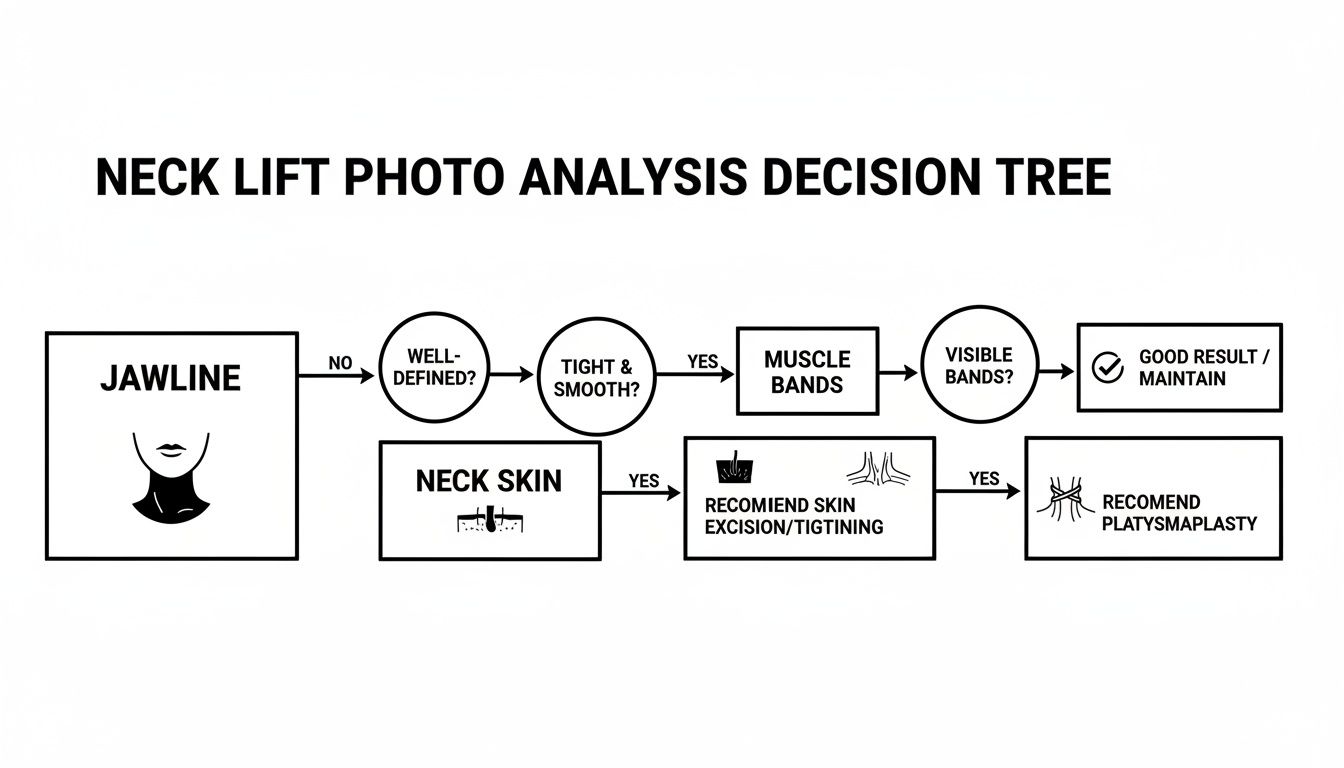
This decision tree can help you think through your own concerns, much like a surgeon would during a consultation.

Flowchart illustrating a neck lift photo analysis decision tree with assessment steps and recommendations.

As you can see, a truly comprehensive neck rejuvenation focuses on these three pillars: jawline definition, skin laxity, and muscle integrity.

Setting Realistic Expectations

It’s crucial to understand what a neck lift can and cannot do. It delivers powerful, long-lasting results, but it isn’t a magic wand. The best outcomes are seen in patients who are in good general health, don’t smoke, and have a realistic vision for their results.

The decision to move forward should always come from a place of personal well-being, never from outside pressure. It’s about restoring confidence and feeling like your reflection finally shows the world how vibrant you really are.

A successful neck lift doesn't aim to make you look like a different person. The goal is to restore the elegant contours of your youth, helping you look refreshed and natural.

Many patients who come to see me are concerned with platysmal banding and jowling, which often become more noticeable after age 40 or following significant weight loss. Studies consistently show a remarkable 80-95% improvement in neck contour post-procedure, and 85% of patients report a huge boost in self-confidence. With results that can last 10-15 years, a surgical neck lift offers a significant advantage over temporary, non-surgical fixes.

A key part of the consultation process is figuring out if your goals are best met with a neck lift alone, a facelift, or a combination of the two. You can learn more in our detailed guide on the differences between a neck lift and a facelift. This knowledge empowers you to choose the exact procedure that fits your unique anatomy and aesthetic goals.

Exploring Your Neck Rejuvenation Options

When you're looking at different ways to rejuvenate your neck, it's important to know what each procedure can—and can't—do. Those truly dramatic neck lift before and after results you see online are almost always from a surgical procedure. That’s because surgery is designed to fix the neck’s underlying structure, not just what’s happening on the surface of the skin.

Let’s get into the specifics of surgical versus non-surgical approaches.

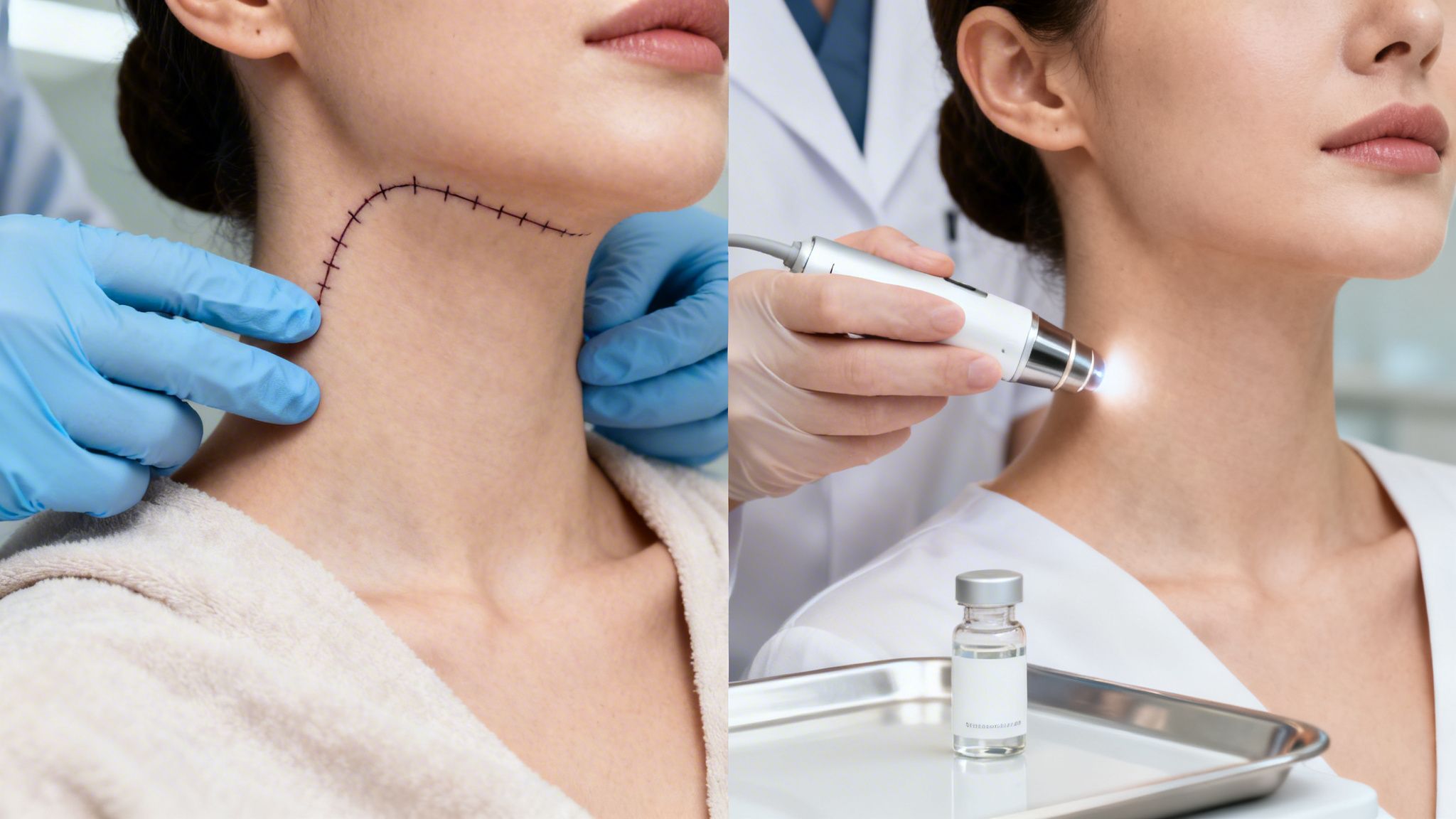
Split image showing neck lift preparation with surgical markings and a light therapy treatment.

Surgical neck lifts are the gold standard for a reason: they correct the two main culprits of an aging neck, which are loose skin and weakened muscles. Think of it like this: you can iron a wrinkled shirt, but if the fabric itself is stretched out, it will never look crisp again. Surgery is what re-tailors the fabric.

A full neck lift usually combines two powerful techniques, and they are almost always performed together for the best outcome.

The Foundation of Surgical Neck Lifts

The most significant results come from a dual approach that addresses both skin and muscle. This is the key to creating a smooth, well-defined neck contour that lasts.

  1. Cervicoplasty: This part of the surgery deals with the loose, excess skin. The surgeon carefully trims the extra skin and redrapes it, creating a tighter and smoother surface along your neck and jawline. This is what gets rid of that sagging, crepey texture.
  2. Platysmaplasty: This technique goes deeper to work on the platysma muscle. Over time, these vertical bands of muscle in your neck can separate and sag, creating that "turkey neck" look. The surgeon tightens and repairs these muscles, often stitching them together to create a strong internal sling that supports the whole neck structure.

These two procedures are the workhorses of any real neck rejuvenation. To get a better sense of how it all comes together, you can read up on the specifics of the neck lift procedure. When combined, they restore the neck's structural integrity and give you that truly refreshed appearance.

What About Non-Surgical Alternatives

In contrast, non-surgical options are best for patients who are just starting to see signs of aging or only need very subtle improvements. These treatments work on the surface and simply cannot address the loose muscle that a surgical neck lift is designed to correct.

While they have their place, the results just don't compare to what surgery can achieve.

Some of the most common non-surgical treatments include:

  • Kybella: This is an injectable that uses an acid to dissolve fat cells, specifically under the chin. It can be effective for reducing a "double chin" but does absolutely nothing for loose skin or those vertical muscle bands.
  • Radiofrequency (RF) Treatments: These treatments use energy to heat the deeper layers of skin, which helps stimulate new collagen. Over time and with multiple sessions, this can create a bit of skin tightening, but it won't fix significant sagging or separated muscles.

These methods can be a decent choice for younger patients with good skin elasticity or for minor touch-ups, but they will never produce the crisp jawline and smooth neck you see in the best neck lift before and after galleries. Our guide on dealing with sagging skin under the chin goes into more detail about which treatments are right for different concerns.

It's crucial to match the treatment to the problem. Non-surgical options are like getting a tune-up for your car—they can help things run a little better, but they can't rebuild the engine. A surgical neck lift is the full engine rebuild.

To make things clearer, let's compare these options side-by-side.

Surgical vs Non-Surgical Neck Lifts A Comparison

This table breaks down the key differences to help you see which approach aligns with your goals and anatomy.

Feature Surgical Neck Lift (Platysmaplasty/Cervicoplasty) Non-Surgical Options (e.g., RF, Kybella)
Ideal Candidate Individuals with moderate to severe skin laxity, jowling, and visible neck bands. Patients with mild skin laxity, good skin elasticity, or isolated submental fat.
Results Dramatic, long-lasting improvement in neck contour, jawline definition, and skin tightness. Subtle to moderate improvement, often requiring multiple sessions for noticeable results.
Longevity Results typically last 10-15 years or more. Temporary results lasting from 6 months to a few years, requiring ongoing maintenance.
Downtime Requires 1-2 weeks of initial recovery, with final results refining over months. Minimal to no downtime, with some treatments causing temporary swelling or redness.

Understanding this distinction is the first step. For anyone looking for a definite and long-term solution for an aging neck, surgery offers a level of correction that non-invasive methods simply can't match.

What to Expect During Your Neck Lift Recovery

A lot of patients are just as interested in the recovery process as they are in the neck lift before and after photos. That makes perfect sense. Knowing what’s coming day-by-day and week-by-week helps you feel prepared and in control as you heal. The conversation about your recovery really starts during your first consultation in our Newport Beach office, where we map out your entire plan.

A woman's journey: resting with a neck brace, natural face, and finally smiling by the beach.

From that initial meeting to your final check-up, our goal is to make the experience as smooth and comfortable as possible. Here’s a look at the typical timeline, so you understand exactly how your new profile will take shape.

The First 48 to 72 Hours

Right after your surgery, the focus is on rest. You'll wake up with a soft, supportive dressing or a special compression garment around your neck and head. This isn't just for comfort; it’s critical for minimizing swelling and giving the healing tissues the support they need.

Most patients describe the feeling as tightness or pressure, not sharp pain, and it’s easily handled with the medication we prescribe. Your main job during these first few days is simply to rest with your head elevated, which does wonders for reducing swelling.

Week One: Finding Your Footing

By the end of the first week, you’ll start feeling much more like yourself. You'll come in for a follow-up appointment with Dr. Bain so he can check your progress and remove any initial sutures. Swelling and bruising will still be around, but you’ll notice they’ve already started to fade.

Most people are up and walking around the house at this point. It’s still very important to avoid any strenuous activity, heavy lifting, or anything else that could raise your blood pressure and slow down your healing.

Weeks Two to Four: Getting Back to Normal Life

This is a big turning point. Around the two-week mark, the most noticeable swelling and bruising have usually gone down enough for patients to feel confident returning to work and their social routines. You’ll still notice some tightness, which is completely normal as everything settles internally.

This is often when you get the first real look at your new neckline. The sharper contour and improved definition really start to show through, which is always an exciting moment.

One to Three Months: Watching the Results Refine

During this phase, your final results truly begin to emerge. The last bits of residual swelling disappear, and your incision lines—which we carefully place in natural skin creases—will fade from pink to a much lighter, less obvious tone.

That feeling of tightness will be almost entirely gone, and your neck will feel much more flexible and natural. The deep structural work from the surgery, like tightening the muscles and redraping the skin, is now fully settling into its new, more youthful position.

It's worth noting how happy patients are with this procedure. Research consistently shows that 90% or more of patients are satisfied with their sharper jawline and tighter skin, with 95% reporting the procedure was "worth it."

This high satisfaction rate really speaks to how effective a neck lift can be. In fact, recent data shows that neck lifts are performed in 20-30% of all facelift procedures, highlighting their role in creating a balanced and complete rejuvenation. Dr. Bain’s Orange County patients see consistently excellent outcomes, with complication rates below 1%—well under global averages—thanks to his proven, evidence-based techniques. You can find more statistics like these over at the American Society of Plastic Surgeons' website.

Six Months and Beyond: The Final Reveal

At the six-month mark, you’re looking at your final result. All the minor swelling is gone, the tissues have completely softened, and your neck's new contour is beautifully defined and settled. This is usually when we take the official "after" photos, because they give a true picture of the long-term outcome.
Your scars will have matured into fine, pale lines that are practically invisible. From here on out, you get to enjoy a refreshed, natural-looking appearance that will last for years.

How to Find the Best Neck Lift Surgeon in Orange County

Choosing your surgeon is, without a doubt, the single most important decision you'll make in your entire neck lift journey. The quality of your neck lift before and after photos, your safety, and your peace of mind all hinge on this one choice.

In a place like Orange County, the options can feel overwhelming. But finding a true expert means looking past the flashy website and digging into the qualifications that really matter.

Look for Board Certification and Specialization

Your first filter should always be board certification, specifically by the American Board of Plastic Surgery. This isn't just a nice-to-have; it's the gold standard. It tells you a surgeon has gone through years of dedicated, rigorous training focused only on plastic and reconstructive surgery. Consider it a non-negotiable starting point.

From there, you'll want to find a surgeon whose practice is heavily centered on facial procedures. While many plastic surgeons are excellent generalists, a specialist like Dr. Michael A. Bain dedicates a huge part of his practice to the complex anatomy of the face and neck. That kind of deep focus is what leads to truly refined, natural-looking results.

Critically Review Their Before and After Gallery

A surgeon's photo gallery is their resume, and you need to review it like you're hiring for the most important job. Look for consistency and an artistic style that matches what you envision for yourself.

Pay close attention to these details:

  • A Variety of Patients: Does the surgeon consistently get great results for people with different ages, skin qualities, and neck issues? This shows adaptability and skill.
  • High-Quality Photos: The photos should be clear, well-lit, and taken from the same standard angles (front, side, three-quarter view). This is the only way to make a fair, honest comparison.
  • Natural-Looking Results: The best work doesn't scream "I've had surgery." The goal is to look refreshed and revitalized, not like a different person.

Dr. Bain maintains a private gallery of his work shown during your personal consultation, allowing you to see a comprehensive range of outcomes on patients with goals similar to yours.

When a surgeon shows you their portfolio, they are showing you their artistic signature. Make sure it's a signature you want written on you.

Understanding Neck Lift Costs in Orange County

Cost is a real-world factor, and it's important to understand exactly what the price includes. In the Orange County area, the total cost for a surgical neck lift will vary depending on the surgeon's experience, how complex your procedure is, and the surgical facility itself.

Think of it as an investment in your confidence. The total cost is typically broken down into three main parts:

  1. Surgeon's Fee: This covers the surgeon's skill, time, and expertise.
  2. Anesthesia Fee: This is for the board-certified anesthesiologist ensuring your safety and comfort.
  3. Facility Fee: This covers the cost of using the fully accredited surgical center.

Many premier practices, including Dr. Bain's, offer financing options through trusted third-party companies like CareCredit. These plans help make the procedure more accessible by breaking the cost into manageable monthly payments. This allows you to choose the right surgeon for you without finances being the only deciding factor. An open discussion about all these elements is a key part of any good consultation.

Answering Your Neck Lift Questions

As you browse through incredible neck lift before and after photos, it’s only natural for practical questions to pop up. Getting clear on what to expect during recovery, what happens with scarring, and how other procedures fit in will help you make your decision with confidence. Here are some straightforward answers to the questions we hear most often from our patients.

How Painful Is a Neck Lift Recovery?

Most of our patients describe the feeling after a neck lift as tightness and discomfort, not sharp or severe pain. This is most noticeable for the first few days after your surgery, and it’s easily managed with the pain medication we prescribe.

That sensation of tightness, especially right under your chin and along your jaw, is completely normal. It’s a good sign, actually—it means the underlying muscles and tissues are healing in their new, elevated position. This feeling will slowly fade over the first week or two as the initial swelling goes down.

Will My Neck Lift Scars Be Noticeable?

A surgeon's skill is often measured by what you can't see. A big part of our job is to meticulously place incisions where they are naturally hidden. For a neck lift, that means tucking them into the crease behind your ears and within the natural fold just under your chin.

At first, like any new scar, the incision lines will look a bit pink and may be slightly raised. But over the course of several months to a year, they mature, soften, and fade into very fine, pale lines. If you follow the scar care instructions we provide, they usually become incredibly difficult to spot, even when you pull your hair back.

The art of a great neck lift lies not only in the rejuvenated contour but also in the near-invisibility of the surgical work. Meticulous incision placement is a hallmark of an expert facial surgeon.

How Soon Will I See the Final Results?

You’ll see a major change right away, but the final, refined result takes some time to fully emerge. It's a bit like watching a sculpture being unveiled; the basic shape is there from the start, but the delicate details become clearer as the weeks go by.

  • Initial Results (1-4 Weeks): The most significant swelling and any bruising will clear up within the first few weeks. This is when you'll first get a real look at the improvements to your neck and jawline.
  • Refined Results (1-3 Months): As the last bits of swelling continue to disappear, your new contours will look sharper and more defined. The skin really starts to settle into its new position.
  • Final Outcome (6+ Months): By the six-month mark, almost all the swelling is gone and the tissues have completely softened. This is when your results are considered final and stable—and it's typically when we take your official "after" photos.

Can I Combine a Neck Lift With Other Procedures?

Yes, and in fact, it's very common. Combining procedures is often the best way to achieve a balanced and natural-looking rejuvenation for the entire face. A neck lift is frequently done at the same time as other surgeries to make sure all your features appear to age in harmony.

Some of the most common pairings include:

  • Facelift: This is the most popular combination. It addresses aging in the mid-face and jowls at the same time as the neck for a truly comprehensive result.
  • Eyelid Surgery (Blepharoplasty): Refreshing tired or drooping eyes can make your entire face look more rested and alert.
  • Brow Lift: Lifting a heavy brow complements the work done on the lower face and neck, creating a cohesive and beautifully natural outcome.

Doing procedures together is also more efficient. It means one recovery period and one set of facility and anesthesia fees. During your consultation, we can talk about which combination, if any, makes the most sense for achieving your aesthetic goals.


Ready to see how these principles apply to your own goals? At the practice of Michael A. Bain, MD, we provide personalized consultations to map out a plan that aligns with your vision for a natural, refreshed look. To explore our approach and see the possibilities, please visit us at https://www.drbain.com.

7 Breast Augmentation Before and After Transformations: Your 2026 Guide

Deciding to pursue breast augmentation is a deeply personal journey, and a crucial part of that process is visualizing the potential outcomes. Reviewing breast augmentation before and after photo galleries is one of the most effective ways to understand what is surgically possible. These images help set realistic expectations, show a surgeon's specific aesthetic style, and allow you to see results on bodies similar to your own. A well-curated gallery provides more than just pictures; it offers vital details like implant type, size, placement, and the patient’s original anatomy, which are all key factors in your final result.
This guide is designed to help you navigate the best online resources for high-quality, informative before and after photos. We will explore several leading platforms, from the official galleries of board-certified plastic surgery societies to the dedicated patient results shared by top surgeons like Dr. Michael A. Bain. Each entry will analyze the strengths of the respective gallery, providing screenshots and direct links to help you find inspiration and clarity. Our goal is to equip you with the tools to confidently research your procedure, understand your options, and feel prepared for your own consultation and potential transformation.

1. Michael A. Bain, MD

Dr. Michael A. Bain’s website serves as an authoritative and deeply informative resource for individuals exploring breast augmentation. The platform stands out by centering its approach on patient education and transparent communication, moving beyond a simple service menu to provide a comprehensive overview of what to expect. It's an ideal starting point for anyone seeking to understand the nuances of breast augmentation before and after, grounded in the expertise of a board-certified plastic surgeon with impeccable credentials and hospital affiliations.

Michael A. Bain, MD, breast augmentation before and after results

The site immediately establishes credibility through Dr. Bain's background, highlighting his UCLA training, prestigious Davis Scholarship, and board certification. This assurance of high safety and quality standards is a critical first step for any prospective patient. The user experience is straightforward, guiding visitors toward the information they need most, from procedure details to the surgeon’s philosophy.

In-Depth Analysis of Key Strengths

One of the most valuable assets of Dr. Bain's online presence is the private before-and-after gallery. This feature is critical for setting realistic expectations. By requiring private access, the practice respects patient confidentiality while still providing an essential visual tool for decision-making. Unlike public galleries, this curated collection allows prospective patients to see a range of outcomes specific to Dr. Bain’s surgical style, which emphasizes natural-looking and refined results.

Another key component is the emphasis on unrushed, one-on-one consultations. The website's content and structure reinforce this patient-first philosophy, encouraging visitors to ask questions and feel fully informed before making a commitment. This approach directly counters the high-pressure sales tactics sometimes found in the cosmetic surgery field, building trust from the very first interaction.

Actionable Takeaways & Practical Tips

  • Access the Private Gallery: To get a clear picture of potential outcomes, take the step to request access to the private before-and-after photo gallery. This is the best way to evaluate Dr. Bain's aesthetic and see results for patients with similar body types or goals.
  • Explore Educational Resources: The site contains useful articles that help answer common questions. For instance, you can find a detailed comparison of saline vs. silicone breast implants to better understand your options before a consultation.
  • Review Patient Testimonials: Read through the written testimonials to gain insight into the patient experience, from the initial consultation to the final results and post-operative care.

Access and Availability

Dr. Bain's practice is located in Newport Beach and primarily serves Orange County residents, including those in Irvine, Costa Mesa, and Laguna Beach. While the website does not list standard procedure prices, it provides clear information on available financing options. Costs are determined on an individual basis following a comprehensive consultation, which can be scheduled directly through the site.

Website: https://www.drbain.com

2. American Society of Plastic Surgeons (ASPS) – Breast Augmentation Photo Gallery

For those beginning their research, the American Society of Plastic Surgeons (ASPS) website offers an authoritative and extensive collection of breast augmentation before and after photos. As the largest specialty society for board-certified plastic surgeons in the United States, its gallery is a trusted, non-commercial resource. It aggregates hundreds of real patient cases submitted by its qualified members, including Dr. Bain, providing a broad overview of what is possible with modern cosmetic surgery.

American Society of Plastic Surgeons (ASPS) – Breast Augmentation Photo Gallery

The platform’s primary strength is the sheer variety and credibility of its content. You can view results from a wide range of body types, starting breast shapes, and patient goals. Each case typically includes important details like implant type (saline or silicone), size in cubic centimeters (cc), and placement (submuscular or subglandular). This level of detail is critical for setting realistic expectations and understanding how different variables contribute to the final look. If you are unsure about what these specifications mean, our comprehensive breast implant size guide can help you decode the terminology.

Key Features and User Experience

While the site's filtering capabilities are not as granular as a private practice gallery, its educational focus is a significant benefit. The ASPS pairs its visual gallery with in-depth articles covering everything from surgical techniques to recovery and potential risks. This context helps patients make more informed decisions.

  • Trust and Authority: Every photo comes from a board-certified ASPS member, ensuring the results are from a vetted, qualified professional.
  • Educational Context: The site provides reliable information alongside the images, which is essential for a complete understanding of the procedure.
  • Diverse Examples: You can find cases that closely match your own anatomy and aesthetic goals, which is a key part of the research process.

Keep in mind that the ASPS website is a society-level resource, not a direct provider. You will not find pricing information, as costs vary significantly by surgeon, location, and the specifics of the procedure. The site is best used as an educational tool for initial research before scheduling consultations with individual surgeons.

Website: plasticsurgery.org/cosmetic-procedures/breast-augmentation/photos

3. The Aesthetic Society – Breast Augmentation Before & After Gallery

Similar to the ASPS, The Aesthetic Society (formerly ASAPS) provides a professional, high-quality gallery of breast augmentation before and after photos submitted by its board-certified members. This organization is dedicated specifically to aesthetic plastic surgery, and its gallery reflects a strong emphasis on artistic outcomes and consistent clinical photography. This standardization helps users make more accurate, apples-to-apples comparisons between different surgical results.

The platform’s main advantage lies in its detailed case notes and focus on combination procedures. Many entries include not just implant specifications but also information about concurrent surgeries, like a breast lift (mastopexy). This is particularly useful for patients who need both an increase in volume and a correction for sagging. The accompanying write-ups give valuable context to the visual results, helping you understand the surgeon's approach and the patient's original concerns.

Key Features and User Experience

While the user interface is straightforward, the level of detail in the case notes can vary depending on what each surgeon submits. However, the connection to board-certified aesthetic specialists provides a layer of trust. The site is a great resource for seeing how different techniques address specific issues, from minor asymmetry to significant post-pregnancy changes. For those considering a combined procedure, understanding what to expect during the healing process is key; you can read more about what breast augmentation recovery entails on our dedicated page.

  • Focus on Aesthetics: The gallery is curated by a society specializing in cosmetic outcomes, ensuring a high standard of results.
  • Helpful Case Notes: Many photos include valuable context, such as implant details and whether a breast lift was also performed.
  • Surgeon Vetting: Each photo links back to a member surgeon's profile, making it easy to research and contact qualified professionals.

Like other society-run galleries, this website does not provide pricing, as costs are determined by the individual surgeon and the complexity of the procedure. Use this site to gather visual references and identify potential surgeons whose aesthetic style aligns with your goals before scheduling consultations.

Website: theaestheticsociety.org/procedures/breast/breast-augmentation/before-after-photos

4. RealSelf – Breast Augmentation Before & After Photos

RealSelf stands out as a massive, community-driven platform where patients and doctors share a wealth of information, including thousands of breast augmentation before and after photos. This U.S.-centric aesthetics marketplace connects prospective patients with providers and serves as a powerful research tool. Its extensive gallery is built on real-world contributions, offering a candid look at results from a wide spectrum of surgeons and patients.

The platform’s greatest asset is its enormous, user-generated library combined with powerful search filters. You can quickly narrow down thousands of images by specific implant sizes, types (saline or silicone), placement techniques, and even patient body characteristics like height and weight. This functionality makes it exceptionally useful for gathering "wish pics" to help communicate your aesthetic goals to a surgeon, like Dr. Bain, during your consultation.

Key Features and User Experience

While the volume of content is a major draw, it is the user-driven reviews and Q&A sections that add another layer of depth. You can see photos tied directly to a doctor’s profile and read about the patient’s personal experience. This community aspect provides valuable social proof and firsthand accounts of the surgical journey, though professional medical advice is always paramount.

  • Unmatched Photo Volume: The sheer number of photos provides an unparalleled resource for seeing results on diverse body types.
  • Granular Filtering: Its search capabilities allow you to find examples that are highly specific to your anatomy and desired outcome.
  • Patient Reviews and Stories: Photos are often accompanied by detailed reviews and personal stories, offering insights into the patient's perspective.

Be mindful that RealSelf is a commercial marketplace, and the quality of information can vary. Not all photos include complete clinical details, and it is vital for patients to independently verify a surgeon's board certification. The platform is best used for initial research and visual exploration, not as a substitute for a professional medical consultation where your individual needs can be properly assessed.

Website: realself.com/photos/breast-augmentation

5. Cleveland Clinic – Cosmetic & Plastic Surgery Before & After Gallery

For patients who value the credibility and clinical standards of a world-renowned hospital system, the Cleveland Clinic’s gallery provides a dependable, academic perspective on breast augmentation before and after results. As a leading non-profit academic medical center, its aesthetic surgery gallery offers a transparent look at patient outcomes, grounded in standardized clinical photography and patient safety. This resource is especially useful for those seeking a benchmark for what natural-looking, medically sound results can look like.

Cleveland Clinic – Cosmetic & Plastic Surgery Before & After Gallery

The gallery’s main advantage is its institutional trustworthiness and the consistency of its presentation. All images follow a strict clinical photography standard, ensuring the lighting, patient posing, and angles are uniform. This makes it easier to objectively compare results without the marketing flair common on other platforms. While the gallery may not specify implant sizes in cubic centimeters (cc) as consistently as a private practice might, it often pairs photos with educational content on incision types and implant placement, helping you understand the surgical techniques behind the outcomes.

Key Features and User Experience

The Cleveland Clinic’s website is designed for clarity and education rather than extensive browsing with filters. The user experience is straightforward, guiding prospective patients through procedural information alongside the visual examples. This integrated approach ensures you are not just looking at photos but also learning about the surgery itself, including recovery and candidacy, from a trusted medical source.

  • Institutional Credibility: The gallery is backed by a globally respected medical institution, offering a high degree of trust and reliability.
  • Standardized Photography: Consistent, clinical-grade photos allow for a more objective assessment of surgical results across different patients.
  • Educational Focus: The site offers valuable explanations of surgical techniques, such as incision locations, which helps in making an informed choice.

Like other large institutional sites, you will not find pricing details, as costs are patient-specific. The gallery generally features more conservative, natural-leaning results often favored in an academic setting. While you cannot book a procedure with Dr. Bain through this site, it serves as an excellent reference point for understanding clinical best practices before your consultation.

Website: my.clevelandclinic.org/cosmetic-plastic-surgery/photos

6. Grover Aesthetics (Newport Beach, CA) – Breast Augmentation Gallery

For prospective patients in Southern California, Grover Aesthetics offers a highly relevant and extensive gallery of breast augmentation before and after photos. As a well-known practice in Newport Beach, this website is an excellent resource for seeing results on a local patient population, which can be particularly helpful for understanding aesthetic trends and outcomes specific to the area. The gallery showcases the work of a single, high-volume surgeon, providing a clear picture of his specific style and capabilities.

Grover Aesthetics (Newport Beach, CA) – Breast Augmentation Gallery

The primary advantage of this platform is its large collection of well-organized case studies. Patients can easily browse through numerous examples, comparing different implant sizes, types, and patient body frames to find results that align with their goals. The gallery includes not only primary augmentations but also more complex procedures like breast lifts with implants and revision surgeries. This provides a detailed view of what is achievable, from subtle enhancements to more dramatic transformations.

Key Features and User Experience

While a single-practice gallery reflects one surgeon’s aesthetic, it offers a consistent and predictable look at potential outcomes. The user interface is straightforward, allowing for easy navigation through the different breast procedure albums. This local focus is a major benefit for anyone in the Orange County area, as it simplifies the process of moving from online research to an in-person consultation.

  • Strong Local Relevance: Ideal for patients in Orange County and Southern California who want to see local results and easily schedule a consultation.
  • Large Case Variety: The extensive collection allows for detailed visual comparison of implant sizes, body types, and final aesthetics.
  • Procedural Diversity: Includes examples of primary augmentation, lift-with-implant, and revision cases, offering a complete view of breast enhancement options.

It is important to note that, like most private practices, the website does not list pricing information. Costs are determined after a personal evaluation with the surgeon. This gallery is best used by individuals who appreciate Dr. Grover's aesthetic style and are seriously considering a consultation at his Newport Beach office.

Website: drgrover.com/gallery/breast-procedures/breast-augmentation/

7. Pacific Center for Plastic Surgery (Newport Beach, CA) – Before & After Gallery

For patients in Southern California, the Pacific Center for Plastic Surgery offers a highly localized and practical gallery of breast augmentation before and after images. This established Orange County practice features work from multiple board-certified surgeons, giving potential patients a unique opportunity to compare different artistic styles all within a single, reputable center. Their gallery is a strong reflection of local aesthetic preferences, providing real-patient results that are especially relevant to those in the area.

Pacific Center for Plastic Surgery (Newport Beach, CA) – Before & After Gallery

The primary advantage of this gallery is its high practical value for prospective patients in and around Newport Beach. Instead of browsing national or international results, you can see outcomes achieved by surgeons you can actually consult with. The gallery is well-organized by procedure, with a dedicated breast augmentation section that is frequently updated. While not all case entries provide the same level of implant detail, the sheer volume of examples from a cohesive team approach makes it a powerful research tool.

Key Features and User Experience

The site’s design allows you to focus on the work of specific surgeons or browse the collective portfolio, which is helpful for finding a surgeon whose style aligns with your goals. The gallery also includes a wide range of other breast procedures, such as lifts and revisions, making it a good resource for patients with more complex needs.

  • Local, Relevant Results: View outcomes from surgeons in your community, reflecting the aesthetic standards of the Southern California area.
  • Compare Surgeon Styles: The multi-surgeon practice lets you evaluate the work of different doctors side-by-side to find the best fit.
  • High Volume of Cases: The practice’s team approach results in a large and frequently updated collection of before and after photos.

As with most private practice sites, pricing is not listed online and requires a personalized consultation for an accurate quote. The main purpose of this gallery is to help you assess the surgeons' skill and aesthetic consistency before committing to an appointment with Dr. Bain or another specialist.

Website: pacificcenterplasticsurgery.com/gallery/

Breast Augmentation Before & After — 7-Source Comparison

Source Implementation complexity 🔄 Resource requirements ⚡ Expected outcomes ⭐📊 Ideal use cases 💡 Key advantages
Michael A. Bain, MD Moderate — individualized surgical planning and high technical skill High — OR/hospital privileges, pre/post care, financing options High-quality, natural-looking, long-term surgical results supported by patient photos/testimonials Patients seeking board-certified, in-person care for face, breast, and body procedures in Orange County Board-certified surgeon, hospital privileges, evidence-based techniques, personalized consultations
American Society of Plastic Surgeons (ASPS) – Gallery Low — simple online browsing and filtering Low — internet access; no consult required for initial review Broad, trustworthy sample of surgeon-submitted cases with educational context Early research to set realistic expectations and compare nationwide cases Large, vetted member submissions and educational content for expectation-setting
The Aesthetic Society – Gallery Low — browse with consistent clinical-photo format Low — internet access; links to surgeons for follow-up Comparable, standardized clinical photos with case notes for apples-to-apples viewing Vetting surgeons by results and comparing augmentation vs. combined procedures Consistent photo standards and useful case write-ups linking to surgeon profiles
RealSelf – Photos Low — searchable, filterable consumer platform Low to moderate — time to filter/vet entries; account optional Very large, diverse dataset; variable quality and completeness across entries Early-stage idea gathering and assembling “wish pics” to bring to consultations Massive volume, granular filters (implant size/technique), patient reviews and Q&A
Cleveland Clinic – Gallery Low — curated institutional gallery with standardized photos Moderate — institutional resources behind content; fewer cases than marketplaces Reliable clinical benchmarks and educational explanations reflecting conservative outcomes Patients seeking academically reviewed examples and clear procedural explanations Institutional credibility, standardized clinical photography, educational context
Grover Aesthetics (Newport Beach) – Gallery Moderate — practice-level organization reflecting one surgeon’s style High — local practice resources and in-person consultation availability Consistent local-case results useful for regional aesthetic expectations Local SoCal patients wanting nearby consults and region-specific results Large local case variety, easy in-person follow-up, regional relevance
Pacific Center for Plastic Surgery – Gallery Moderate — multi-surgeon practice with organized galleries High — multiple surgeons and frequent gallery updates Diverse outcomes across surgeons within one center; good for intra-practice comparisons Patients comparing surgeon styles within a single local center Team approach, multiple board-certified surgeons, frequently updated galleries

Your Next Step: From Inspiration to Consultation

Navigating the world of breast augmentation before and after photos can be an incredibly insightful and personal experience. By exploring the galleries from respected sources like the American Society of Plastic Surgeons, RealSelf, and local experts like Dr. Grover and the Pacific Center for Plastic Surgery, you’ve taken a significant step in your research. These visual resources do more than just showcase results; they provide a realistic framework for what is achievable, highlighting the importance of anatomical considerations, implant choices, and surgical techniques.

The key takeaway from this extensive review is the power of visual information in setting realistic expectations. Each case study, from Dr. Bain’s own portfolio to the broader collections, underscores that a successful outcome is deeply personal. It's about achieving proportion, symmetry, and a profile that aligns with your specific body type and aesthetic goals, not simply replicating a photo you admire.

From Visuals to a Personalized Plan

The galleries serve as a vital educational tool, but they represent the final chapter of someone else’s story. Your journey requires a personalized approach, guided by an expert who can translate your inspiration into a safe and effective surgical plan. The most critical step you can take now is to move from passive research to active consultation.

Here’s how to make that transition effectively:

  • Compile Your Favorites: Gather a few before-and-after images that resonate with you. Note what you like about each "after" photo-is it the shape, the projection, the size relative to the patient's frame?
  • Prepare Your Questions: Your review has likely sparked questions about recovery, implant types (saline vs. silicone), placement (submuscular vs. subglandular), and potential risks. Write them down to bring to your consultation.
  • Consider the Surgeon's Role: Remember that the surgeon's skill, experience, and aesthetic judgment are the most important factors. Look for a board-certified plastic surgeon whose results consistently align with your goals. As you prepare for a consultation, it can be helpful to understand how plastic surgeons optimize their online presence, offering insights into how you might find reputable practitioners through a comprehensive Plastic Surgeon SEO Guide.

Choosing the Right Partner for Your Journey

The decision to undergo breast augmentation is significant, and the choice of your surgeon is paramount. The goal of reviewing these breast augmentation before and after galleries is not just to find a look you like, but to find a surgeon you trust. A consultation is your opportunity to establish that trust, have your concerns addressed, and co-create a plan that is uniquely yours. It is the bridge between the inspiration you've gathered and the beautiful, confident outcome you deserve.


Are you ready to see what's possible for you? Schedule a one-on-one consultation with Michael A. Bain, MD, a board-certified plastic surgeon in Newport Beach with decades of experience creating beautiful, natural-looking results. Dr. Bain can provide a personalized assessment and help you understand your options for achieving your aesthetic goals.

Facelift Surgery Before and After Photos: See Real Transformations

Considering a facelift is a significant decision, and one of the most powerful tools for understanding the possibilities is seeing real results. The journey to facial rejuvenation often begins with a simple search for "facelift surgery before and after," but the sheer volume of images online can be overwhelming. It's difficult to distinguish between marketing hype and authentic surgical outcomes, or to understand the specific techniques that lead to a particular result.

This guide is designed to cut through the noise. We will examine a curated collection of real patient case studies, providing an in-depth look at what different types of facelifts can achieve. You won't just see pictures; you will gain a deeper understanding of the entire process. Each example will break down the patient's original concerns, the exact procedures performed, and insights into the surgeon's approach. We'll explore the nuances of different techniques, from the deep plane facelift to mini-lifts, and discuss how they are combined with other procedures like neck lifts or eyelid surgery for balanced, natural-looking rejuvenation.

Our goal is to provide a clear, educational resource that helps you visualize potential outcomes and feel more prepared for a consultation. By analyzing these transformations from expert surgeons, including our own Dr. Bain here in Newport Beach, you can develop a more refined aesthetic eye and a better sense of what you hope to achieve. This collection serves as your visual guide to the art and science of modern facial plastic surgery, showing you what is truly possible.

1. Michael A. Bain, MD

Featured Choice for Comprehensive Surgical Excellence

Dr. Michael A. Bain's website serves as a premier educational resource for anyone in the Newport Beach and greater Orange County area considering facial rejuvenation. It stands out by providing an in-depth, professional gateway into the world of cosmetic surgery, with a particular focus on achieving natural, refined outcomes. For users seeking credible facelift surgery before and after examples, the site offers a well-curated, private gallery that showcases the surgeon's artistry and technical skill.

The platform is designed not just as a brochure but as a foundational tool for patient decision-making. It details Dr. Bain's philosophy, which marries artistic judgment with surgical precision, a combination that reassures patients they are in capable hands. This approach is backed by impressive credentials, including board certification, training at esteemed institutions like UCLA, and surgical privileges at top-tier facilities such as Hoag Memorial Hospital.

In-Depth Analysis: Why Dr. Bain is a Top-Tier Choice

The strength of Dr. Bain's practice lies in its patient-first framework. Every element, from the unrushed consultations to the emphasis on evidence-based techniques, is structured to build confidence and deliver lasting results. The website effectively communicates this commitment, setting it apart from competitors that may prioritize volume over individualized care.

Key Strategic Insight: The practice positions itself as a center for comprehensive aesthetic care. By offering a full spectrum of procedures for the face, breast, and body, Dr. Bain becomes a single point of contact for a patient's long-term cosmetic journey, fostering trust and continuity of care that is especially critical for significant procedures like a facelift.

Practical Benefits for Prospective Patients

For individuals exploring their options, the website offers several tangible advantages:

  • Verified Expertise: Dr. Bain's credentials and hospital affiliations are prominently displayed, offering immediate assurance of his qualifications and commitment to safety.
  • Visual Evidence: Access to a private before-and-after photo gallery allows serious candidates to view real patient outcomes, helping them set realistic expectations and appreciate the surgeon's aesthetic style.
  • Educational Resources: The site includes valuable information to guide patients through their surgical journey. For example, those concerned about the post-operative experience can find a detailed facelift recovery timeline, which outlines what to expect week by week.
  • Patient-Centric Support: The inclusion of financing options and robust testimonials speaks to a practice that understands and addresses patient concerns beyond the operating room.

Important Considerations

While the website excels in providing detailed information about procedures and the surgeon's philosophy, it follows a common industry practice of not listing prices online. Costs are provided only after a personal consultation, which ensures the quote is tailored to the patient’s specific needs and anatomical considerations. Furthermore, the practice is physically located in Newport Beach, meaning patients from outside Orange County must factor in travel for all appointments and surgical care.

Website: https://www.drbain.com

2. American Society of Plastic Surgeons (ASPS) – Facelift Photo Gallery

For those beginning their research into facelift surgery before and after outcomes, the American Society of Plastic Surgeons (ASPS) photo gallery serves as an authoritative and broad starting point. As the largest plastic surgery specialty organization in the world, ASPS provides a gallery that aggregates real patient results exclusively from its board-certified members. This ensures a high standard of care and provides a national perspective on what is possible with a facelift.

American Society of Plastic Surgeons (ASPS) – Facelift Photo Gallery

The primary value of the ASPS gallery is its scope and the educational context it provides. Unlike a single practice's website, it allows you to see the work of many different surgeons across the U.S., offering a diverse look at surgical styles and patient results across various age groups and ethnicities. Each case is often accompanied by useful details, such as the specific type of rhytidectomy performed and any complementary procedures like blepharoplasty (eyelid surgery) or a neck lift.

Strategic Analysis & Actionable Takeaways

This platform is less about finding a specific surgeon and more about educating yourself on the procedure itself. By viewing dozens of facelift surgery before and after examples, you can start to identify the specific outcomes you find most appealing.

Practical Tips for Using the ASPS Gallery:

  • Filter and Compare: Use the site’s filtering tools to narrow down results by procedure. Pay close attention to cases that list the patient's age and initial concerns, looking for individuals with a similar facial structure or aging pattern to your own.
  • Study the Details: Look beyond the photos. Read the descriptions to understand which combination of procedures created the final result. This helps you build a vocabulary for your own consultation.
  • Note the Variances: One of the cons is the inconsistent photo quality; angles, lighting, and backgrounds differ from one surgeon's submission to another. This variation, however, offers a crucial lesson. For clinics showcasing patient results, mastering tools like AI image editing can ensure 'before and after' photos are professionally optimized for clarity and impact within a gallery.

The ASPS gallery also provides general statistics on average surgeon fees, which can help set realistic budget expectations before you begin scheduling consultations. While it doesn't offer direct, case-by-case pricing, this macro-level financial information is an important piece of the planning puzzle.

Website: https://www.plasticsurgery.org/photo-gallery

3. The Aesthetic Society – Facelift Before & After Photo Gallery

For patients seeking results that epitomize modern aesthetic standards, The Aesthetic Society's photo gallery offers a curated view into the world of advanced facial rejuvenation. This organization, formerly known as the American Society for Aesthetic Plastic Surgery (ASAPS), is comprised of board-certified plastic surgeons who specialize in cosmetic surgery. Their gallery, therefore, reflects a high degree of specialization and provides excellent examples of contemporary facelift techniques focused on natural-looking outcomes.

The Aesthetic Society – Facelift Before & After Photo Gallery

The key advantage here is the aesthetic focus. While many organizations cover all types of plastic surgery, The Aesthetic Society's members are deeply invested in the art and science of cosmetic procedures. This translates to a gallery where the facelift surgery before and after photos often showcase sophisticated work. You'll find multi-view photo sets (front, side, and oblique angles) that give a more complete picture of the surgical result, a crucial element for assessing changes to the jawline and neck contour.

Strategic Analysis & Actionable Takeaways

This platform is ideal for refining your aesthetic goals. After getting a broad overview from a site like ASPS, The Aesthetic Society's gallery helps you zero in on the nuances of high-quality facelift outcomes. The consistent interface makes it simple to browse through the work of many top-tier surgeons.

Practical Tips for Using The Aesthetic Society Gallery:

  • Focus on Technique Subtleties: Pay attention to how surgeons address not just sagging skin but also volume loss and neck laxity. Many cases include adjunctive procedures like fat grafting or neck lifts, which are often essential for a balanced result.
  • Use the Educational Links: Each procedure page links to detailed articles on what to expect, safety considerations, and recovery. Use this to deepen your understanding of the surgical process itself. This knowledge is power when you enter a consultation.
  • Assess Surgeon Styles: While case notes can be brief, the visual evidence is strong. Note the names of surgeons whose results consistently align with your vision. This can help you create a shortlist of potential surgeons to research further. For instance, you might see results from a "deep plane" facelift versus a "mini" facelift. To understand what these differences mean for your own anatomy and goals, exploring a detailed comparison of mini vs. full facelifts can provide critical context.

One of the drawbacks is the limited price transparency on a case-by-case basis, which is standard for these types of aggregate galleries. However, by seeing the caliber of work and the complexity of the procedures shown, you can begin to appreciate the investment required for a premium, natural-looking result.

Website: https://www.theaestheticsociety.org/photo-gallery/head-face/facelift

4. Andrew Jacono, MD – New York Center for Facial Plastic & Laser Surgery

For patients seeking a deep dive into a specific, advanced surgical technique, the gallery of Dr. Andrew Jacono offers a masterclass in the extended deep-plane facelift. As a world-renowned facial plastic surgeon, Dr. Jacono’s website provides an extensive library of high-resolution facelift surgery before and after photos that showcase natural-looking, sophisticated results. This platform is ideal for those who have moved beyond general research and want to understand the nuanced outcomes of a particular methodology.

Andrew Jacono, MD – New York Center for Facial Plastic & Laser Surgery

The defining feature of this gallery is its focus and consistency. Every case highlights the results of Dr. Jacono's signature M.A.D.E. (Minimal Access Deep-Plane Extended) facelift, providing a clear picture of his surgical style. The galleries are well-organized into categories like standard facelifts, mini facelifts, and complex revision cases, allowing prospective patients to find examples directly relevant to their situation. The inclusion of multi-angle views and videos provides a complete, 360-degree understanding of the changes achieved.

Strategic Analysis & Actionable Takeaways

This website serves as an excellent case study for patients interested in the deep-plane technique, helping them develop a precise understanding of its capabilities. By examining dozens of consistent, high-quality examples from a single surgeon, you can learn to identify the hallmarks of this approach, such as a restored jawline and smooth neck without a "pulled" or "wind-swept" appearance.

Practical Tips for Using Dr. Jacono's Gallery:

  • Study Technique-Specific Results: Focus on how the deep-plane technique addresses the mid-face, jowls, and neck in unison. Compare the outcomes in the revision facelift gallery to the primary cases to appreciate the skill required for corrective work.
  • Analyze Combined Procedures: Many cases detail adjunctive procedures like temporal lifts, fat grafting, or eyelid surgery. Note how these additions contribute to a balanced and comprehensive facial rejuvenation, which is critical for planning your own surgical goals.
  • Consider the Logistics: The main drawback is the exclusivity and cost. As a high-demand surgeon in New York City, pricing is at a premium and not listed on the site. For patients in Orange County, this gallery is best used as an educational tool to refine your aesthetic goals before consulting with a local specialist like Dr. Bain.

The transparency regarding surgical technique is a significant pro. Detailed explanations and diagrams of the extended deep-plane facelift accompany the visual evidence, offering an educational experience that empowers patients to have more informed conversations during their own consultations.

Website: https://www.newyorkfacialplasticsurgery.com/photo-gallery

5. Babak Azizzadeh, MD – CENTER for Advanced Facial Plastic Surgery

For patients specifically interested in the deep-plane facelift technique, the gallery of Dr. Babak Azizzadeh offers a focused, high-quality resource. Based in Beverly Hills, his practice, the CENTER for Advanced Facial Plastic Surgery, provides a curated collection of patient results that highlight the nuances of modern facial rejuvenation. This platform is less about broad-stroke examples and more about demonstrating the specific outcomes achievable with an advanced surgical method.

Babak Azizzadeh, MD – CENTER for Advanced Facial Plastic Surgery

The strength of this site lies in its educational approach and visual clarity. It features dedicated galleries for both general facelifts and deep-plane facelifts, allowing for a direct comparison. The high-resolution, multi-angle photos are exceptionally clear, providing a detailed look at how the procedure addresses the neck, jowls, and mid-face. Each case implicitly promotes the concept of facial balance, a key principle of the deep-plane technique.

Strategic Analysis & Actionable Takeaways

This gallery is ideal for individuals who have progressed beyond initial research and are now investigating specific surgical techniques. Viewing these facelift surgery before and after photos helps you understand the aesthetic philosophy of a surgeon who specializes in the deep-plane method, which repositions the deeper layers of facial muscle and tissue.

Practical Tips for Using Dr. Azizzadeh’s Gallery:

  • Focus on the Deep-Plane: Spend time in the deep-plane facelift gallery to see how it differs from other techniques. Note the natural-looking elevation of the cheeks and the smooth, well-defined jawline, which are hallmarks of this approach.
  • Analyze Multiple Angles: Use the multiple photo angles (frontal, oblique, and profile) to assess the three-dimensional changes. Pay close attention to the neck and the area under the chin, where the deep-plane technique often produces dramatic improvements.
  • Read the Educational Content: The site provides academic-backed explanations of the procedure, including indications and recovery. Reading this information will arm you with specific questions to ask during your own consultations, such as whether a deep-plane or a different technique is better for your anatomy and goals. The longevity of results is also a critical factor; for a deeper dive, you can explore information about how long a facelift lasts.

While the site does not list pricing, it’s important to recognize that a surgeon with this level of specialization in a premium market like Beverly Hills typically commands higher fees. A potential drawback is the curated nature of the gallery, which presents a smaller number of cases compared to large organizational databases. However, the quality and consistency of the examples make it an excellent learning tool for discerning patients.

Website: https://facialplasticsbh.com/gallery-face/

6. Rod J. Rohrich, MD – Dallas Plastic Surgery Institute

For patients seeking to understand what is achievable with a master surgeon, the gallery of Dr. Rod J. Rohrich offers a curated look into high-level facelift outcomes. As a globally recognized plastic surgeon, Dr. Rohrich’s website provides a detailed and transparent view of his surgical philosophy, which emphasizes natural-looking, long-lasting results. This gallery is less about volume and more about the quality and consistency of the work.

Rod J. Rohrich, MD – Dallas Plastic Surgery Institute

The main benefit of Dr. Rohrich's gallery is its clinical precision and educational value. The photography is consistently clear, well-lit, and taken from multiple angles, allowing for a thorough evaluation of the surgical changes. Each case often includes a short description detailing the patient’s goals and the specific procedures performed. This often includes not just the type of facelift but also complementary treatments like fat grafting or laser resurfacing that contribute to the total rejuvenation.

Strategic Analysis & Actionable Takeaways

This website is a powerful resource for studying the finer details of facelift surgery before and after results, particularly concerning incision placement and the appearance of scars over time. The focus on results shown at the one-year postoperative mark gives a realistic preview of the final, settled outcome, moving past the initial swelling and recovery phases.

Practical Tips for Using Dr. Rohrich’s Gallery:

  • Study Incision Artistry: Pay close attention to the close-up photos of the ear and hairline. This is where you can see how a surgeon masterfully hides incisions within natural creases, a key indicator of surgical skill.
  • Analyze Combination Procedures: Many cases are not just a facelift alone. Note how often fat transfer is used to restore volume to the cheeks or how a neck lift is integrated to create a seamless jawline. This helps you understand that total facial harmony often requires more than just lifting.
  • Use as a Benchmark for Quality: While Dr. Rohrich's practice is a high-demand, premium option that may not be accessible to everyone due to fees and availability, his results serve as an excellent benchmark. You can use his gallery to develop a critical eye for quality and bring examples of what you like to consultations with surgeons in your own area.

The site also features extensive patient resources, including aftercare guides, which provide valuable insight into the recovery process. While direct pricing is not available, the premium positioning of the practice suggests fees at the higher end of the market, which is an important financial consideration.

Website: https://drrohrich.com/photographs/facelift/

7. Sam Rizk, MD – Manhattan Facial Plastic Surgery

For individuals researching advanced or revision facelift techniques, the website of Dr. Sam Rizk, a double board-certified facial plastic surgeon in Manhattan, offers a highly specialized resource. His gallery is not just a collection of images; it's a series of case studies demonstrating sophisticated work, particularly in deep-plane facelifts and complex revision surgeries. This platform is ideal for discerning patients who want to understand the nuances of modern surgical approaches.

Sam Rizk, MD – Manhattan Facial Plastic Surgery

The key distinction of Dr. Rizk's site is its focus on narrative and timing. Many facelift surgery before and after galleries show only final, long-term results. Dr. Rizk often includes photos from different post-operative stages, such as a few weeks versus one year later. This transparency provides a realistic glimpse into the healing process and the evolution of the final outcome, an invaluable insight for managing patient expectations.

Strategic Analysis & Actionable Takeaways

This website serves as an educational masterclass in high-definition and deep-plane facelift results. It moves beyond simple before-and-afters to explain the "why" behind specific techniques, connecting the surgical plan to the patient's unique anatomy and aesthetic goals. It’s a destination for those who have already done basic research and are now seeking an expert’s perspective.

Practical Tips for Using Dr. Rizk's Gallery:

  • Analyze the Narratives: Read the case descriptions carefully. Dr. Rizk often explains why a deep-plane technique was chosen over a traditional SMAS lift for a particular patient. This helps you learn the vocabulary to discuss your own facial structure with a surgeon.
  • Focus on Revision Cases: If you are considering a secondary or revision facelift, pay special attention to these examples. They showcase the skill required to correct previous work and address complex issues like scar tissue and unnatural results.
  • Observe the Timelines: Note the photos that specify "early recovery" versus "1 year post-op." This helps you build a mental map of the healing journey, from initial swelling to the final, settled result. One of the primary cons is that as a top-tier NYC surgeon, his pricing is likely well above national averages and is not listed, requiring a consultation for a quote.

The platform excels at demonstrating how a masterful facelift focuses on overall facial harmony rather than just tightening skin. The results consistently appear natural and un-operated on, a testament to the deep-plane technique that repositions underlying muscle and tissue. While the gallery reflects a single surgeon's style, it provides a benchmark for what is achievable with advanced surgical methods.

Website: https://www.drsamrizk.com/photo-gallery/facelift-surgery.html

Facelift Before & After: Top 7 Comparison

Item Implementation complexity 🔄 Resource requirements ⚡ Expected outcomes ⭐📊 Ideal use cases 💡 Key advantages ⭐
Michael A. Bain, MD 🔄 Moderate — individualized surgical planning and in‑person consults ⚡ High — OR/hospital privileges, dedicated staff, financing options ⭐📊 Natural-looking, long-term results with strong patient satisfaction 💡 Comprehensive face, breast, and body cases; patients seeking personalized care ⭐ Board-certified, evidence-based techniques, private gallery and patient testimonials
American Society of Plastic Surgeons (ASPS) – Gallery 🔄 Low — browseable online resource with no clinical coordination ⚡ Low — web access only ⭐📊 Broad national sample; variable photo quality and non‑uniform case details 💡 Benchmarking typical outcomes, fees, and learning candidacy/risks ⭐ National scope and contributor baseline of board-certified surgeons
The Aesthetic Society – Gallery 🔄 Low — online facelift-specific browsing ⚡ Low — web access only ⭐📊 Focused, multi-view facelift examples with linked education 💡 Reviewing modern aesthetic facelift techniques and safety info ⭐ Aesthetic-focused membership and consistent browsing interface
Andrew Jacono, MD 🔄 High — advanced deep‑plane techniques and case-specific planning ⚡ High — high-demand NYC practice; travel/logistics for non-locals ⭐📊 High‑resolution natural outcomes, well-documented technique examples 💡 Candidates for extended deep‑plane, complex or revision facelifts ⭐ Deep documentation of technique and extensive multi-angle galleries
Babak Azizzadeh, MD 🔄 High — deep‑plane and balance-focused surgical approach ⚡ High — Beverly Hills practice with premium market positioning ⭐📊 Clear multi-angle photos emphasizing facial balance and indications 💡 Patients prioritizing academic-backed deep‑plane expertise ⭐ High-resolution images, academic credentials, procedure explanations
Rod J. Rohrich, MD 🔄 Moderate–High — comprehensive case notes and timelines ⚡ High — established practice resources and aftercare support ⭐📊 Consistent clinical photos with emphasis on longer‑term results 💡 Studying incision placement and 6–12+ month outcomes ⭐ Informative case notes, reliable clinical photography, extensive patient resources
Sam Rizk, MD 🔄 High — advanced facelift/neck work with revision cases ⚡ High — NYC-based practice; premium fees and travel may apply ⭐📊 Transparent timelines (early and late) and emphasis on facial harmony 💡 Patients comparing recovery timelines and revision examples ⭐ Varied timeline examples and detailed case narratives

Your Next Step: Planning Your Transformation with Dr. Bain in Newport Beach

The journey through these facelift surgery before and after examples reveals a powerful truth: a successful outcome is a blend of artistry, surgical precision, and a deep understanding of individual anatomy. We've analyzed the work of top surgeons and organizations, from Dr. Jacono's deep plane techniques to the extensive galleries provided by the ASPS and The Aesthetic Society. Each case study underscores that the goal isn't to look like a different person, but a revitalized, more confident version of yourself.

You have seen how different approaches, such as the deep plane facelift, mini facelift, or a combination with neck lifts and eyelid surgery, can address specific patient concerns. The detailed breakdowns demonstrate that a surgeon's ability to customize the procedure is what produces natural, lasting results. This is the most critical takeaway for anyone considering this significant step.

From Inspiration to Action: Key Considerations

As you move from viewing galleries to planning your own procedure, the focus shifts from the "what" to the "how." The examples in this article serve as a guide to what is possible, but your personal journey requires careful consideration of several key factors.

  • Defining Your Goals: Are you primarily concerned with jowls and neck laxity, or are mid-face volume loss and tired eyes your main issues? Having a clear understanding of your desired outcome, as seen in the patient stories, will facilitate a productive consultation.
  • Surgeon's Philosophy and Specialization: Each surgeon has a distinct aesthetic philosophy. Dr. Rohrich’s emphasis on natural results or Dr. Rizk's focus on advanced technology highlights the importance of aligning with a surgeon whose artistic vision matches your own. Look for a board-certified plastic surgeon who specializes in facial procedures.
  • Understanding the Techniques: The analysis of different facelift types (deep plane, SMAS, mini-lift) should empower you to ask informed questions. Inquire why a surgeon recommends a specific technique for you and how it addresses your unique facial structure and aging patterns.
  • Recovery and Realism: The recovery timelines shared in the case studies provide a realistic framework. A successful transformation includes planning for the necessary downtime to heal properly. Open communication with your surgeon about the recovery process is essential for managing expectations.

The best surgeons not only have impressive galleries but also excel at communicating their process. As you consider your options and plan your transformation, understanding the strategies top practices use to communicate their results can be insightful. Many leading aesthetic clinics partner with a dedicated med spa marketing company to effectively showcase patient journeys and real transformations.

Your Personalized Consultation in Orange County

The most crucial step in this process is a one-on-one consultation. This is where the generalized information from facelift surgery before and after galleries becomes a personalized surgical plan tailored to your face, your skin quality, and your aesthetic desires. It's an opportunity to build trust and ensure you and your surgeon share the same vision for your results.

Dr. Michael Bain, featured as a premier example in this guide, embodies the synthesis of technical skill and patient-centered care. His work in Newport Beach and Orange County is a testament to what can be achieved when a surgeon takes the time to listen to a patient’s story and craft a procedure that honors their natural beauty. Your transformation is a significant, personal decision. Armed with the insights from these examples, you are now prepared to take the next, most important step with confidence.


Ready to see what a personalized facelift plan could look like for you? Schedule a private consultation with Michael A. Bain, MD to discuss your goals and explore the possibilities for your own stunning "before and after" story. Visit the Michael A. Bain, MD website to learn more about his approach to facial rejuvenation in the heart of Newport Beach.

Choosing a Top Cosmetic Surgeon Orange County for Your Transformation

Deciding on a cosmetic surgeon in Orange County is one of the most important choices you'll make in your aesthetic journey. It's a decision that goes far beyond marketing claims and flashy websites. My goal here is to help you cut through the noise and focus on what truly matters for your safety and your results.

Finding Your Ideal Cosmetic Surgeon in Orange County

Think of this as your personal game plan for finding a true artist, not just another practitioner. As you search, you'll see many types of facilities offering aesthetic treatments, from specialized med spas and aesthetic practices to larger clinics. But when it comes to surgery, nothing is more critical than focusing your search on a board-certified plastic surgeon.

The right surgeon won't just perform a procedure; they'll understand your aesthetic goals and have the skill to deliver beautiful, natural-looking outcomes. This requires a bit of homework on your part—evaluating credentials, experience, and their personal artistic touch.

Key Milestones in Your Surgeon Selection Journey

I like to break the selection process down into three critical checkpoints. Each step helps you narrow down your options, filtering out the noise until you find the perfect partner for your procedure. It's a quality control process designed to protect your health and ensure you're happy with the final result.

A successful cosmetic surgery outcome is a partnership. It begins not in the operating room, but with the careful, informed selection of a surgeon whose expertise and aesthetic sense you implicitly trust.

This decision path shows the key steps: first, confirming board certification, then carefully reviewing their work, and finally, making sure your vision truly aligns with their surgical philosophy.

Flowchart illustrating the step-by-step process for choosing a qualified surgeon, from candidate to confidence.

As you can see, credentials are the bedrock. But it’s that shared aesthetic vision that ultimately leads to a result you will love for years to come.

From Candidate to Confident Choice

Making the right choice really comes down to knowing what to look for and which qualifications are simply non-negotiable. You’re looking for a surgeon who not only possesses incredible technical skill but who also genuinely listens to what you want to achieve.

Here are the crucial elements you should focus on during your evaluation:

  • Verifiable Board Certification: This is the absolute gold standard. It confirms a surgeon has completed extensive, specialized training and is committed to the highest standards of patient safety.
  • A Strong Before-and-After Gallery: A surgeon’s portfolio is their resume. Look for consistency in their results and, most importantly, for outcomes that reflect the aesthetic you’re hoping for.
  • Clear Communication and Rapport: During a consultation, you should feel completely comfortable. The surgeon should make you feel heard, respected, and confident in their care.

By focusing on these fundamentals, you can turn a search that feels overwhelming into a clear, manageable process. For a deeper dive, you might find our guide on tips to find trusted experts near you helpful. It provides an even more structured approach to finding the right cosmetic surgeon in Orange County for your specific needs.

Why Board Certification Is Your Most Important Guideline

When you start looking for a cosmetic surgeon in Orange County, the number of qualifications and credentials can feel overwhelming. But there's one term that should be at the very top of your checklist: board-certified. What does this actually mean for you as a patient?

It’s a critical distinction. Any licensed doctor can legally perform cosmetic procedures, but that doesn't make them a plastic surgeon. Think of it this way: board certification is the official, verifiable proof that your surgeon has dedicated years of specialized training exclusively to the art and science of plastic surgery. It separates a true specialist from a generalist.

The gold standard in our field is certification from the American Board of Plastic Surgery (ABPS). This isn't a membership you can simply buy into; it's an accomplishment earned through years of demanding, hands-on surgical training and rigorous testing.

What Does ABPS Certification Guarantee?

An ABPS-certified surgeon has successfully navigated a very specific and challenging training path. This journey is designed to produce surgeons who are not just competent, but genuine experts in the full spectrum of plastic and reconstructive surgery.

This path requires:

  • Graduation from an accredited medical school. This is the baseline for every physician.
  • Completion of a demanding general surgery residency. Before they can even begin to focus on aesthetics, these doctors spend at least three years mastering the fundamentals of comprehensive surgery.
  • An additional, specialized plastic surgery residency. Following their general surgery training, they must complete another three years of residency focused entirely on plastic surgery of the face and body.
  • Passing intensive written and oral examinations. These exams are notoriously difficult, testing a surgeon’s medical knowledge, ethical judgment, and ability to handle complex, real-world surgical scenarios.

This extensive process ensures your surgeon has a deep understanding of anatomy, patient safety, and the artistic skill needed to deliver beautiful, natural-looking results. You can learn more about the key qualities to look for in a plastic surgeon to help guide your search.

Choosing a board-certified plastic surgeon isn't just about ensuring good results; it's about prioritizing your safety. It confirms your surgeon has the proven expertise to handle both routine procedures and unexpected complications with the highest level of skill.

The Importance of Hospital Privileges

Beyond board certification, another crucial sign of a surgeon’s credibility is hospital privileges. This means a surgeon has been thoroughly reviewed and granted permission to perform procedures at a reputable local hospital, like Hoag Memorial Hospital in Newport Beach.

Hospitals have their own strict credentialing committees that independently verify a surgeon's training, experience, and safety record. Granting privileges is the hospital’s vote of confidence—their way of saying, "We trust this surgeon to operate on patients in our facility."

If a surgeon only operates out of their private suite and doesn’t have privileges at a local hospital, it should be a major red flag. This may suggest they cannot meet the high standards set by established medical institutions.

To make sure you're in the safest hands, you need to verify your surgeon's credentials for yourself.

Here is a checklist of essential questions to ask during your consultation. Don't be shy about asking them—a transparent, qualified surgeon will be happy to provide this information.

Essential Questions for Your Surgeon Consultation

Use this checklist during your consultations to verify credentials and ensure your chosen surgeon is the right expert for you.

Category Essential Question What This Reveals
Board Certification "Are you certified by the American Board of Plastic Surgery?" Confirms they are a true specialist, not just a "cosmetic surgeon."
Training "Can you tell me about your plastic surgery residency training?" Reveals the depth and focus of their surgical education.
Hospital Privileges "At which hospitals do you have privileges to perform this procedure?" Shows they are trusted by established medical institutions.
Experience "How many times have you performed this specific procedure?" Demonstrates their familiarity and skill with your desired surgery.
Safety "Is your operating facility accredited?" Ensures the surgical suite meets rigorous national safety standards.

Always ask a potential surgeon where they maintain hospital privileges. It’s a simple question that tells you a lot about their standing in the medical community. A top cosmetic surgeon in Orange County will always be proud to share this information with you.

Exploring Modern Facial Rejuvenation Procedures

Close-up of a smiling middle-aged woman with smooth, radiant skin looking at the camera.

The entire philosophy behind facial cosmetic surgery has changed. It's no longer about drastic, obvious alterations. The modern approach is all about refinement and restoration—helping you look like the best, most refreshed version of yourself, not like someone else entirely.

An expert cosmetic surgeon in Orange County doesn't just see a collection of features; they see the face as a whole, where every element should exist in harmony. This isn't just about surgical skill. It's about having a true artist's eye for balance and proportion to deliver results that look completely natural.

This is exactly what sophisticated patients want: subtle improvements that turn back the clock on specific signs of aging, like a softening jawline or tired eyes, without telling the world you’ve had work done.

We're seeing this trend reflected in the numbers. While non-surgical options are still popular, many people are now choosing definitive surgical solutions like facelifts for more significant and lasting results. You can learn more about recent plastic surgery statistics that show a clear shift toward these targeted, face-focused procedures.

The Modern Facelift: Restoring Natural Contours

Forget the tight, "windswept" look you might associate with facelifts of the past. Today's techniques are in a different league entirely. A modern facelift isn't about just pulling the skin; it’s about lifting and repositioning the deep structural tissues that have sagged over time.

Think of it this way: your skin is like fabric draped over the underlying framework of your face. With age, that framework weakens, causing the fabric to droop and fold. A skilled surgeon carefully lifts that foundational layer, allowing the skin to be redraped smoothly and naturally, without any tension.

Different facelift techniques are used to target specific concerns:

  • Full Facelift: A comprehensive approach that addresses aging from the mid-face all the way down to the neck, tackling jowls, deep folds, and loose skin.
  • Mid-Facelift: Focuses on the cheek area, lifting sagging cheeks to soften the lines around the nose and mouth.
  • Lower Facelift/Neck Lift: Specifically designed to redefine the jawline, correct jowls, and address the "turkey neck" caused by loose neck skin and muscle bands.

The right procedure for you depends entirely on your unique facial structure and what you hope to achieve.

Eyelid Surgery: Reclaiming a Youthful Gaze

Your eyes are often the first feature to show age. Puffiness, drooping upper lids, and fine lines can make you look tired or sad, even when you feel full of energy. Eyelid surgery, known as blepharoplasty, is an incredibly effective procedure for refreshing your appearance.

This is one of the most impactful facial surgeries because the changes are precise and subtle, yet they can brighten your entire face. The goal is to restore a rested, alert look while keeping the natural shape and character of your eyes intact.

A well-performed blepharoplasty is a procedure of millimeters. The difference between looking naturally refreshed and looking "overdone" is incredibly small, which is why your surgeon's meticulous skill is absolutely critical.

Eyelid surgery can be broken down into two main types:

  1. Upper Blepharoplasty: Corrects drooping by removing a precise amount of excess skin (and sometimes a bit of fat) from the upper eyelids. This can open up the eyes, restore a defined eyelid crease, and in some cases, even improve vision.
  2. Lower Blepharoplasty: Addresses bags and puffiness under the eyes. This is done by removing or repositioning the fat pads and tightening the skin for a smooth, rejuvenated contour.

A great surgeon will customize the procedure to your specific features, ensuring the results are a perfect complement to you.

Rhinoplasty: Creating Harmony and Balance

Rhinoplasty, or a "nose job," is arguably the most artistic of all plastic surgeries. Because the nose is the central, defining feature of your face, even a tiny adjustment can bring all of your other features into beautiful harmony. It demands immense technical skill combined with a deep understanding of facial aesthetics.

Modern rhinoplasty isn't about stamping out a generic, "perfect" nose. A top cosmetic surgeon in Orange County will work to refine your nose so that it fits your face flawlessly, enhancing your natural beauty and preserving your unique ethnic character.

The goal is simple: for people to notice your beautiful eyes or your warm smile—not your nose.

A Guide to Breast and Body Contouring Surgeries

For many women, breast and body contouring isn't just about changing their appearance—it's about getting back to themselves. Life events like pregnancy, childbirth, and major weight loss can leave behind changes that no amount of diet or exercise can fix. These procedures are about restoring the contours you once had and making your reflection finally match the way you feel inside.

A truly skilled cosmetic surgeon in Orange County thinks like an artist. The goal isn’t to hit a specific cup size or number on a scale, but to create harmony and proportion that complements your unique frame. This is what ensures your results look natural, balanced, and completely you.

Common Breast Enhancement Procedures

Breast surgeries are consistently among the most popular cosmetic procedures, offering solutions for everything from size and shape to lift and position. Breast augmentation remains the number one cosmetic surgery in the U.S., with over 300,000 procedures performed each year. In a lifestyle-focused place like Orange County, it's a go-to for many women.

What’s really telling is the patient satisfaction rate: an incredible 98% report that their results met or went beyond their expectations. This speaks volumes about modern techniques and the shift toward natural-looking outcomes. You can discover more about the trends shaping patient preferences on OrangeCountyPlasticSurgery.com.

Let's break down the most common options:

  • Breast Augmentation: This procedure uses saline or silicone implants to increase breast size and improve fullness. It’s an ideal choice for women who feel their breasts are naturally too small, have lost volume after having children, or have noticeable asymmetry.
  • Breast Lift (Mastopexy): A lift specifically targets sagging. By removing excess skin and repositioning the nipple to a higher, more youthful spot, it reshapes the breast for a perkier look without adding significant volume.
  • Breast Augmentation-Lift: Why choose one? For women who want both more volume and a lifted position, these two procedures are often combined to create a full, youthful, and perfectly positioned breast profile.

A great surgeon will walk you through the pros and cons of saline versus silicone implants, taking into account your body type, the feel you want, and your ultimate goals. This personalized guidance is what makes the difference between a good result and one that feels like a natural part of you.

Popular Body Contouring Options

Body contouring procedures are designed to smooth, tighten, and reshape the specific areas that just won't budge with diet and exercise. They are especially popular among mothers looking to restore their pre-pregnancy figure (often called a "Mommy Makeover") and people celebrating a major weight loss journey.

The objective is to create smoother lines and a more toned physique. Think of a sculptor revealing the form within a block of stone; the surgeon removes what’s obscuring your shape to reveal the more defined, aesthetic contours underneath.

The most successful body contouring results come from a surgeon who combines technical precision with a deep understanding of human anatomy. It's about revealing the natural shape that's been obscured by excess skin or stubborn fat.

Here are a few of the most requested body procedures:

  1. Tummy Tuck (Abdominoplasty): A tummy tuck is a powerhouse procedure for creating a flat, firm abdomen. It not only removes excess skin and fat but, more importantly, it tightens the separated abdominal muscles (diastasis recti). That's something no amount of crunches can fix, making it a true cornerstone of post-pregnancy restoration.
  2. Liposuction: This procedure is all about targeting localized pockets of stubborn fat. It’s not a weight-loss tool, but a contouring one used to slim down specific spots like the abdomen, thighs, hips, arms, or neck. An experienced surgeon uses it with an artistic eye to sculpt the body and enhance its natural curves.
  3. Body Lifts: After massive weight loss, patients can be left with a significant amount of loose, hanging skin. Body lift procedures—like an arm lift, thigh lift, or lower body lift—are designed specifically to remove this excess skin and tighten the underlying tissue. It’s the final step that reveals the patient's hard-earned new shape.

Finding the right cosmetic surgeon in Orange County is about finding a partner who will build a surgical plan just for you. They’ll look at your unique body shape, skin quality, and personal goals to recommend the procedure—or combination of procedures—that will deliver the beautiful, confidence-boosting results you’re looking for.

Navigating Your Consultation, Recovery, and Final Results

Smiling female patient reviews her face in a mirror with a cosmetic surgeon and a nurse.

Think of your cosmetic surgery journey as a true partnership—one that begins long before you ever step into an operating room. This entire relationship is built on trust, and that trust starts with a thorough, unhurried consultation. A top cosmetic surgeon in Orange County will never make you feel rushed during this first meeting.

Instead, they take the time to really listen and understand not just what you want to change, but why. This is your time to ask every question you have, share any anxieties, and make sure you feel a genuine connection. It's a two-way conversation. You're interviewing the surgeon just as much as they're assessing if you're a good candidate for a procedure.

A huge part of this meeting is looking at before-and-after photos. Don't just scan for pretty results. Look for patients who had a similar starting point to you—same body type, same facial structure—and whose results reflect the look you're hoping for. This is the single best way to make sure your vision aligns with the surgeon’s aesthetic.

What to Expect During the Initial Consultation

The consultation is the foundation for your entire experience. A good first meeting should feel like an open dialogue, not a sales pitch. It's where realistic expectations are set and your personalized surgical plan starts to take shape.

Here’s what a high-quality consultation should always cover:

  • A Deep Dive into Your Goals: Your surgeon should ask specific questions about your motivations and desired outcome.
  • A Thorough Medical Evaluation: Expect a complete review of your health history. Safety is always the top priority.
  • Clear Procedural Explanations: The surgeon will walk you through the recommended procedure, including the technique, where incisions will be, and what can realistically be achieved.
  • Review of Before-and-After Photos: This helps you visualize what's possible and confirms the surgeon's style is a good fit for you.

This initial meeting is your most powerful tool for building confidence. It allows you to move forward feeling like an informed, active partner in your own care.

A successful outcome is defined by results that look natural and feel right for you. This is only possible when a surgeon takes the time to truly listen and create a surgical plan tailored to your unique anatomy and personal aesthetic.

Demystifying the Recovery Process

The word "recovery" can sound a little daunting, but when you understand the timeline, it becomes far more manageable. Healing is a gradual process—it doesn't happen overnight. A reputable cosmetic surgeon in Orange County will give you a detailed, step-by-step guide so you know exactly what’s coming.

It helps to think of recovery in phases. Each stage has its own milestones and instructions, and following them carefully is absolutely crucial for a smooth journey and the best possible final results.

A Realistic Timeline for Healing

While every procedure and every person is different, healing tends to follow a predictable path. Breaking it down helps you prepare both mentally and logistically for the road ahead.

Phase 1: The First 48 Hours
This is the initial healing period where rest is your only job. You’ll likely have some swelling, bruising, and discomfort, all of which can be managed with prescribed medication. Your main focus is simply to relax and let your body begin its work.

Phase 2: The First Week
During this time, you'll start to feel more like yourself. Swelling and bruising will begin to go down, though they’ll still be visible. You'll have follow-up appointments to check on your progress, and most patients are able to get back to light, non-strenuous daily routines.

Phase 3: The First Month and Beyond
By the one-month mark, a lot of the major swelling will have resolved, giving you a great preview of your final look. You'll likely be cleared to get back to most of your normal activities, including exercise. But it’s important to remember that subtle, residual swelling can stick around for several months. Your final, fully refined results will continue to emerge over the next six to twelve months as your body completely settles. Patience during this final phase is key.

Understanding the Costs and Smart Financing Options

Let's talk about the financial side of cosmetic surgery. It's a question every patient has, and it’s important to have a clear, straightforward conversation about it. The first thing to know is that procedures performed for purely aesthetic reasons are considered elective, which means they almost never fall under health insurance coverage.

Think of this as a personal investment in yourself, much like you would invest in a major home improvement or higher education. You are funding a lasting improvement in your own confidence and well-being. Because this is a significant decision, it's critical to get a full picture of the total cost before you commit.

Breaking Down the Total Price Tag

The quote you get from a cosmetic surgeon in Orange County isn’t just a random number. It’s actually a comprehensive price that bundles several key services together. When you understand what those are, you can see exactly where your investment is going.

Typically, the total cost is made up of three main parts:

  • The Surgeon’s Fee: This is the largest part of the total cost. It covers the surgeon's expertise, time, and the artistic skill required to achieve your results. It reflects their years of specialized training, board certification, and proven experience.
  • Anesthesia Fees: This fee covers the services of a board-certified anesthesiologist or a certified registered nurse anesthetist (CRNA). Their entire job is to ensure you are safe, comfortable, and properly monitored throughout your surgery.
  • Facility Fees: This pays for using the accredited surgical facility, whether it’s a private surgical suite or an operating room in a hospital. This includes the state-of-the-art equipment, the dedicated support staff, and all necessary surgical supplies.

Making Your Goals Financially Achievable

Knowing the total cost is step one; figuring out how to manage it is step two. Many people think they have to pay the entire amount all at once, but that's rarely the case. Most top-tier practices have relationships with trusted third-party financing companies to make cosmetic surgery much more accessible.

These companies specialize in medical loans, which work a lot like a standard personal loan. You can apply for a payment plan that lets you cover the cost of your surgery in predictable, manageable monthly installments. This approach transforms a large one-time expense into a payment structure that fits comfortably into your budget.

Think of financing as a tool that empowers you. It bridges the gap between the procedure you want and the budget you have, putting your aesthetic goals within realistic reach without financial strain.

When you start exploring these options, focus on plans that have clear terms, fair interest rates, and flexible repayment schedules. A great surgical practice will have a patient coordinator who can walk you through the process and help you find the right fit. If you'd like to get a head start, you can learn more about how to finance cosmetic surgery and see what options might be available for you. This reframes the cost from an obstacle into a planned, positive investment in yourself.

Of course. Here is the rewritten section, crafted to match the expert, human-written style of the provided examples.


Frequently Asked Questions About Cosmetic Surgery

Even after doing your research, it’s completely normal to have a few more questions. After all, this is a big decision. Here are some straightforward answers to the questions we hear most often from patients considering a procedure here in Orange County.

How Do I Know If I Am a Good Candidate for Surgery?

The only way to know for sure is to come in for a one-on-one consultation. Generally speaking, though, the best candidates are healthy adults who don't smoke and are at a stable weight they’re happy with. Most importantly, you should be seeking improvement, not perfection—having realistic expectations is key.

During your visit, your surgeon will do a full evaluation of your health history, your unique anatomy, and what you’re hoping to achieve. This is how we can confirm you’re a great candidate and map out the safest, most effective procedure for your specific goals.

What Is the Typical Recovery Time?

Recovery really depends on the procedure. A less invasive surgery like liposuction might mean just a few days of downtime before you’re back on your feet. Something more involved, like a full tummy tuck or a facelift, will likely require taking one to two weeks off from work and your usual routine.

You won't be left guessing. Your surgeon will give you a detailed, week-by-week recovery plan. This roadmap will tell you what to expect, what activities to avoid, and when you can get back to normal life, making sure you’re prepared every step of the way.

Natural results are the signature of a highly skilled cosmetic surgeon. The key is to choose a surgeon whose aesthetic philosophy aligns with yours and who creates a plan that enhances your features, rather than creating an artificial or 'overdone' look.

How Can I Ensure My Results Look Natural?

This starts with picking the right surgeon. Spend time looking through their before-and-after photo gallery. You’re not just looking for good results, but for consistency. Do the patients look refreshed and rejuvenated—like better versions of themselves? That's the sign of a surgeon with an artistic eye.

When you go in for your consultation, be open and clear about your goals. A top cosmetic surgeon in Orange County will listen carefully and design a surgical plan that respects your natural body proportions or facial structure. The goal is always to enhance your inherent beauty, never to erase it.


Ready to take the next step with a trusted, board-certified plastic surgeon? At the office of Michael A. Bain, MD, we are dedicated to providing compassionate care and refined, natural-looking results. Schedule your personal consultation today to begin your journey with confidence.

7 Incredible Tummy Tuck Before and After Examples for 2026

Considering a tummy tuck? The most powerful way to understand the potential impact is to see real, unretouched results. This procedure isn't just about removing excess skin; it's about restoring core strength, reshaping contours, and rebuilding confidence lost to pregnancy, weight fluctuations, or aging. But how do you interpret what you see in a gallery?

The surgeon's technique, the patient's unique anatomy, and the specific abdominoplasty performed all play a crucial role in the final outcome. This guide moves beyond generic galleries to provide a detailed analysis of tummy tuck before and after examples. We will deconstruct what makes a result successful, highlight key surgical strategies, and offer actionable insights to help you define your own goals. By examining these diverse cases from top plastic surgeons, including local Newport Beach specialist Dr. Michael Bain, you will learn to evaluate photos with a critical eye.

You will see the clear differences between a standard and an extended tummy tuck and understand the dramatic effect of muscle repair (diastasis recti plication). This curated collection of real patient journeys is designed to show you what is truly possible. Let's explore these examples to empower you to take the next step in your body contouring journey with clarity and confidence. We'll examine high-quality photos, patient goals, procedure details, and recovery information to give you a complete picture.

1. Michael A. Bain, MD

Dr. Michael A. Bain’s website serves as a standout educational resource for individuals in the Orange County area exploring abdominoplasty. It distinguishes itself not just as a portfolio, but as a comprehensive guide grounded in patient safety, advanced surgical expertise, and a clear, evidence-based philosophy. For anyone researching tummy tuck before and after transformations, this site provides the depth and authority needed to make a well-informed decision. The platform’s strength lies in its meticulous presentation of Dr. Bain's credentials, his patient-centric approach, and the wealth of information supporting a prospective patient's journey.

A visual showing body measurement marks for a tummy tuck procedure

The site immediately builds confidence through its transparent display of Dr. Bain’s qualifications. As a board-certified plastic surgeon with training from UCLA and Hahnemann University, his expertise is front and center. Crucially, his staff privileges at Hoag Memorial Hospital and Newport Beach Surgery Center underscore a commitment to safety and high standards of care, which is a primary concern for any surgical candidate.

Strategic Analysis: Building Trust Through Authority and Detail

The website’s strategy pivots away from flashy marketing and toward establishing deep-seated trust. It achieves this by presenting a complete picture of the practice, from the surgeon’s background to the patient experience. This approach directly addresses the core anxieties of prospective patients: safety, results, and support.

Key Insight: The site doesn’t just tell you Dr. Bain is a good surgeon; it shows you through an accumulation of evidence: hospital affiliations, a comprehensive list of procedures indicating broad expertise, and a philosophy that rejects "gimmicks and shortcuts." This builds credibility that resonates more strongly than simple before-and-after photos alone.

In-Depth Feature Breakdown

The platform excels in providing practical, patient-focused resources that guide users from initial curiosity to consultation.

  • Private Before-and-After Gallery: While not public, the mention of a private gallery is a strategic choice. It respects patient privacy while still offering a way for serious candidates to view real results during a consultation. This exclusivity implies a high level of care and discretion.
  • Written Testimonials: Authentic patient stories, with quotes like, "You have given me a new lease on life," offer powerful social proof. These narratives help prospective patients envision their own successful outcomes and connect on an emotional level.
  • Comprehensive Procedure Information: The website offers dedicated pages for each procedure, including tummy tucks. This allows users to find detailed information on candidacy, techniques, and expected outcomes in one place.
  • Support and Logistics: By providing clear information on financing, the consultation process, and its convenient Newport Beach location, the practice demonstrates that it has considered the entire patient journey, not just the surgery itself. The site also includes valuable resources like Dr. Bain's guide to tummy tuck recovery tips, which helps set realistic expectations for the postoperative phase.

Practical Takeaways for Your Search

When using the site, focus on how the information aligns with your personal goals. Note the emphasis on "refined, natural-looking results," which indicates Dr. Bain’s specific aesthetic style. Prepare for your consultation by reviewing the detailed procedure descriptions and testimonial themes.

While the lack of online pricing is a consideration, it aligns with the practice’s emphasis on personalized care; a tummy tuck isn't a one-size-fits-all procedure. The cost depends on the specific techniques used and the extent of the surgery required. The true value of this website is in its ability to thoroughly educate you, so you can walk into a consultation with Dr. Bain feeling prepared and confident.

Website: https://www.drbain.com

2. American Society of Plastic Surgeons (ASPS) – Tummy Tuck Photo Gallery

For those beginning their research, the American Society of Plastic Surgeons (ASPS) website serves as a trusted and authoritative starting point. As the largest professional organization of board-certified plastic surgeons in the United States, its Tummy Tuck Photo Gallery is an extensive, credible resource. The platform aggregates hundreds of tummy tuck before and after photos exclusively from its vetted members, offering a realistic cross-section of what qualified surgeons can achieve.

American Society of Plastic Surgeons (ASPS) – Tummy Tuck Photo Gallery

Unlike individual practice websites, the ASPS gallery provides an exceptionally broad view of surgical outcomes. You will find cases spanning various ages, starting body types, and degrees of complexity, from simple skin removal to extensive muscle repair combined with liposuction. This variety is crucial for setting realistic expectations and understanding how results can differ from person to person.

Why It Stands Out

The primary advantage of the ASPS gallery is its inherent credibility. Every photo is linked to a board-certified plastic surgeon, allowing you to instantly verify credentials and explore the surgeon's full profile. This direct link from a real result to a qualified professional removes the guesswork and risk associated with unverified galleries.

For organizations like the American Society of Plastic Surgeons looking to present transformations effectively, exploring how to create an engaging Before and After Slider can offer a compelling visual narrative within their photo gallery. While the ASPS site uses static side-by-side images, an interactive slider could further improve the user's ability to scrutinize the details of a surgical outcome.

Practical Tips for Using the ASPS Gallery

  • Focus on Surgeon Verification: Use the gallery as a tool to find surgeons. When you see a result you like, click through to the surgeon’s profile to learn more about their specific experience and philosophy.
  • Look for Combined Procedures: Many "tummy tuck before and after" photos on the site involve more than just an abdominoplasty. Look for labels indicating liposuction, a panniculectomy, or a "mommy makeover" to understand the full scope of the transformation.
  • Prepare for Browsing: The search and filter tools are basic. Be prepared to scroll through many pages to find patients whose "before" images closely match your own body shape and concerns.

Pros:

  • High trust factor; all contributing surgeons are board-certified.
  • Extensive variety of patient body types and surgical complexities.
  • Direct links to surgeon profiles for further research.

Cons:

  • Limited filtering options require manual browsing.
  • No cost information is provided; pricing is only available through direct consultation.

Website: plasticsurgery.org/cosmetic-procedures/tummy-tuck/photos

3. The Aesthetic Society – Tummy Tuck Photo Gallery

For those who prioritize aesthetic nuance and the artistry of plastic surgery, The Aesthetic Society’s gallery offers a specialized view. This organization, comprised of board-certified plastic surgeons with a specific focus on cosmetic surgery, presents a curated collection of tummy tuck before and after images. The gallery emphasizes refined outcomes, making it an excellent resource for patients interested in the finer details of body contouring.

The Aesthetic Society – Tummy Tuck Photo Gallery

This platform is particularly useful for visualizing different types of abdominoplasty, such as mini vs. full tucks, and those combined with other procedures in a "mommy makeover." The cases often highlight subtle but important details, like the final position and shape of the belly button (umbilicus), the discreet placement of scars, and the smoothness of the final contour. It provides a more focused lens on cosmetic excellence.

Why It Stands Out

The key distinction of The Aesthetic Society's gallery is its strong emphasis on aesthetic results. While also featuring board-certified surgeons, its members are specifically vetted for their focus and experience in cosmetic procedures. This translates to a gallery where the quality and natural appearance of the results are paramount. Each photo set is linked to the performing surgeon's profile, providing a direct and trustworthy path from an admired result to a qualified professional.

The case-by-case presentation allows for a detailed look at individual transformations. You can scrutinize scar healing, muscle definition post-repair, and how the surgeon tailored the procedure to the patient’s specific anatomy. This level of detail is critical for patients who have specific aesthetic goals in mind.

Practical Tips for Using The Aesthetic Society Gallery

  • Study the Nuances: Pay close attention to the details. Compare the shape of the belly buttons, the faintness and location of the incision lines, and the overall harmony of the new abdominal contour.
  • Identify Combined Procedures: Many examples are part of a larger mommy makeover. Look for notes indicating breast augmentation, breast lift, or liposuction to get a complete picture of the patient's surgical journey.
  • Use as a Surgeon Vetting Tool: When you find a series of results that align with your goals, click through to the surgeon’s profile. This is an efficient way to build a shortlist of doctors whose aesthetic style you appreciate.

Pros:

  • Strong focus on high-quality cosmetic outcomes.
  • All surgeons are board-certified with an emphasis on aesthetic surgery.
  • Directly connects inspiring photos to the surgeon who performed the procedure.

Cons:

  • The gallery is not as extensive as the ASPS collection.
  • Filtering options are minimal, requiring more manual browsing to find specific cases.
  • Cost is not discussed; you must schedule a consultation for any pricing details.

Website: https://www.theaestheticsociety.org/photo-gallery/body/tummy-tuck/81571

4. Newport Beach Plastic Surgery – Tummy Tuck Before & After (Milind K. Ambe, MD)

For prospective patients in Southern California, the gallery from Newport Beach Plastic Surgery offers a hyperlocal and highly relevant collection of results. This long-established practice, led by Dr. Milind K. Ambe, presents a robust, case-based gallery featuring dozens of tummy tuck before and after examples. The focus on local Orange County patients provides a tangible sense of what is achievable within the community.

Newport Beach Plastic Surgery – Tummy Tuck Before & After (Milind K. Ambe, MD)

The gallery excels by showcasing a large volume of cases, including full abdominoplasty, mini-tummy tucks, and mommy makeovers. This extensive library makes it easier for individuals to find a "before" body type that closely mirrors their own. The high-resolution images and multiple viewing angles (front, side, and oblique) for each patient allow for a detailed examination of the surgical changes, from scar placement to navel reconstruction.

Why It Stands Out

The primary advantage of this gallery is its regional specificity and the sheer number of local examples. Unlike national directories, this collection reflects the aesthetic style of a single, highly experienced surgeon in the Newport Beach area. It also emphasizes healed results, showing patients well past the initial recovery phase, which gives a more accurate depiction of the final outcome. This is a critical detail that helps manage patient expectations about long-term appearance.

For those in Orange County, reviewing local galleries is an excellent step in the research process. Once you have a clear idea of your goals, you can learn more about what to expect before a tummy tuck surgery in Newport Beach to prepare for your consultation.

Practical Tips for Using the Newport Beach Plastic Surgery Gallery

  • Filter by Body Type: With dozens of cases, take your time to find patients with a similar starting point in terms of skin laxity, muscle separation, and fat distribution. This will give you the most realistic preview.
  • Observe Scar Maturation: Pay attention to the photos that show healed timelines. This can provide valuable insight into how incision lines fade and settle over many months.
  • Note Combined Procedures: Many patients have undergone a tummy tuck as part of a "mommy makeover." Look for notes indicating simultaneous breast augmentation or liposuction to understand the full scope of the transformation shown.

Pros:

  • Local to Newport Beach, making it convenient for consultations.
  • Large volume of cases helps patients find closer physical analogs.
  • High-resolution photos with multiple angles offer detailed views.
  • Focuses on healed results for a more realistic expectation.

Cons:

  • No upfront pricing is listed; quotes require a formal consultation.
  • Some cases lack detailed technical notes on the specific techniques used.
  • Represents the aesthetic and results of only one surgeon.

Website: newportbeachplasticsurgery.com/gallery/tummy-tuck/

5. Heavenly Plastic Surgery – Tummy Tuck Gallery (Orange County/Fullerton)

For prospective patients in Southern California, particularly Orange County, the gallery from Heavenly Plastic Surgery offers a localized and highly relevant collection of results. This gallery is especially valuable for those seeking tummy tuck before and after examples related to post-pregnancy body changes, as it features a strong concentration of mommy makeover and abdominoplasty cases. The focus on a specific geographic area provides a look at the work of a local practice, which is a practical step for anyone considering a consultation.

Heavenly Plastic Surgery – Tummy Tuck Gallery (Orange County/Fullerton)

This platform showcases results across a spectrum of ages and starting body mass indexes (BMIs). Many examples highlight combined procedures, which is useful for postpartum patients who often require both diastasis recti (muscle) repair and skin removal with body contouring. The consistent, clinical-standard photography makes it easier to compare outcomes across different patients fairly.

Why It Stands Out

The key distinction of the Heavenly Plastic Surgery gallery is its sharp focus on specific aesthetic details that are critical to a successful tummy tuck. There is a clear emphasis on achieving excellent waist definition and creating a natural-looking umbilicus (belly button), two elements that significantly impact the final appearance. By showcasing numerous cases where these details are handled well, the gallery gives patients a clear idea of the surgeon’s aesthetic goals and skill in these nuanced areas.

This collection is a prime resource for postpartum women and individuals after significant weight loss. It moves beyond just showing a flatter stomach and provides multiple examples of comprehensive torso reshaping, giving a much clearer picture of what a full transformation can entail.

Practical Tips for Using the Heavenly Plastic Surgery Gallery

  • Study the Mommy Makeovers: Pay close attention to cases labeled as "mommy makeovers" to see how a tummy tuck is combined with other procedures like breast augmentation or liposuction for a more complete result.
  • Focus on Belly Button Aesthetics: Use the images to assess the appearance of the new belly buttons. A natural, vertically oriented, and well-hidden scar is often a sign of a meticulous surgical technique.
  • Navigate to Your Body Type: The site organization may require a few clicks to get to specific galleries. Be prepared to navigate from the main photo gallery page to the "Body" section and then to the "Tummy Tuck" sub-gallery to find the most relevant images.

Pros:

  • Excellent local resource for patients in Orange County and surrounding areas.
  • Strong representation of postpartum and mommy makeover scenarios.
  • Clear emphasis on aesthetic details like waist contouring and belly button shape.

Cons:

  • Website navigation can involve extra clicks to find specific procedure galleries.
  • Some case entries have limited written details about the specific surgical techniques used.

Website: https://www.heavenlyplasticsurgery.com/photo-gallery/photo-gallery-body/tummy-tuck-gallery/

6. South Bay Plastic Surgeons – Tummy Tuck Photo Gallery (Torrance/Los Angeles South Bay)

For prospective patients in the greater Los Angeles area, the South Bay Plastic Surgeons gallery offers a deep dive into the work of a multi-surgeon practice. This extensive collection is a valuable tool for understanding how different surgical styles can address similar anatomical concerns. The platform features a high volume of tummy tuck before and after photos, showcasing results from standard, extended, and combined procedures with impressive consistency in photo quality.

South Bay Plastic Surgeons – Tummy Tuck Photo Gallery (Torrance/Los Angeles South Bay)

The gallery provides an excellent educational resource on what an abdominoplasty can achieve, particularly when paired with other body contouring treatments. By presenting numerous cases from different surgeons under one roof, it allows users to compare artistic approaches to incision placement, belly button reconstruction, and overall torso sculpting. This variety is key for anyone trying to find a result that aligns with their personal aesthetic goals.

Why It Stands Out

The main strength of the South Bay Plastic Surgeons gallery is its disciplined photographic approach. Nearly every case includes professional, well-lit photos from the front, side, and oblique angles. This consistency is critical for making meaningful comparisons between your own body and the patient examples, as it removes the distortion that can come from inconsistent lighting or posing. Seeing the same high-quality views across dozens of patients helps you develop a more trained eye for evaluating surgical outcomes.

Furthermore, the gallery’s organization by procedure and surgeon simplifies the research process. If you find a particular surgeon whose results you admire, you can easily filter to see more of their specific work. This feature is particularly useful for identifying a surgeon whose style matches your desired outcome before scheduling a consultation.

Practical Tips for Using the South Bay Plastic Surgeons Gallery

  • Study the Angles: Pay close attention to the full set of front, oblique, and lateral photos for each patient. This gives you a 3D understanding of the final contour and how the surgeon managed skin, fat, and muscle from all sides.
  • Compare Surgeon Styles: Use the gallery to see how different surgeons in the same practice handle similar cases. Note the variations in incision length, scar placement, and the final shape of the abdomen.
  • Look for Combined Procedures: Many cases are labeled with accompanying procedures like liposuction or a breast lift. This context is important for managing expectations about what a tummy tuck alone can accomplish versus what a more comprehensive "mommy makeover" can achieve.

Pros:

  • Large volume of cases makes it easier to find a patient with a similar starting body type.
  • Consistent, professional photography with multiple views (front, side, oblique).
  • Results from multiple surgeons allow for comparison of different techniques and styles.

Cons:

  • Located in Torrance, which may be a considerable drive for those in South Orange County.
  • Case descriptions lack detailed information like patient BMI, amount of skin removed, or recovery specifics.
  • No cost information is available on the website.

Website: https://www.plasticsurgerysource.com/gallery/body-contouring/tummy-tuck/

7. Orange County Plastic Surgery – Tummy tuck Before and After Gallery (Newport Beach/OC)

For individuals in Southern California, the Orange County Plastic Surgery gallery offers a hyperlocal and relevant look at abdominoplasty results. This gallery provides prospective patients a direct view into the work of a local practice, which is an essential step when moving from general research to selecting a specific surgeon. The collection showcases a variety of tummy tuck before and after cases, with a useful focus on different patient demographics and surgical combinations.

Orange County Plastic Surgery – Tummy Tuck Gallery (Newport Beach/OC)

Unlike large, national aggregators, this gallery provides a curated look at a single surgeon’s aesthetic and technical approach. You will find examples of male tummy tucks, procedures on post-weight-loss patients, and cases where an abdominoplasty was combined with peripheral liposuction for enhanced contouring. This specificity helps you understand a particular surgeon's style and typical patient outcomes, which is critical for making an informed decision.

Why It Stands Out

The key strength of this gallery is its local relevance and focus on case diversity. It is one thing to see ideal results from across the country; it is another to see high-quality outcomes from a surgeon in your own community. The inclusion of various ages, both male and female patients, and individuals who have undergone massive weight loss provides a realistic spectrum of potential results. Brief notes on healing timelines, such as showing results at six months post-op, also help set practical recovery expectations.

The user interface is straightforward, presenting cases in a grid format that allows for quick visual comparison. While it lacks the advanced filtering of larger platforms, its focused nature means you are only ever viewing the work of one surgical team, ensuring a consistent aesthetic standard across the board. This is a significant advantage when you are ready to evaluate a specific surgeon's capabilities.

Practical Tips for Using the Orange County Plastic Surgery Gallery

  • Assess Surgeon's Style: Pay close attention to the consistency in results. Look at the shape of the navel, the location and neatness of the incision line, and the overall abdominal contour to see if the surgeon's aesthetic matches your goals.
  • Evaluate Combination Procedures: Note the cases that explicitly mention liposuction. This helps you understand how adjunct procedures contribute to the final tummy tuck before and after result and whether you should discuss a similar approach during your consultation.
  • Use as a Consultation Tool: Save images of results you find appealing. Bringing these specific examples to your consultation can provide a clear visual reference to help you and your surgeon get on the same page.

Pros:

  • Strong local relevance for patients in Orange County and surrounding areas.
  • Good variety of body types shown, including male and post-weight-loss patients.
  • Clearly demonstrates results from combined procedures like liposuction.

Cons:

  • Gallery navigation and layout are basic.
  • Limited technical details are provided for each case.
  • As a single-practice site, the volume of photos is smaller than national platforms.

Website: gallery.orangecountyplasticsurgery.com/photos/tummytuck/

Tummy Tuck Before & After — 7-Source Comparison

Option 🔄 Implementation complexity ⚡ Resource requirements ⭐ Expected outcomes 📊 Ideal use cases 💡 Key advantages
Michael A. Bain, MD Moderate–high: personalized surgical planning and follow‑up High: in‑office consults, hospital privileges, periop support; financing available ⭐ Consistent natural-looking, long-term results; strong patient satisfaction 📊 Local patients seeking comprehensive face/breast/body aesthetic or reconstructive care 💡 Board-certified surgeon, evidence-based techniques, private before/after gallery
ASPS – Tummy Tuck Photo Gallery Low: browse aggregated member cases; basic filtering Low: online access only ⭐ Broad, vetted range of real surgical outcomes (varied quality across contributors) 📊 Research typical outcomes nationally; locate vetted surgeon profiles 💡 Large, continually updated dataset with surgeon credential links
The Aesthetic Society – Gallery Low–moderate: curated case navigation Low: online access; surgeon contact via profiles ⭐ High aesthetic focus emphasizing contouring and scar/umbilicus detail 📊 Compare cosmetic technique nuances (muscle repair, mini/extended approaches) 💡 Curated cosmetic emphasis; easy surgeon verification
Newport Beach Plastic Surgery (Milind K. Ambe, MD) Moderate: practice-level case organization with notes Moderate: high‑resolution images; convenient local consults ⭐ Good healed-timeline examples; multiple angles per patient 📊 Orange County patients wanting local, healed before/after comparisons 💡 Many OC-relevant cases; high-res photos for closer body matches
Heavenly Plastic Surgery (Fullerton) Moderate: clinic-standard galleries; mixed navigation Moderate: consistent photography; in-clinic consults ⭐ Strong representation of mommy-makeover and postpartum results 📊 Postpartum patients seeking diastasis repair and umbilical aesthetics 💡 Good postpartum/weight-loss examples; consistent clinic photography
South Bay Plastic Surgeons (Torrance) Moderate: multi-surgeon labeling and multi-view cases Moderate: professional studio lighting; larger case volume ⭐ Wide stylistic variation; clear front/oblique/lateral comparisons 📊 Compare incision lengths, contour strategies, and surgeon styles 💡 Multi-surgeon comparisons with clear labeling and many cases
Orange County Plastic Surgery (Newport Beach/OC) Moderate: OC-focused gallery but less uniform layout Moderate: varied image quality; local consult access ⭐ Shows diversity including male and post-weight-loss cases 📊 OC patients comparing skin excision, peripheral lipo + abdominoplasty combos 💡 Variety of body types and some timeline notes; local relevance

Your Next Step: From Inspiration to Consultation in Newport Beach

Exploring this extensive gallery of tummy tuck before and after photos has offered a detailed look into the real-world results of abdominoplasty. You've seen the powerful impact these procedures have on individuals who have experienced pregnancy, significant weight loss, or the natural effects of aging. The collection, featuring work from Dr. Bain and other esteemed surgeons across Orange County and Southern California, illustrates a critical point: successful outcomes are never one-size-fits-all.

The most compelling transformations arise from a personalized approach. Each patient case you've reviewed, from a mini-abdominoplasty targeting lower abdominal skin to a full tummy tuck with extensive muscle repair, began with a unique set of goals and anatomical considerations. This is the essence of high-quality plastic surgery – it's a blend of technical skill and artistic vision tailored specifically to you.

From Digital Galleries to a Personal Plan

As you move from viewing these inspiring examples to considering your own journey, remember the key takeaways we’ve analyzed:

  • Technique Matters: The choice between a mini, full, or extended tummy tuck directly impacts the final contour, scar placement, and recovery process. Your specific concerns, like diastasis recti or excess flank skin, determine the optimal surgical plan.
  • Surgeon Artistry is Crucial: Notice the nuances in how surgeons sculpt the waistline, reposition the navel, and create a flat, natural-looking abdominal profile. This artistic element separates a good result from an exceptional one.
  • Realistic Expectations are Key: The patient stories highlight that recovery is a process. Following post-operative instructions diligently is just as important as the surgery itself for achieving the best possible outcome.

These online galleries are excellent tools for research and inspiration. They help you visualize possibilities and refine your own aesthetic goals. However, the most definitive step you can take is to translate that inspiration into a concrete, professional evaluation.

Your Consultation with Dr. Bain: The Definitive Step

If these tummy tuck before and after images resonate with you, the next move is a private consultation. This is where your personal story and goals meet medical expertise. In Newport Beach, Dr. Michael A. Bain is known for his patient-centered philosophy, which prioritizes clear communication, education, and creating a comfortable, no-pressure environment.

During your one-on-one meeting, Dr. Bain will:

  1. Listen Carefully: He will take the time to understand your motivations, concerns, and what you hope to achieve.
  2. Conduct a Thorough Assessment: A physical examination will allow him to evaluate your skin elasticity, muscle tone, and overall body frame.
  3. Provide Honest Recommendations: Dr. Bain will explain which procedure or combination of procedures, such as an abdominoplasty with liposuction, aligns with your anatomy and goals. He provides transparent guidance on what is realistically achievable.

This consultation is your opportunity to gain clarity and confidence. You can review Dr. Bain’s own extensive portfolio of patient results, ask specific questions about his techniques, and receive a clear breakdown of the entire process, from pre-operative preparation to the full recovery timeline and associated costs. For those contemplating their own journey, understanding how clinics are enhancing accessibility and interaction is crucial. Many modern practices now leverage technology to provide exceptional service, with AI Virtual Receptionists playing a key role to boost patient experience with an AI Virtual Receptionist and ensure every patient feels heard and supported from their very first inquiry.

Ultimately, the decision to pursue a tummy tuck is deeply personal. By equipping yourself with information and seeking expert guidance, you empower yourself to make a choice that aligns with your vision for your body and your life. The confidence and comfort you see in the "after" photos are within reach.


Ready to see what's possible for you? Schedule a personalized consultation with Michael A. Bain, MD, a board-certified plastic surgeon in Newport Beach. Dr. Bain can provide a professional assessment and help you understand how a tummy tuck can address your specific goals for abdominal contouring.

Discover Your Breast Reconstruction Options After Mastectomy

Facing a mastectomy is a profound and difficult experience. Understanding your next steps is a powerful part of the process, and it all begins with knowing the main breast reconstruction options after mastectomy. The primary choices involve using either implants or your own body tissue, and deciding on the timing—either immediate reconstruction (at the same time as the mastectomy) or delayed reconstruction (months or even years later).

Your Path Forward After a Mastectomy Diagnosis

Receiving a breast cancer diagnosis is overwhelming, and the decisions that follow are deeply personal. There is no single "right" path for every woman. This guide is here to provide clear, supportive information about breast reconstruction, helping you move forward and reclaim a sense of wholeness.

We want to give you the knowledge you need to have confident, productive conversations with your surgical team and make the choice that feels right for you.

Understanding the Journey Ahead

Your path forward involves several key decisions. It's not just about which procedure to choose, but also about the timing, the recovery process, and what you hope to achieve. For additional support, a comprehensive guide to breast cancer after surgery recovery and wellness can be an invaluable resource.

Here are the main points we will cover to help you feel prepared:

  • Types of Reconstruction: We'll break down the difference between implant-based reconstruction and autologous reconstruction, which uses your own tissue.
  • Surgical Timing: You'll learn about immediate versus delayed reconstruction and the reasons why one might be a better fit for your situation.
  • The Decision Process: We will offer insight into the factors—like your health, body type, and lifestyle—that help determine the best path for you.
  • Recovery and Wellness: Knowing what to expect during recovery is crucial for both physical and emotional healing. The average hospital stay is 1-3 days, though this can be longer if reconstruction is done at the same time as your mastectomy.

The most important first step is gathering good information. Understanding your breast reconstruction options after mastectomy allows you to become a partner with your surgeon in making choices that align with your personal goals.

Of course, the financial aspect is also a key part of planning. To get a clearer picture of the investment involved, you can learn more about the cost of breast reconstruction in our detailed guide. Ultimately, every decision is yours to make, on your own timeline, with the full support of your medical team.

The Two Main Paths in Breast Reconstruction

When it comes to breast reconstruction after a mastectomy, you really have two main roads you can go down. The choice is fundamentally between using breast implants or using your own body tissue, a technique we call autologous or "flap" reconstruction.

These two approaches are very different, and understanding them is the first real step in figuring out what’s right for you. Each path can lead to a beautifully restored breast shape, but the surgery, recovery, and what it’s like to live with long-term are worlds apart.

This flowchart maps out the typical journey, showing how reconstruction fits into the bigger picture after your initial diagnosis and treatment decisions.

A flowchart illustrates the mastectomy pathway, detailing steps from diagnosis to decision-making and reconstruction.

As you can see, reconstruction isn't an afterthought. It’s a deliberate step that you and your care team will plan for, right alongside your cancer treatment.

Implant-Based Reconstruction Explained

This is, by far, the most common type of breast reconstruction performed today. The goal here is to create a new breast mound using a saline or silicone gel implant. Most of the time, this happens in two stages.

First, during the mastectomy surgery, a device called a tissue expander is placed under the chest muscle. Think of it as a small, empty balloon. Over the next few weeks and months, we gradually inject salt water (saline) into the expander through a tiny port. This gently stretches the skin and muscle, creating a pocket that’s perfectly sized for the final implant.

The second surgery is much less involved. We simply remove the tissue expander and replace it with the permanent breast implant, finalizing the shape and feel of your new breast.

This two-step process allows your body to recover from the mastectomy and prepares the chest for an implant that fits well and looks natural. Sometimes, we can do a "direct-to-implant" reconstruction, placing the final implant at the same time as the mastectomy, but this is only an option in specific cases.

Autologous (Flap) Reconstruction Explained

Autologous reconstruction, or flap surgery, is a more advanced technique where we rebuild the breast using a section of your own skin, fat, and sometimes muscle. We call this section of tissue a "flap." It's most commonly taken from the lower abdomen, but the back, thighs, or buttocks are also options.

There are two main ways we can move this tissue:

  1. Pedicled Flap: The tissue is tunneled under the skin to the chest while remaining connected to its original blood supply.
  2. Free Flap: The tissue and its blood vessels are completely detached from the donor area. We then use microsurgery to carefully reconnect those tiny arteries and veins to a new blood supply in the chest.

Flap surgeries are definitely more complex procedures than implants, and the initial recovery is longer. However, the result is a breast made entirely of your own living tissue. This means it will feel softer, warm to the touch, and will even change size with you if you gain or lose weight—it ages with you, just like the rest of your body.

Of all the breast reconstruction options after mastectomy, implants are currently the most prevalent. In the United States, tissue expander and implant combinations are the leading technique, accounting for 65% of total reconstructions and making up 60.6% of the 137,808 procedures performed in 2020. This popularity is driven by both cosmetic and reconstructive surgeries, with about 88,000 implants used for post-cancer reconstruction annually. You can read more about the market trends in breast reconstruction to understand their widespread use.

Exploring Autologous Flap Reconstruction Procedures

Patient on medical bed with surgical drapes, illuminated during examination, showing arrows and a scar.

While implants are a fantastic option, many women are drawn to a more natural approach called autologous reconstruction. This technique uses your own living tissue to rebuild the breast—in essence, you become your own tissue donor. We call this flap surgery. A plastic surgeon will carefully move a "flap" of skin, fat, and its blood supply from one area of your body to your chest.

The result is a new breast mound that feels warm, soft, and completely natural. And because it's your tissue, it will fluctuate with you, gaining or losing weight just like the rest of your body. This is a powerful reason why so many women consider these more involved procedures.

The Art of Microsurgery in Flap Procedures

The most advanced flap surgeries today are free flaps, and they hinge on an incredible skill: microsurgery. Think of it like moving a delicate plant from one part of your garden to another. It's not enough to just dig up the plant (the tissue flap); you have to painstakingly reconnect its tiny roots (the blood vessels) to a new water source so it can thrive.

Using a high-powered microscope, your surgeon will detach the flap along with its tiny artery and vein. They then reattach these hair-thin vessels to a new blood supply in the chest. It's this delicate, precise work that ensures the transferred tissue stays alive, healthy, and integrated.

Common Types of Abdominal Flaps

For many women, the most popular donor site is the lower abdomen. This is often a welcome two-for-one, as the procedure combines breast reconstruction with the cosmetic perks of a tummy tuck.

  • DIEP Flap (Deep Inferior Epigastric Perforator Flap): This is widely considered the gold standard in autologous reconstruction. Your surgeon takes only skin and fat from the lower belly, meticulously working around and preserving the underlying rectus abdominis muscle (your "six-pack"). Because it's a muscle-sparing procedure, recovery tends to be faster and core strength is better protected.

  • TRAM Flap (Transverse Rectus Abdominis Myocutaneous Flap): An older but still very effective technique, the TRAM flap takes skin, fat, and a portion of the rectus abdominis muscle. It can be performed as a "pedicled" flap (where the tissue is tunneled under the skin) or a "free" flap. Since muscle is involved, there is a higher risk of abdominal weakness or hernias down the road.

Key Takeaway: The main difference between a DIEP and TRAM flap is muscle preservation. A DIEP flap is a muscle-sparing procedure, which is a major advantage for maintaining long-term abdominal strength and a smoother recovery.

Other Donor Site Options

What happens if you don't have enough extra tissue on your abdomen? Not a problem. Your surgeon has several other excellent options, each using a different part of the body to create your new breast.

Latissimus Dorsi Flap

This procedure borrows a section of skin, fat, and muscle from your upper back, right below the shoulder blade. It's usually done as a "pedicled" flap, where the tissue is simply tunneled to the chest while remaining connected to its original blood supply.

The latissimus flap itself is often quite thin, so it’s frequently paired with a small breast implant to achieve the desired size and projection. This makes it a hybrid approach, giving you the natural feel of your own tissue with the volume of an implant. The scar is usually easy to hide along your bra line on your back.

Exploring Other Flap Techniques

If the abdomen and back aren't suitable, surgeons can source tissue from other areas. These are less common, but they are incredibly valuable breast reconstruction options after mastectomy for the right person.

  • GAP Flap (Gluteal Artery Perforator Flap): This technique uses skin and fat from the buttocks. It can be a superior GAP (from the upper buttock) or an inferior GAP (from the lower buttock, near the crease).

  • TUG/VUG Flap (Transverse/Vertical Upper Gracilis Flap): This flap sources tissue from the inner thigh, sometimes including the thin gracilis muscle. The resulting scar is typically well-hidden in the groin crease.

Choosing the right flap procedure is a very personal decision that starts with a detailed conversation with your surgeon. They will carefully evaluate your body, your medical history, and your goals to recommend the donor site and technique that will give you the best possible outcome. While the surgery is more complex and the recovery is longer than with implants, the truly life-like result is a compelling benefit for many women.

A Closer Look at Implant-Based Reconstruction

When it comes to breast reconstruction after a mastectomy, using implants is the most common road women take. This is a very reliable and well-established method. Compared to using your own body tissue (flap surgery), implant reconstruction is a less complex surgery, which usually means a shorter initial recovery time.

The whole thing is typically done in two separate stages. However, some women might be good candidates for what's called a single-stage, or 'direct-to-implant,' procedure. For most patients, though, the first step is all about creating the perfect foundation for the final implant.

The Standard Two-Stage Process

The most common approach for implant reconstruction involves two surgeries. This gives your body the necessary time to heal and allows us to create the best possible cosmetic outcome.

Stage One: Placing the Tissue Expander
The first surgery happens right after your mastectomy. Once the breast surgeon has removed the breast tissue, the plastic surgeon steps in to place a tissue expander beneath your chest muscle and skin.

You can think of a tissue expander as a temporary, empty implant—like a small, deflated balloon. It has a tiny, built-in port just under the skin that allows your surgeon to gradually fill it over time.

Over the next several weeks and months, you’ll come into the office for regular visits. During these appointments, we'll inject a sterile salt-water solution (saline) into that port. This process slowly and gently stretches the skin and muscle, creating a soft, well-defined pocket that will eventually hold your permanent implant. This gradual expansion is key to getting a natural shape and avoiding a tight feeling.

Stage Two: The Exchange Surgery
After a few months, once the tissue pocket is the right size and your body has healed, you'll come in for a second, much simpler outpatient surgery. In this procedure, the tissue expander is removed and replaced with the permanent breast implant you’ve chosen. This is also our chance to make any final adjustments to improve symmetry and overall shape.

Comparing Implant-Based vs. Autologous Reconstruction

Making this decision can feel overwhelming, so let's break down the key differences between using implants and using your own tissue. This table gives you a quick, side-by-side look to help clarify things.

Factor Implant-Based Reconstruction Autologous (Flap) Reconstruction
Surgery Time Shorter, less complex initial surgery. Longer, more complex surgery.
Recovery Faster initial recovery from the first stage. Longer initial recovery period.
Number of Surgeries Typically two stages; may require future surgeries. Often one major surgery, but revisions are common.
Scars Scars are limited to the breast area. Scars on the breast and at the donor site (e.g., abdomen).
Feel & Appearance Can feel less natural; potential for rippling. Feels and ages more like natural breast tissue.
Long-Term Upkeep Implants are not lifetime devices; may need replacement. Results are generally permanent; no implant maintenance.
Ideal Candidate Good for women who want a quicker recovery or lack donor tissue. Best for women seeking a more natural result who have adequate donor tissue.

Ultimately, there's no single "best" option—only what's best for you. We'll discuss your anatomy, lifestyle, and aesthetic goals in-depth during your consultation to find the right path.

Modern Techniques in Implant Reconstruction

Surgical techniques are always getting better, and implant reconstruction is no different. We now have more advanced tools to create a breast mound that looks and feels more natural.

A major step forward is the use of Acellular Dermal Matrix (ADM). This is a special surgical mesh, almost like a scaffold or an internal bra that helps support and position the implant.

Using an ADM can:

  • Create a more natural-looking slope and contour.
  • Add an extra layer of tissue coverage over the implant.
  • Help prevent the implant from rippling or moving out of place.

Another modern option is direct-to-implant reconstruction. With this single-stage procedure, we place the final, permanent implant at the same time as the mastectomy, completely skipping the tissue expander. This is a great choice, but only for a select group of patients—usually those with smaller breasts and good skin quality who won't need radiation therapy.

Choosing Your Implant: Saline vs. Silicone

When it's time for your second surgery, you'll need to decide on the type of permanent implant. The two main choices are saline and silicone, and each has a different feel.

  • Saline Implants: These have a silicone outer shell but are filled with sterile salt water after they're placed. They often feel a bit firmer.
  • Silicone Implants: These come pre-filled with a silicone gel that very closely mimics the feel of natural breast tissue.

Your surgeon will walk you through the pros and cons of each. For a more detailed breakdown, have a look at our guide on saline vs. silicone breast implants.

The need for these procedures is clear. The global market for breast reconstruction, valued at USD 1.77 billion in 2025, is expected to climb to USD 2.67 billion by 2030. Post-mastectomy reconstruction accounts for a huge 68.85% of this market, showing just how vital this surgery is for women as they recover and regain their sense of self. You can discover more insights about the growing breast reconstruction market and what's driving it.

Deciding on the Timing of Your Surgery

Beyond choosing how to rebuild your breast, one of the biggest decisions you'll make is when to have the surgery. This isn't just a scheduling question—the timing of your reconstruction has real-world effects on your cancer treatment, your recovery, and your emotional path forward.

Essentially, you have two main timelines for breast reconstruction options after mastectomy: doing it right away (immediate) or waiting until later (delayed).

The right choice comes down to your specific cancer treatment plan, your overall health, and simply when you feel ready. There’s no single answer that fits everyone, and both paths have their own set of pros and cons.

The Immediate Reconstruction Option

Immediate reconstruction means your plastic surgeon starts rebuilding your breast during the very same operation as your mastectomy. For many women, this is a powerful and positive option.

One of the most significant psychological benefits is waking up from surgery with a breast mound already there. This can profoundly ease the sense of loss that comes with a mastectomy.

This approach also combines surgical steps. This can mean fewer total surgeries and often leads to better cosmetic results, since the surgeon has the best chance to preserve your natural skin. A major analysis of over 1.5 million mastectomy patients showed that 32.7% opted for immediate reconstruction. You can read the research on breast reconstruction rates to see the full findings on this trend.

However, immediate reconstruction isn’t the best path for every patient.

If your treatment plan includes radiation after your mastectomy, your surgeon will likely advise against placing a final implant right away. Radiation can damage the skin and tissue, which significantly increases the risk of complications like hard scarring (capsular contracture), implant failure, or a result that just doesn't look or feel right.

The Delayed Reconstruction Option

Delayed reconstruction is exactly what it sounds like—the procedure happens months, or even years, after your mastectomy and after your cancer treatments are finished. This timeline gives you the space to focus on one thing at a time: first your cancer, then your reconstruction.

Choosing to wait can be a very wise decision for several reasons:

  • Focus on Healing: It allows your body to fully recover from the mastectomy and any other therapies like chemo or radiation, without the added physical stress of another surgery.
  • Time for Decision-Making: You have more time to breathe and carefully think through all your breast reconstruction options after mastectomy without feeling rushed into a choice.
  • Better Results After Radiation: If you need radiation, waiting is key. It lets your skin heal and settle, which leads to much better and more predictable reconstructive results when you are finally ready.

The main downside for some women is living with a flat chest during that in-between period, which can be an emotional challenge. However, this approach puts you in complete control over when you choose to move forward. Your emotional and physical readiness are what matter most.

No matter which timeline you're leaning toward, it's vital to know how it will be covered. You can check out our guide on breast reconstruction insurance coverage for more detailed information. This decision is deeply personal, and the best timing is whatever is right for your health and your life.

Partnering With Your Surgeon to Make the Right Choice

Learning about breast reconstruction after a mastectomy can feel like a crash course in a subject you never wanted to study. You’ve now learned the key differences between implants and using your own tissue (autologous flaps), the timing of surgery, and what to expect from each path. The final step is taking all that information and creating a plan that’s right for you. That process starts with the most important conversation you’ll have—the one with your plastic surgeon.

There is no single "best" choice written in a medical textbook. The right answer comes from an open, honest discussion that takes into account your body, your lifestyle, and what you hope to achieve. Medical factors like your radiation history, overall health, and available donor tissue are part of the equation. But just as crucial are your personal feelings about how you want to look and feel for years to come.

Preparing for Your Consultation

Think of your consultation as more than just an appointment; it's a partnership. This is where you and your surgeon work together to design a surgical plan. To get the most out of this meeting, it pays to come prepared.

The goal is to find a board-certified plastic surgeon with deep experience in post-mastectomy reconstruction and build a relationship based on trust. This collaboration is the key to a result that doesn’t just restore your body, but also helps bring back your confidence and sense of self.

To help you get started, we've put together a list of essential questions. Don't hesitate to print this out and bring it with you. Take notes. This is your time to get the clarity you need.

Essential Questions to Ask Your Surgeon

Your time with the surgeon is valuable. Having questions ready helps ensure you cover everything you need to know to make a confident decision.

Questions About Experience and Recommendations:

  • Based on my specific medical history, body type, and cancer treatment, which type of reconstruction do you think will give me the best result and why?
  • How many of these procedures (like a DIEP flap or direct-to-implant) do you perform a year?
  • Can I see before-and-after photos of your patients who have a similar body and had the surgery you're recommending for me?

Questions About the Procedure and Recovery:

  • What does the recovery timeline really look like? When can I realistically expect to get back to work and my normal life?
  • What are the most common risks or complications you see with this specific surgery?
  • How will my pain be managed right after surgery? The initial recovery from mastectomy can take 2-4 weeks, so having a clear pain management plan is crucial.
  • Will I need physical therapy to get my full range of motion back?

Questions About Long-Term Outcomes:

  • What can I expect the scars to look like on my breast and on the donor site (if we're using my own tissue)?
  • How will the reconstructed breast change or age over time, especially compared to my other breast?
  • If I go with implants, what does long-term care look like? Will they need to be monitored or eventually replaced?

Having this open dialogue is what empowers you to move forward. It allows you to make a choice for your body and your future with confidence.

Frequently Asked Questions About Reconstruction

It’s completely natural to have a lot of questions as you think about breast reconstruction after a mastectomy. This is an incredibly personal journey, and our goal is to give you the clear, honest information you need to make decisions that feel right for you. Here are some of the questions we hear most often from our patients.

Will My Reconstructed Breast Have Feeling?

This is a huge quality-of-life question, and the honest answer is: it depends. The first thing to understand is that during the mastectomy itself, nerve endings are cut. This means the skin on your chest area will be numb right after surgery, regardless of your reconstruction choice.

From there, the potential for returning sensation really comes down to the type of reconstruction you have.

  • Implant Reconstruction: An implant is an object, so the breast mound itself won't have any nerve connections or feeling. Over time, some sensation might return to the overlying skin, but it's often limited.

  • Flap Reconstruction: Because these procedures use your own living tissue, there's a much better chance for sensation to return over the months and years following surgery. Some advanced microsurgical techniques even allow us to reconnect nerves from the flap to your chest, which can potentially restore a significant amount of feeling. This isn't a guarantee, but it offers a possibility that isn't available with implants.

What Is Recovery Really Like?

The recovery process looks very different for implant-based surgery versus autologous flap surgery. As a general rule, the more complex the operation, the more involved the initial recovery will be.

With implant reconstruction, the recovery is typically faster. Most patients are back to light, daily activities within a couple of weeks. You’ll have restrictions on exercise and heavy lifting for about four to six weeks. For the first week or two, managing the surgical drains is a key part of the early healing process.

With flap surgeries, you're healing in two places: your chest and the donor site (usually your abdomen). This makes the initial recovery more demanding. A hospital stay of a few days is standard, and it will likely take six to eight weeks before you feel ready to get back to all of your normal activities.

What About Nipple and Areola Reconstruction?

For many women, having a nipple and areola created is the finishing touch that helps the reconstructed breast feel whole and complete. This is usually a minor outpatient procedure done several months after your main surgery, once the breast mound has healed and settled into its final position.

We can use a small amount of your own skin from the reconstructed breast to build a new, projected nipple. Then, for the areola, 3D medical tattooing has become a true art form. A skilled tattoo artist can create an incredibly realistic appearance with custom color, shading, and detail.

Is It Okay to Not Reconstruct?

Absolutely. Choosing not to have reconstruction surgery is a perfectly valid and empowering decision. This is often called "going flat." There is no medical requirement to reconstruct your breasts—this is 100% your choice, about your body.

The most important thing is that you feel confident and comfortable. The right decision is the one that best suits your personal goals, your lifestyle, and your sense of self.


Your journey, your body, and your goals are unique. At Michael A. Bain, MD, we're here to provide compassionate, one-on-one care to help you explore every option with confidence. Schedule your personal consultation today to discuss the best path forward for you.

What is non surgical rhinoplasty – what is non surgical rhinoplasty, explained

Non-surgical rhinoplasty, often called a liquid nose job, is a minimally invasive cosmetic procedure that uses injectable dermal fillers to reshape and enhance the nose. It has become a hugely popular alternative to surgery for patients looking for subtle improvements without the significant downtime.

A Sculptor’s Approach to Nose Reshaping

Hands applying a clay-like substance to a nose model, symbolizing non-surgical rhinoplasty with hyaluronic acid.

Think of traditional rhinoplasty like carving a sculpture from a block of stone—it's a subtractive process that permanently removes bone and cartilage. Non-surgical rhinoplasty is the exact opposite. It’s an additive process, much like a sculptor carefully adding small amounts of clay to perfect a statue’s form.

This procedure uses hyaluronic acid (HA) dermal fillers, a substance your body already produces naturally, to make very precise adjustments. A skilled injector strategically places the filler to:

  • Smooth out bumps on the nasal bridge, like a dorsal hump.
  • Lift a drooping or downturned nasal tip.
  • Add definition and height to a flat nasal bridge.
  • Correct minor asymmetries for a more balanced appearance.

To give you a quick overview, here are the key details of the procedure.

Non Surgical Rhinoplasty At a Glance

Attribute Description
Procedure Type Minimally invasive, injectable
Anesthesia Topical numbing cream
Treatment Time Approximately 15-30 minutes
Recovery Minimal to no downtime; some swelling or bruising
Results Immediate, but temporary
Longevity Typically 6 to 18 months, depending on the filler

This table highlights just how convenient and accessible a liquid nose job can be for the right candidate.

Why Is It So Popular

The appeal of a liquid nose job really comes down to convenience and minimal commitment. The entire treatment is often completed in under 30 minutes, letting patients get back to their daily lives almost immediately. This speed is a game-changer for people with busy schedules who want to enhance their look without putting their life on hold for surgery.

This demand for fast, effective treatments has fueled incredible growth. In 2022, the global market for this procedure hit USD 696.6 million, and North America led the way with a 23.9% share. This trend is driven by high patient awareness and the accessibility of skilled injectors in areas like Orange County. You can dive deeper into these figures by exploring the non-surgical rhinoplasty market trends on Grand View Research.

At its core, a non-surgical nose job is about refinement, not reconstruction. It offers a powerful way to enhance your natural features and boost your confidence through subtle, strategic improvements rather than a complete overhaul.

How a Liquid Nose Job Actually Works

Think of a non-surgical rhinoplasty less as a medical procedure and more as an art form. It's a lot like sculpting, where I'm not removing anything, but rather adding tiny, precise amounts of filler to enhance your natural contours and create a more harmonious shape. It’s all about addition, not subtraction.

Close-up of a patient receiving a non-surgical nose job (rhinoplasty) with a syringe and filler.

The treatment itself is surprisingly quick, usually taking less than 30 minutes from start to finish. We begin by applying a strong topical numbing cream to make sure you're completely comfortable. Once the area is numb, the real artistic work starts.

Using an ultra-fine needle or a delicate microcannula, I strategically place small deposits of dermal filler into very specific points along your nose. This is far from a one-size-fits-all approach; every single injection is planned to achieve a specific goal, whether it's smoothing a bump or lifting the tip.

The Role of Hyaluronic Acid

The key to this entire process is a substance called hyaluronic acid (HA), which is the main ingredient in the specialized dermal fillers we use. Your body naturally produces HA to keep your skin hydrated and supple. As a filler, this gel-like substance gives us immediate volume and structure exactly where we need it. You can learn more about how we use dermal fillers for various facial enhancements in our guide.

Because HA is so versatile and integrates beautifully with your own tissue, it’s the perfect tool for nasal contouring.

  • Filling Depressions: It can be expertly placed around a dorsal hump, effectively camouflaging it and making the bridge of the nose appear perfectly straight.
  • Adding Height and Definition: A few precise injections along the nasal bridge can create the illusion of a higher, more refined bridge.
  • Lifting the Nasal Tip: A small amount of filler at the base of the nose can provide the structural support needed to subtly lift a drooping tip.

The filler works like a soft, moldable liquid implant that allows for incredibly natural and customized results that are tailored to your unique facial structure.

You can think of the filler as a tool for controlling light and shadow. By strategically adding volume, an experienced injector can create optical illusions that make the nose look straighter, more defined, and symmetrical—all without a single incision.

Precision Is Paramount

The success of a liquid nose job comes down entirely to the skill and anatomical knowledge of the person holding the syringe. The nose is a complex area with a dense network of blood vessels, so placing filler safely and effectively requires immense precision.

An experienced plastic surgeon understands precisely where to inject—and, more importantly, where not to. We use our deep knowledge of facial anatomy to build upon your existing structure, creating subtle enhancements that bring your entire face into better balance. This artistic approach ensures the final result looks like a better version of you, not like you have a different nose.

Are You an Ideal Candidate for This Procedure?

A non-surgical rhinoplasty can be a game-changer for the right person, but it’s crucial to understand that it's not a one-size-fits-all fix for every nasal concern. The first step to a great result is making sure your cosmetic goals line up with what this procedure can realistically deliver. Think of it as strategic addition, not subtraction.

The best candidates are usually people looking for refinement, not a radical change. If you have mild to moderate imperfections you’d like to smooth over, a liquid nose job can offer beautiful improvements with incredible precision. It’s an excellent choice if you're generally happy with your nose but just want to fine-tune a few specific features.

This approach truly shines for those who feel their nose has minor irregularities or lacks a certain balance, disrupting their overall facial harmony.

You Might Be a Great Candidate If…

So, is this procedure right for you? Take a look at the common concerns we address. If you find yourself nodding along with any of the points below, a non-surgical approach could be a perfect match.

  • You Want to Smooth a Dorsal Hump: If you have a slight bump on the bridge of your nose, filler can be expertly placed above and below it. This simple technique creates the illusion of a perfectly straight, smooth profile.
  • You Desire a More Defined Bridge: For those with a naturally flat or low nasal bridge, filler adds height and definition. This creates a stronger, more projected appearance that enhances your entire profile.
  • You Have a Drooping Nasal Tip: A tiny amount of filler, placed strategically at the base of the nose, can provide just enough structural support to give the tip a subtle, attractive lift.
  • You Need to Correct Minor Asymmetry: If your nose has slight crookedness, divots, or indentations, filler can be used to add volume precisely where it’s needed, resulting in a more balanced and symmetrical look.

The ideal candidate for a liquid nose job is someone looking to enhance their existing nasal structure by camouflaging imperfections. It’s all about creating optical illusions that perfect the nose’s appearance without touching its underlying framework.

Understanding the Procedure's Limitations

While a non-surgical nose job is incredibly effective for what it does, it's just as important to be clear about what it cannot do. Setting realistic expectations from the start is the key to being happy with your results. This procedure is not a suitable option if your main goals are to reduce size or make significant structural changes.

A liquid nose job is not the right choice if you want to:

  • Make their nose smaller: Because the entire technique relies on adding volume with filler, it simply cannot physically reduce the size of your nose.
  • Correct significant structural issues: Things like major crookedness, a severely deviated septum, or very large humps are beyond the scope of fillers and require surgical intervention.
  • Fix breathing problems: A non-surgical rhinoplasty is a purely cosmetic procedure. It cannot address functional issues like a blocked airway or other breathing difficulties.

Ultimately, understanding what is non surgical rhinoplasty and who it helps most will give you the confidence to make a well-informed decision before you even schedule a consultation.

The Benefits and Limitations Compared to Surgery

When you're thinking about reshaping your nose, you’re really looking at two different paths: the immediate refinement of a non-surgical nose job or the permanent, structural change of surgery. For many people, especially those seeking cosmetic tweaks without the major commitment of a traditional procedure, the non-surgical option has some powerful advantages. The biggest one? Speed.

You walk out of the office with immediate results after a procedure that typically takes less than 30 minutes. There’s no general anesthesia, no hospital stay, and virtually no downtime. Most of my Orange County patients are back to their normal routines almost immediately, which is a huge benefit for anyone with a busy life.

Another critical advantage is reversibility. Because we use hyaluronic acid-based fillers, the results can be completely undone with a simple injection of an enzyme called hyaluronidase. This acts as an incredible safety net, giving you the freedom to "try on" a new nose without being locked into a lifelong change.

A Look at the Key Advantages

To put it simply, here are the main reasons patients are drawn to the non-surgical approach:

  • No General Anesthesia: We only use a topical numbing cream for the procedure, which completely avoids the risks that come with general anesthesia.
  • Minimal Downtime: Surgical rhinoplasty can mean weeks of recovery. With fillers, you might have some minor swelling or bruising for a few days, but that's about it.
  • Lower Upfront Cost: A liquid nose job is far more affordable than a surgical one, putting it within reach for many more people.
  • Reversible and Adjustable: If you’re not thrilled with the results, they can be dissolved. If you love them, we can perform small touch-ups to maintain the look.

This approach is perfect for addressing specific, common concerns.

Summary of ideal nose job candidates, detailing common concerns like small hump, low bridge, and droopy tip.

As you can see, it's an ideal solution for things like smoothing a small hump, building up a low bridge, or lifting a droopy tip by strategically adding volume.

Understanding the Trade-Offs

It’s just as important, though, to be realistic about the limitations. The most significant trade-off is permanence. The beautiful results from a liquid nose job are temporary, usually lasting somewhere between 9 to 18 months as your body naturally absorbs the filler. Maintaining the look means coming back for periodic treatments.

The other key limitation is what it can’t do. Because this technique is all about adding volume, it can't make a large nose smaller. It can't narrow wide nostrils or fix major structural issues like a severely deviated septum. For those kinds of changes, surgery is still the only effective path. A great first step is figuring out if your goals are purely cosmetic or if there's a medical side to them. You can learn more by reading our article on the cosmetic and medical reasons for rhinoplasty.

The growing popularity of this procedure really speaks to a larger shift toward effective, low-risk aesthetic treatments. The global market, valued at USD 752 million in 2021, is expected to reach USD 1,566 million by 2033, growing at a 9.1% CAGR. MedSpas account for over 40% of this market, offering procedures for USD 600-1,500 compared to $7,000+ for surgery. In expert hands, the risk of complications like filler migration is just 0.4%, a stark contrast to the 10-15% revision rate for surgical rhinoplasty. For a deeper dive into these numbers, you can review the non-surgical rhinoplasty market findings on datainsightsmarket.com.

Surgical vs Non-Surgical Rhinoplasty: A Direct Comparison

To help you visualize the differences, let's compare the two procedures side-by-side. This table breaks down what you can expect from each.

Feature Non-Surgical Rhinoplasty Surgical Rhinoplasty
Permanence Temporary (9-18 months) Permanent
Downtime Minimal (less than a day) Significant (1-2 weeks or more)
Anesthesia Topical numbing cream General anesthesia
Cost $600 – $1,500 $7,000+
Results Immediate Final results take up to a year
Best For Minor cosmetic refinements Major structural changes
Reversibility Yes, easily dissolvable No, requires revision surgery
Procedure Time 15-30 minutes 2-4 hours

Ultimately, this comparison shows there is no single "better" procedure—only the one that is better for you.

The choice comes down to your personal aesthetic goals, your lifestyle, your budget, and how you feel about things like permanence and recovery time. It's a conversation we'll have to find the perfect fit for you.

Understanding the Risks and Ensuring Safe Treatment

While the non-surgical nose job is a very safe procedure overall, your well-being is always the top priority. Like any medical treatment, it’s important to go in with a full understanding of the potential risks, even if they’re uncommon. A frank, transparent discussion about safety is the first step toward excellent care.

Most side effects are quite minor and temporary. It’s completely normal to see some mild swelling, a bit of redness, or even some bruising at the injection sites. These things typically clear up on their own within a few days and are just the body's natural response to the treatment.

Minimizing Serious Complications

More serious complications are extremely rare, but they are essential to be aware of. The most significant risk is something called vascular occlusion. This happens if filler is accidentally injected into a blood vessel, which can block blood flow. This is precisely why your choice of injector is the single most important decision you'll make.

An expert injector, particularly a board-certified plastic surgeon, has an intimate, three-dimensional knowledge of the nose's complex network of blood vessels. This deep understanding of facial anatomy is what allows for the precise placement of filler, dramatically minimizing any risks.

The demand for non-surgical rhinoplasty is growing worldwide, with the market expected to hit USD 752.35 million in 2024. This growth is also pushing innovation in safety. For patients here in the U.S. and in areas like Orange County, this means access to advanced techniques that bring risks like vascular occlusion down to under 0.05%, sometimes using methods like ultrasound-guided injections. You can read more about these global market trends and safety standards on techsciresearch.com.

The key to a safe procedure isn't just the filler—it's the skilled hand and expert anatomical knowledge of the person administering it. Choosing a highly qualified provider is your best defense against complications.

This is where shared decision making with your doctor is so important. A good consultation ensures you are fully informed about every aspect of the procedure, including all potential risks and any alternative options. This collaborative conversation empowers you to move forward with complete confidence, knowing you've made the best and safest choice for your goals.

What to Expect During Your Consultation and Treatment

Understanding the entire process, from the first conversation to the final result, can make anyone feel more comfortable with a new cosmetic treatment. A non-surgical rhinoplasty is a very straightforward procedure, and every step is centered around your personal goals and safety.

A smiling doctor shows rhinoplasty options on a tablet to a patient during a consultation.

It all starts with a detailed consultation. This isn't just a quick chat; it's a deep dive into what you want to achieve. We'll talk about your aesthetic goals, I'll carefully look at your unique facial anatomy, and we'll have an honest discussion about what a liquid nose job can and cannot do for you. This is how we map out a treatment plan that's made specifically for you.

The Treatment Process Step by Step

Once we have our plan, the treatment itself is surprisingly fast—often taking only about 30 minutes. Many of our patients schedule it right on their lunch break and head back to work afterward.

  1. Preparation: First, we apply a strong topical anesthetic cream to your nose. This numbs the area completely to make sure you are comfortable throughout the entire process.
  2. Precise Injections: Using an ultra-fine needle, I place small, strategic amounts of hyaluronic acid filler at very specific points. This is what allows me to smooth out bumps, lift the tip, or add definition to your nasal contours.
  3. Immediate Refinement: You’ll see the change right away as the filler begins to reshape your nose. Most patients tell me they feel only a bit of pressure during the injections, but no real pain.

The whole experience is built around patient comfort and precision. From our initial talk to the final injection, every step is carefully planned to give you natural-looking results that bring your face into better harmony. To understand more about the environment where these treatments are performed, you can find helpful information about what a medical spa offers in our detailed guide.

Simple Aftercare for Great Results

After your treatment, the recovery is simple. You can get back to your normal routine immediately, but there are a few important guidelines to follow for a smooth, quick healing process.

  • Avoid wearing glasses or putting any pressure on your nose for 24-48 hours.
  • Hold off on any strenuous exercise for at least 24 hours.
  • Try not to touch or rub the treated area. This allows the filler to settle perfectly into place.

Following these straightforward instructions is the best way to ensure your beautiful new results heal just right.

Answering Your Questions About Liquid Rhinoplasty

Even with a good understanding of the basics, it's natural to have more specific questions about what the experience is actually like. Getting clear, straightforward answers can help you feel confident and prepared. Here are the answers to some of the most common questions we hear from our patients.

How Long Do the Results of a Non-Surgical Rhinoplasty Last?

The results are temporary but impressively long-lasting, typically enduring from 9 to 18 months. The exact timeline really depends on a few things: the specific type of hyaluronic acid filler we use, your own unique metabolism, and how quickly your body naturally processes the filler.

Over time, your body will safely and completely absorb the filler material. Many of our patients find it easy to schedule a quick touch-up appointment about once a year to maintain their refined nasal shape without any interruption.

Is the Non-Surgical Nose Job Procedure Painful?

Most people tell us they only feel minimal and very brief discomfort. Your comfort is our priority, so we always begin by applying a powerful topical numbing cream to the nose, which makes the skin's surface much less sensitive.

On top of that, the dermal fillers we use are formulated with lidocaine, a local anesthetic. This means the area actually becomes more numb as the treatment goes on. You might feel a little bit of pressure or a quick pinch, but the whole process is very fast and extremely well-tolerated.

One of the first things patients say afterward is how surprised they were by how comfortable the procedure was. The combination of the numbing cream and the lidocaine in the filler really makes the experience very manageable.

Can a Liquid Rhinoplasty Be Reversed?

Yes, it can, and this is one of the biggest advantages of using hyaluronic acid-based fillers. The entire procedure is completely reversible. If you’re not thrilled with the outcome for any reason, or even if you just change your mind, we can undo it.

We can inject an enzyme called hyaluronidase into the treated area, which dissolves the filler quickly and safely. This feature is an incredible safety net that provides a lot of peace of mind, especially for anyone who is a little nervous about trying a nasal enhancement for the first time.


Ready to see if a non-surgical rhinoplasty is the right choice to refine your look? At Michael A. Bain, MD, we combine artistry with medical expertise to deliver stunning, natural-looking results for our Orange County patients. Schedule your personalized consultation today and take the first step toward the balanced, confident profile you deserve.

What to Expect After Rhinoplasty A Patient’s Guide

Once your rhinoplasty is complete, the focus immediately shifts to your recovery. This initial period is all about managing the expected swelling, stuffiness, and early discomfort as your body begins to heal. Your first day will be dedicated to resting with your head elevated, sticking to soft foods, and using the medication we’ve prescribed, all while a protective cast shields your new nose.

The First 24 Hours After Your Rhinoplasty

The moment you wake up from anesthesia, your recovery journey has officially begun. While surgery naturally makes people think of "pain," most of our patients actually describe the feeling differently. It’s more of a significant pressure and stuffiness, much like you’d feel with a bad head cold. This sensation is completely normal and is simply the result of internal swelling and the supportive splints placed inside your nose.

Think of the external cast on your nose as its personal bodyguard for the first week. We custom-mold it to keep the delicate bone and cartilage structures perfectly stable as they start to mend. This cast is crucial for protecting your nose from any accidental bumps and ensuring everything holds its new, refined shape.

Your Immediate Post-Op Priorities

During these first 24 hours, your main job is to rest and create the best possible environment for healing. Your post-operative instructions are your guide, but they all boil down to a few key actions.

First and foremost is managing any discomfort. You’ll go home with prescriptions for pain medication, and it's important to stay on top of the schedule. Don't wait for discomfort to build up before taking it; staying ahead of it will help you relax and rest much more effectively.

Next, you need to pay close attention to your positioning. Keeping your head elevated above your heart is absolutely non-negotiable.

Pro Tip: For the first few nights, prop yourself up on two or three pillows or, even better, sleep in a recliner. This simple trick uses gravity to your advantage, making a huge difference in minimizing swelling and bruising around your cheeks and eyes.

Eating and Relying on Help

You can expect your energy levels to be low as you recover from the anesthesia. This is why having a dedicated helper for the first day or two is so important. This person can bring you food, water, and medication, freeing you up to focus completely on resting.

When it comes to your diet, stick with soft, easy-to-chew foods. Good options include:

  • Yogurt and smoothies
  • Applesauce or pudding
  • Soup or broth
  • Mashed potatoes

You'll want to avoid hard, crunchy, or very hot foods for now. They require more effort to eat and can cause unnecessary discomfort around your nose and mouth.

Finally, a bit of minor bleeding is common in the first 24-48 hours. We’ll often tape a small gauze pad, or a "drip pad," under your nostrils to catch any light oozing. This is perfectly normal and usually stops very quickly. For more in-depth advice on this, learning how to care for an incision after surgery can give you extra confidence. Following these initial steps carefully will set a strong foundation for a smooth and successful recovery.

Your Week-By-Week Rhinoplasty Recovery Timeline

Healing from a nose job is a journey of patience, not an instant reveal. I tell all my patients that understanding the typical progression is the key to setting realistic expectations and appreciating the small, steady improvements. Think of your recovery as a timeline, with major milestones that mark your progress from the first few days all the way to your final, settled result.

The first week is often the toughest, both physically and emotionally. You'll be doing a lot of resting, managing discomfort with the medication we provide, and probably feeling very eager for that first big milestone.

Week 1: The Big Reveal

The first few days after your surgery are all about managing swelling and bruising. This is completely normal; it’s your body's natural response to the work we've done. I often describe the swelling as a protective cushion your body builds around the delicate, healing tissues. You can expect this puffiness to peak around day three.

Then comes the moment you’ve been waiting for. Around day seven, you'll come back to our Newport Beach office for your cast removal. Seeing your new nose for the first time is an incredible moment, but it's so important to remember that what you see is just a preview. It’s a swollen version of the final product, not the final product itself.

Your nose will look wide, the tip might seem overly upturned, and the overall shape won't have much definition yet. This is 100% normal and something every patient experiences. The beautiful, refined shape we created is hiding underneath, just waiting for that swelling to go down.

The First Month: Swelling Starts to Fade

During the second and third weeks, you’ll see the most dramatic drop in both swelling and bruising. The "black eyes" that can show up after rhinoplasty will fade away, and you'll start to look and feel much more like yourself again. While you might still feel a bit self-conscious, most of my patients feel comfortable returning to work and their social lives during this period.

By the end of the first month, about 70% of the swelling has typically resolved. You’ll notice the bridge of your nose looks much more defined. The tip, however, will still feel firm and look a bit bulbous. This is because the skin on the nasal tip is the thickest, and it simply holds onto swelling longer than any other part of the nose.

Months 2 to 3: Breathing and Definition Improve

As you head into the second and third months, your recovery shifts into a new phase of refinement. The internal swelling has gone down enough that your breathing should start to feel significantly clearer—often even more open than it was before your surgery.

Externally, the improvements just keep coming. The nasal tip begins to relax and "drop" into its final, more natural position. The underlying cartilage and bone structure we sculpted become more visible. This is when you really start to see the elegant details and sophisticated changes taking shape. For a deeper look at this process, our guide on how long swelling lasts after a nose job breaks it down even further.

A timeline illustrating the first 24 hours of post-operative recovery steps: stuffy nose, elevated sleep, and soft food diet.

To help you visualize the journey, here’s a quick summary of what to expect at each stage.

Rhinoplasty Recovery Timeline At A Glance

This table breaks down the key milestones and expectations, from the initial recovery period to seeing your final result.
Timeframe Key Events & Sensations Activity Level
Week 1 Peak swelling and bruising. Cast and splint are on. Nasal congestion. Strict rest. No strenuous activity. Sleep with head elevated.
Week 2 Cast removed. Most bruising fades. Swelling starts to decrease noticeably. Return to desk work is okay. Light walking permitted. No heavy lifting.
1 Month About 70% of swelling is gone. Bridge looks defined, but tip is still swollen. Can resume most non-contact activities and light exercise.
3 Months Breathing improves significantly. Tip begins to drop and refine. Most swelling is gone. Okay to resume more strenuous exercise. Still avoid contact sports.
6 Months Nasal contours and tip definition continue to improve. Most changes are now subtle. Most restrictions are lifted. The nose is stronger.
1 Year Final 10-15% of swelling has resolved. Tissues are soft. Final result is visible. No restrictions. The healing process is complete.

This timeline provides a great road map, but remember that every patient's healing journey is unique.

6 Months to 1 Year: The Final Result Is Revealed

The period from six months to one full year is all about those final, subtle refinements. The last 10-15% of swelling, which is almost entirely in the nasal tip, slowly disappears. This minor residual swelling is often invisible to others, but it’s something you and I will be able to see as it gradually resolves.

At the one-year mark, your healing is considered complete. The tissues are fully settled and soft, and the result you see in the mirror is the beautiful, permanent outcome you’ve been patiently waiting for. This is the goal we work toward from day one.

How to Manage Swelling, Bruising, and Discomfort

Asian man with blue patches on his nose and eyes resting in bed, with water and a spray bottle on the nightstand.

Swelling and bruising are the most visible signs that your body is healing, and being proactive about managing them can make a huge difference in your comfort. Think of it as your body's natural construction crew rushing to the site; it sends in fluids to protect the area while it rebuilds. This is a completely normal and necessary part of the process.

You can expect the swelling and bruising to be at their most noticeable during the first 2 to 3 days. Your nose, cheeks, and the area under your eyes will likely look quite puffy. This is the peak, and things will start to improve quickly from here.

Controlling Swelling From Day One

A few simple, old-fashioned strategies are your best bet for getting swelling under control. The single most important thing you can do is keep your head elevated above your heart at all times, especially when you sleep. Gravity is your best friend here, as it helps drain fluid away from your face.

Cold compresses are another key tool, but you have to use them correctly for them to be both safe and effective.

  • Placement: Only apply the compresses to your cheeks and around your eyes. Never put them directly on your nose or the cast. The skin is far too delicate, and the cast needs to remain undisturbed.
  • Application: Stick to a strict schedule of 20 minutes on, 20 minutes off. This prevents any risk of damaging the skin from too much cold.
  • Timing: This is most crucial during the first 48-72 hours post-surgery, which is when the swelling response is most active.

Finally, what you eat and drink really matters. Salty foods make your body hold onto water, which can make swelling worse. For the first few weeks, try to stick to a low-sodium diet and drink plenty of water to help your system naturally flush everything out.

From Pain to Pressure and Discomfort

While many people worry about intense pain after surgery, most of my Newport Beach patients describe the feeling after rhinoplasty differently. It's less about sharp pain and more about a significant feeling of pressure, stuffiness, and general discomfort. This is caused by a combination of the internal swelling and the splints supporting your new nasal structure.

You will have medication to manage this, and it’s important to stay on schedule, particularly for the first few days. Don't wait for the discomfort to become intense; staying ahead of it is the key to resting comfortably, which is critical for healing. After a few days, most patients find they can switch over to over-the-counter options as needed. You can find more detail in our guide on how to manage pain after surgery.

Handling Nasal Congestion

A stuffy nose is simply part of the deal in early recovery. The internal swelling can make you feel completely congested, forcing you to breathe through your mouth. It's temporary and gets so much better after we remove your internal splints, which usually happens after about one week.

A Patient Perspective: "The stuffiness was the most annoying part for me. I felt like I had the world's worst cold for a few days, but sleeping in my recliner and using saline spray as instructed made a huge difference. Once the splints came out, it was like a breath of fresh air—literally."

While you're feeling congested, be sure to follow your specific post-op instructions for using saline sprays. You may also find it helpful to look into other general ways to alleviate a stuffy nose. Just remember that your nose is extremely delicate right now, so absolutely no forceful nose-blowing until you get the all-clear from me.

Resuming Your Life and Activities Safely

Understanding when and how to get back to your normal routine is a major part of the rhinoplasty recovery process. I always tell my patients that pushing it too soon can compromise the final result. A conservative, patient approach is always the best way forward.

Think of your nose in the first few weeks like a delicate sculpture that's still setting. Protecting it is absolutely essential for achieving the final shape we worked so carefully to create.

While your first week is all about rest, many people are surprised at how quickly they can start feeling more like themselves. In fact, studies show patients often feel ready to resume their usual daily routines within about 4.1 days. For my patients with desk jobs, this often means they're comfortable returning to work in about a week, especially after we remove the external cast. You can read more about what the data shows in these rhinoplasty recovery statistics and patient satisfaction reports.

Getting Back to Your Daily Routine

Once you are home, a few simple care routines will become your new normal. Our top priority is keeping your nasal passages clean and moist. We will show you exactly how to do this, from gently cleaning around your nostrils with a hydrogen peroxide solution to applying antibiotic ointment to prevent infection and soften any crusting.

Using a sterile saline nasal spray is another cornerstone of proper care. You'll spray this into your nostrils several times a day. This simple step helps to:

  • Wash away any dried blood and mucus.
  • Keep the internal tissues from getting uncomfortably dry.
  • Gently clear congestion without the risks that come from nose-blowing.

This routine not only makes you feel much more comfortable but also creates the ideal environment for your nose to heal from the inside out.

Crucial Reminder: You absolutely must not blow your nose for at least 2 to 3 weeks after your surgery, and sometimes longer. The pressure can easily disrupt the healing tissues and cause bleeding. If you have to sneeze, open your mouth to let the pressure out.

The Return to Exercise and Physical Activity

While you can get back to light daily tasks pretty quickly, returning to your exercise routine requires much more patience. Getting your heart rate up increases your blood pressure, which in turn increases swelling and the risk of a nosebleed. We have to avoid this to protect the delicate work we've done.

For the first two weeks, the only physical activity I want you doing is light walking. It’s great for circulation, but anything more strenuous is completely off-limits.

Around the 3 to 4 week mark, you can start to slowly bring more cardio back into your life. This could be using an elliptical, riding a stationary bike, or going for a brisk walk. High-impact exercises and any heavy lifting are still strictly forbidden.

Navigating Key Restrictions

Beyond exercise, there are a few non-negotiable rules you must follow to protect your new nose. Following these instructions is critical for a successful recovery and an excellent outcome.

One of the most important rules is about your eyewear. Any glasses or sunglasses that rest on the bridge of your nose are forbidden for at least 4 to 6 weeks. The pressure, no matter how light it seems, can actually create indentations in the healing nasal bones and cartilage, compromising your final result.
Sun protection is another crucial factor. After surgery, the skin on your nose is extremely sensitive to the sun. Sun exposure can cause a nasty burn, and it can also increase and prolong swelling. For the first few months, make it a habit to wear a wide-brimmed hat and apply a broad-spectrum SPF 30+ sunscreen anytime you're outside. Protecting your investment from the sun is a simple but powerful step toward achieving that beautiful final result.
The Emotional Side of Recovery and Your Final Result

Happy Asian mother and daughter share a loving moment, looking at their reflections in a mirror.

The path to your final rhinoplasty result is as much an emotional journey as it is a physical one. We've guided countless patients through this, and it's completely normal to feel a mix of excitement, impatience, and even some anxiety as your body heals.

One day, you might feel thrilled about the future, and the next, you might feel a bit discouraged by the swelling. These ups and downs are a standard part of the process for nearly every patient who walks through our doors.

Navigating the "Mirror Checking" Phase

After your cast comes off, it’s only natural to want to constantly check your reflection, analyzing every little change. We see this all the time—it's a common but stressful habit that we call the "mirror checking" phase.

You have to remember that the nose you see from one day to the next is not a true reflection of the final outcome. Swelling fluctuates constantly, influenced by everything from your diet to how you slept the night before. Obsessing over these minor, daily shifts will only create unnecessary worry.

The nose you see right after the cast is removed is just a preview, not the final show. It's a swollen, temporary version of the beautiful result that is still taking shape underneath. Trusting the process is far more productive than over-analyzing daily changes.

Understanding that everyone's healing is unique and learning to manage your expectations is crucial. For more insight on this, it can be helpful to read about why expectations can sometimes hinder your happiness. This perspective is incredibly useful as you navigate your recovery.

Patience and the Final Unveiling

The most important virtue during rhinoplasty recovery is patience. Your nose will continue to refine and settle for a full year, sometimes even longer. The most delicate changes happen in the last few months as that final bit of swelling in the tip disappears. It truly is a marathon, not a sprint.

Staying positive during this time can be challenging, but focusing on the long-term goal is key. Here’s what we advise our patients to help maintain a positive outlook:

  • Avoid Comparisons: Your healing process is entirely your own. Comparing your progress to photos of others online can be misleading and unhelpful.
  • Focus on Milestones: Celebrate the small victories, like when the bruising fades or when you can breathe more easily through your nose again. Don't focus only on the final look.
  • Stay Connected: Keep your follow-up appointments and please, communicate any concerns with our team. We are here to support you every step of the way.

It can also be reassuring to focus on the high rates of success associated with this procedure. When performed by a skilled, board-certified surgeon, patient satisfaction is exceptionally high. Data shows an 83.6% satisfaction rate among patients on social media, and board-certified surgeons consistently achieve success rates between 85-90%.

As the months pass, you will see your new nose emerge, bringing your facial features into a beautiful new harmony. Trusting the timeline and embracing patience will ensure your emotional journey is as successful as your surgical one.

Common Questions About Rhinoplasty Recovery

Having questions during your rhinoplasty recovery isn’t just common; it’s a completely normal part of the process. As your body begins to heal, you’re going to notice all sorts of changes that can feel a bit confusing or even concerning at first. We’ve put this guide together to give you clear, straightforward answers to the questions we hear most often from our Newport Beach patients, offering some peace of mind for your healing journey.

Knowing what to expect after your surgery helps you stay calm and focused on what really matters: your recovery. We've compiled answers to address the most pressing concerns, from breathing and swelling to activity restrictions and potential warning signs.

When Will I Be Able to Breathe Normally Through My Nose Again?

Nasal stuffiness is a universal and temporary experience after every rhinoplasty. For the first few days, you'll have a combination of internal swelling and supportive splints that will make breathing through your nose feel difficult, if not impossible. This is completely normal; you will become a temporary "mouth breather."

The first major improvement usually comes after about one week when we remove your internal splints. That moment often brings a huge sense of relief. From that point on, your breathing will get progressively better week by week as the internal swelling continues to go down.

Think of it like a path that's been blocked by a pile of leaves; week by week, that path is slowly cleared until it's completely open again. Using your prescribed saline spray is absolutely essential during this time. It helps keep your nasal passages moist, gently clears away any crusting, and just helps you feel more comfortable much faster.

My Nose Looks Too Wide or Upturned—Is This Permanent?

Absolutely not. This is probably the single most common anxiety we see in patients, especially in those first few weeks, and the answer is always that it is not permanent. Immediately after your cast comes off, your nose is going to look wider, more swollen, and more upturned than you anticipated.

This look is 100% due to post-surgical swelling, not the final shape of your nose. The nose you see at one week is a temporary, "puffy" version of the beautiful final product. The swelling acts like a camouflage, hiding the refined structure we created underneath.

The nasal tip, in particular, is notorious for holding onto swelling the longest. It will gradually "drop" and settle into its intended, natural position over the coming months. Patience is your most important tool during this phase. The elegant shape you want is there; it just needs time to be unveiled.

What Are the Most Important Warning Signs to Watch For?

While complications after rhinoplasty are rare, being informed empowers you to be an active partner in your own care. Your safety is our highest priority, and quick communication is the best way to handle any potential issues that might arise.

You should contact our office right away if you experience any of the following:

  • A fever higher than 101°F (38.3°C), as this can be a sign of infection.
  • Bleeding that is bright red and continuous. Some light pinkish oozing on the drip pad for the first 48 hours is normal, but active, steady bleeding is not.
  • Severe or worsening pain that isn’t managed by your prescribed medication. Your discomfort should gradually improve day by day, not get worse.
  • Signs of infection at an incision site, such as spreading redness, significant warmth to the touch, or any pus-like discharge.

Trust your instincts. If something feels off or you are worried, it is always better to call and get reassurance or guidance. We are here to support you and ensure any potential issue is handled swiftly and effectively, protecting both your health and your surgical results.

How Soon Can I Wear My Glasses or Sunglasses?

This is a non-negotiable rule that is critical for proper healing and getting the best possible outcome. After surgery, the nasal bones are very delicate and need time to set firmly without any external pressure.

You must avoid wearing any type of glasses or sunglasses that rest directly on your nasal bridge for at least 4 to 6 weeks. Your surgeon will be the one to give you the final green light at one of your follow-up appointments.

The pressure from glasses, even if they feel light, can create small indentations or even shift the healing bones and cartilage. This could permanently alter the final shape of your nose. To get around this restriction, you have a few options:

  1. Tape Them Up: You can use a small piece of medical tape to secure your glasses to your forehead, allowing them to "float" just above your nasal bridge.
  2. Use a Support Device: There are commercially available devices like the "Glasses Gapper" or "NoseComfort" designed specifically for this purpose.
  3. Switch to Contacts: For those who wear contact lenses, you can typically resume using them within just a few days of your surgery.

Following this rule diligently is one of the easiest ways you can help protect the meticulous work performed during your surgery and ensure your results are everything you hoped for.


At Michael A. Bain, MD, we believe a well-informed patient is a confident and comfortable one. If you have more questions or are considering rhinoplasty in the Newport Beach area, we invite you to schedule a personal consultation to discuss your goals. Learn more about our approach to natural, beautiful results by visiting us at https://www.drbain.com.